Mexico National Football Team: The Heartbeat of a Nation
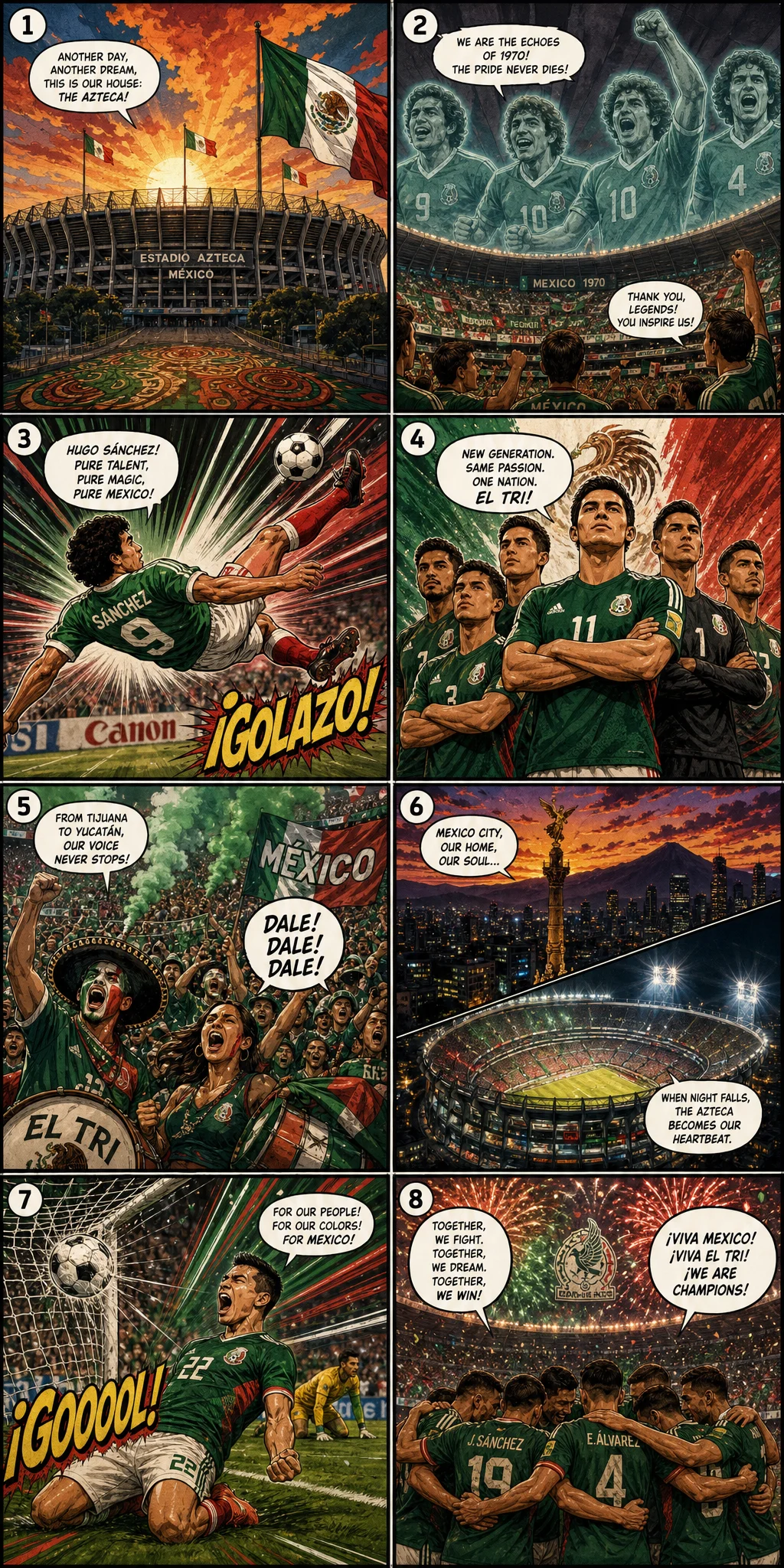
An 8-panel comic celebrating Mexico's national football team journey to the 2026 FIFA World Cup. Panel 1: The Azteca awakens — Estadio Azteca at dawn, flags waving. Panel 2: The Spirit of '70 — ghostly echoes of Pelé and the 1970 final. Panel 3: The Hugol Generation — Hugo Sánchez bicycle kick in silhouette. Panel 4: The Modern Warriors — current stars in El Tri jersey, determined faces. Panel 5: The 12th Player — sea of green-clad fans, drums, and scarves. Panel 6: The Co-Host Dream — split panel showing Mexico City skyline and stadium lights. Panel 7: The Moment — a dramatic goal being scored against South Africa in the opening match. Panel 8: One Nation, One Dream — the entire team standing together under fireworks, Azteca stadium full, text: 'Mexico 2026 — La Copa es Nuestra.'
Published: June 5, 2026
Mexico National Football Team: The Heartbeat of a Nation
The Mexico national football team, known affectionately as "El Tri" for the tricolor flag they carry onto the pitch, represents far more than athletic competition. For over a century, this team has embodied the spirit, resilience, and passion of the Mexican people. As co-hosts of the 2026 FIFA World Cup, Mexico stands at a historic crossroads — the first nation to host the tournament three times, a feat that cements its place in football's pantheon.
HISTORICAL FOUNDATIONS
Mexico's football story began in the late 19th century when British miners and railway workers introduced the sport to the country. The mining towns of Pachuca and Real del Monte became the cradle of Mexican football, with the first organized matches taking place among immigrant workers. The national federation was founded in 1927, and Mexico made its World Cup debut at the inaugural tournament in Uruguay 1930. Though eliminated after three matches, the foundations of a footballing nation were laid.
The true golden age of Mexican football heritage came with hosting duties. The 1970 World Cup remains the most romanticized tournament in the country's history. Brazil's legendary team, led by Pelé, defeated Italy 4-1 in the final at the Estadio Azteca, but the tournament itself showcased Mexico's capacity to organize and celebrate the beautiful game on a global scale. The image of Pelé being carried on his teammates' shoulders, the vibrant colors of the stadium, the searing heat, and the electric atmosphere established the Azteca as football's holy ground. That tournament introduced the world to Mexican warmth: the sunshine hospitality, the rhythmic drums, the cascading waves of sound that would become the Azteca's signature.
In 1986, Mexico again stepped up as host when Colombia withdrew from its duties just four years before the tournament. The nation rallied, rebuilding infrastructure and preparing stadiums at remarkable speed. This tournament gave birth to two immortal moments: Diego Maradona's "Hand of God" — a moment of audacious controversy — and his "Goal of the Century," a slalom through the entire England defense, both witnessed by 114,600 fans at the Azteca. Mexico, under coach Bora Milutinović, reached the quarter-finals, their best World Cup performance, losing a heartbreaking penalty shootout to West Germany after a goalless draw. The team's grit, led by iconic captain Hugo Sánchez, and the nation's unwavering hospitality won universal praise.
LEGENDS OF EL TRI
Hugo Sánchez stands unchallenged as Mexico's greatest footballer. Born in Mexico City, he developed his acrobatic style on the concrete pitches of his neighborhood. His spectacular bicycle kicks and clinical finishing for Real Madrid, where he won five consecutive Pichichi trophies as La Liga's top scorer, inspired an entire generation. Sánchez scored 29 goals in 58 appearances for the national team, and his passion for El Tri remains undimmed. His famous goal celebration — a somersault honoring his gymnast sister — became one of football's iconic images.
Rafael Márquez, the "Kaiser of Michoacán," brought defensive elegance and tactical intelligence to Barcelona during their golden era under Pep Guardiola. He captained Mexico in five consecutive World Cups — a record shared with only four other players in football history, including Lionel Messi and Cristiano Ronaldo. His vision, passing range, and leadership made him the cornerstone of the national team for over 15 years.
Cuauhtémoc Blanco brought the raw creativity of Mexico City's street football to the world stage. His signature "Cuauhtemiña" — a move where he trapped the ball between both feet and bunny-hopped through bewildered defenders — became an instantly recognizable piece of football folklore. Jorge Campos, the eccentric goalkeeper who designed his own neon-colored uniforms, broke every convention and proved that individuality and elite performance could coexist. His willingness to play as both goalkeeper and striker — scoring 35 career goals — makes him unique in football history.
These legends connect to the present through a lineage of Mexican excellence: Javier "Chicharito" Hernández became Mexico's all-time leading scorer with his poacher's instinct. Andrés Guardado, with over 180 caps, provided two decades of tireless service. Guillermo Ochoa, the goalkeeper whose acrobatic saves became World Cup staples, earned international adoration in Brazil 2014 with a performance against the hosts that bordered on the miraculous.
THE MODERN ERA
Mexico enters the 2026 World Cup under the leadership of a new generation determined to rewrite history. The national team has consistently reached the Round of 16 in every World Cup since 1994 — a remarkable streak of seven consecutive tournaments, a consistency matched by few nations. Yet the "quinto partido" — the elusive fifth match, the quarter-final berth — remains the national obsession, the barrier that has defined and tormented Mexican football for three decades.
The 2022 World Cup in Qatar ended in group-stage disappointment, a rare failure that prompted deep soul-searching and systemic renewal. The current squad blends proven experience with explosive youth: Edson Álvarez controls the midfield with the intelligence and physical tenacity honed at Ajax and West Ham; Santiago Giménez possesses the instinctive goal-scoring brilliance that made him one of Europe's most coveted young strikers at Feyenoord; Hirving "Chucky" Lozano provides the spark of unpredictability — his direct running, fearless dribbling, and clutch goals make him the emotional heartbeat of the attack. Behind them, emerging talents like Julián Araujo, César Montes, and Luis Chávez form a spine capable of competing at the highest level.
THE CO-HOST DREAM
Playing at home in 2026 transforms everything. The Estadio Azteca will host the opening match against South Africa on June 11 — a moment of profound significance for the nation and the sport. No other stadium has hosted two World Cup finals and now an opening match for a third tournament. The 83,000-capacity coliseum, sitting 2,200 meters above sea level in the thin air of Mexico City, provides one of football's most intimidating atmospheres. Opponents struggle to breathe; El Tri thrives on the altitude. The stadium's acoustics transform crowd noise into a physical force, a wall of sound that has unnerved the world's greatest players.
Mexico will also play at the Estadio Akron in Guadalajara and the Estadio BBVA in Monterrey, spreading the World Cup experience across the nation's three great football capitals. The co-hosting arrangement places Mexico in Group A alongside South Africa, South Korea, and Czechia — a challenging but navigable path. The group's diversity — African power, Asian technical precision, European tactical discipline — mirrors the global nature of the tournament itself.
FOOTBALL AND MEXICAN CULTURE
In Mexico, football is not merely sport. It is the soundtrack of Sunday afternoons, the sacred bond between grandfather and grandson, the universal language spoken in every plaza, cantina, and street corner. When El Tri scores a World Cup goal, the entire country vibrates — literally. Seismographs registered celebrations after Hirving Lozano's goal against Germany in 2018, a seismic wave of joy rippling outward from Mexico City.
The team's colors are worn with near-religious devotion. The iconic green jersey, white shorts, and red socks represent the flag and the nation's soul. The Azteca's famous "Olé" chant, rolling around the stadium in crashing waves, is among football's most spine-tingling auditory experiences. Mexican supporters — renowned globally for their passion, creativity, costumes, and mariachi-infused atmosphere — transform every stadium into a fiesta, a celebration of life through football.
The economic and social dimensions are equally significant. Football provides a pathway out of poverty for countless young Mexicans. The Liga MX is one of the Americas' strongest domestic leagues, and the national team's success directly impacts national morale, economic activity in host cities, and Mexico's global image. A deep run in 2026 could generate billions in tourism revenue and cement Mexico's reputation as a world-class event host.
THE PATH FORWARD
The 2026 World Cup represents more than a sporting event for Mexico. It is an opportunity to showcase the nation's rich culture, resilient spirit, and legendary warmth to a global audience of billions. The team carries the dreams of over 130 million people, each hoping that this time — on home soil, in the cathedral of football that is the Azteca — the quinto partido will finally be reached, and perhaps even more.
The tactical approach has evolved. Modern El Tri plays with defensive organization, rapid transitions, and attacking flair — a system designed to maximize the altitude advantage while remaining competitive against any opponent. Set pieces, traditionally a weakness, have become a weapon. The team's mental preparation now includes sports psychologists and mindfulness training, addressing the psychological barrier of the quinto partido head-on.
As the sun rises over the Estadio Azteca on June 11, 2026, illuminating the massive murals of Aztec warriors and football legends that adorn its walls, a nation of 130 million will hold its collective breath. The whistle will blow. The drums will thunder. And El Tri will begin the most important journey in Mexican football history. This time, everything is possible. This time, the dream lives at home.