Morocco: Journey to 2026
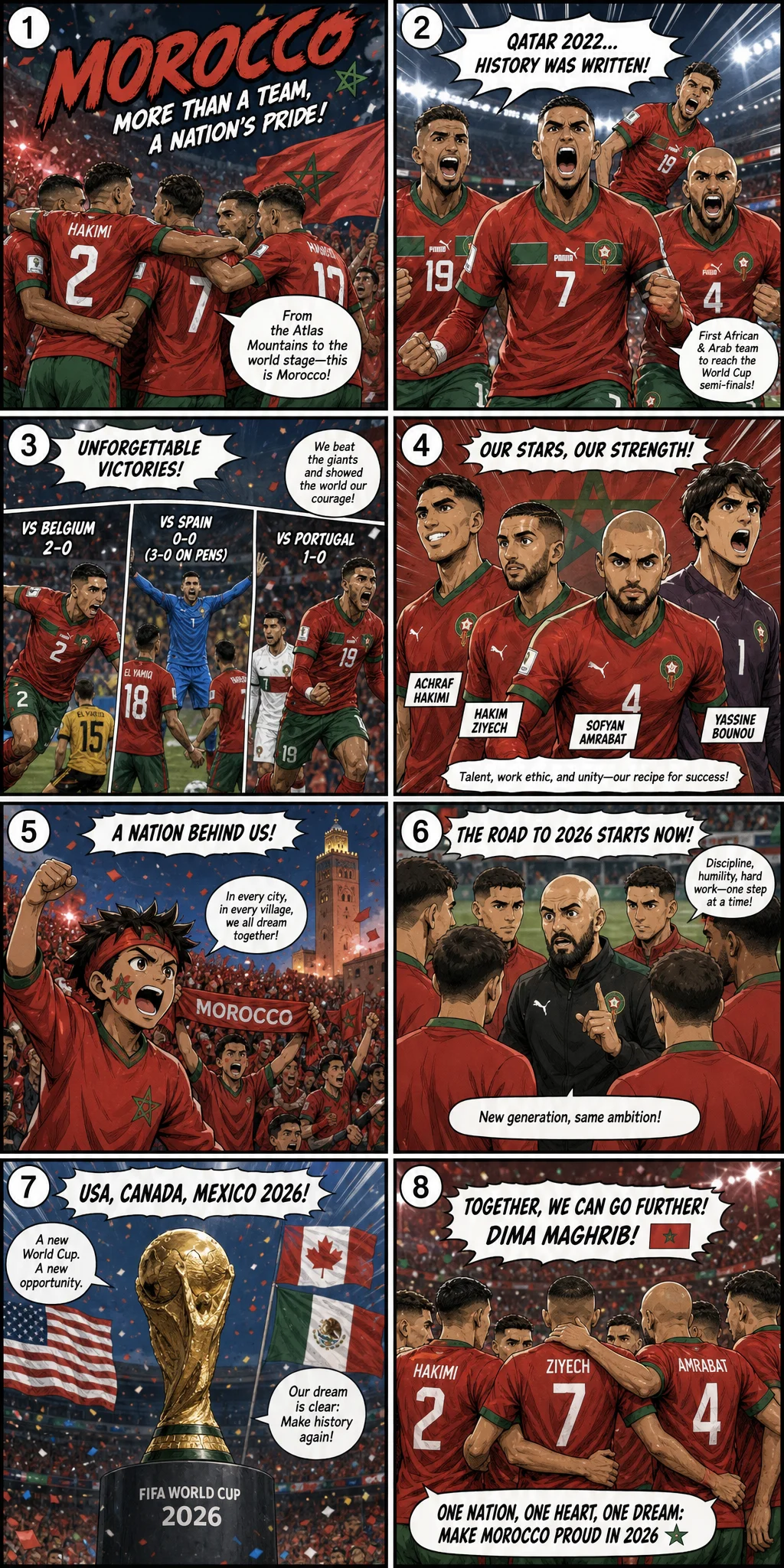
8-panel comic about Morocco national football team and their journey to the 2026 FIFA World Cup.
Published: June 5, 2026
Morocco National Football Team: The Atlas Lions' Roar
The Morocco national football team, known as the "Atlas Lions" — a reference to the Barbary lion that once roamed the Atlas Mountains — represents one of African football's proudest traditions and, since their historic run to the 2022 World Cup semi-finals, one of the global game's most compelling stories. Morocco's achievement in Qatar — becoming the first African and first Arab nation to reach a World Cup semi-final — transformed perceptions of what is possible for football beyond Europe and South America. Entering the 2026 World Cup, the Atlas Lions carry the weight of heightened expectations and the confidence of genuine achievement.
HISTORICAL FOUNDATIONS
Football arrived in Morocco during the French protectorate period in the early twentieth century, spreading through the cities and towns of a country whose history stretches back over a millennium. The Royal Moroccan Football Federation was founded in 1955, just before independence in 1956, and the national team quickly established itself as a force in African football. Morocco's first international match, a 3-3 draw against Iraq in 1957, began a journey that would eventually lead to the summit of the world game.
Morocco made history in 1970 as the first African nation to qualify for a World Cup after the tournament's expansion beyond its original format. The team competed creditably in Mexico, losing narrowly to West Germany and Peru while drawing with Bulgaria. This pioneering appearance established Morocco as a continental leader and opened the door for subsequent African participation at the highest level.
The golden era of Moroccan football arrived in the mid-1970s and 1980s. The national team won the Africa Cup of Nations in 1976, defeating Guinea in the final to claim the continent's premier title. More significantly, the 1986 World Cup in Mexico saw Morocco achieve what no African nation had accomplished before: winning their group, ahead of England, Poland, and Portugal, to reach the Round of 16. The team, featuring the brilliant midfielder Mohammed Timoumi and goalkeeper Badou Zaki, lost narrowly to eventual finalists West Germany. Zaki's performances earned him the African Footballer of the Year award — the only goalkeeper to ever receive the honor.
LEGENDS OF THE ATLAS LIONS
Larbi Benbarek, known as the "Black Pearl," was Morocco's first world-class footballer. Born in Casablanca in 1914, Benbarek played for Marseille, Atlético Madrid, and the French national team (Morocco being under French rule at the time), becoming one of the most admired players of his generation. Pelé once said of him: "If I am the king of football, then Benbarek is God." His elegance, technique, and vision set a standard of excellence that Moroccan football has aspired to ever since.
Ahmed Faras, the prolific striker who scored 36 goals in 77 international appearances, led Morocco to its 1976 Africa Cup of Nations triumph and was named African Footballer of the Year. His goalscoring instinct and leadership made him the face of Moroccan football during its first golden era.
Mustapha Hadji electrified the 1998 World Cup with his flowing locks, explosive dribbling, and a stunning goal against Norway. His performances earned him the African Footballer of the Year award for 1998, and his eleven-year international career bridged generations. Salaheddine Bassir, Youssef Chippo, and Noureddine Naybet — the powerful defender who starred for Deportivo La Coruña and Tottenham Hotspur — were part of a generation that maintained Morocco's competitive standing through the 1990s and early 2000s.
THE MODERN MIRACLE
The 2022 World Cup in Qatar represented the culmination of decades of Moroccan football development — and the arrival of a golden generation that exceeded all expectations. Under coach Walid Regragui, appointed just months before the tournament, Morocco navigated a group containing Croatia (the 2018 runners-up), Belgium (ranked second in the world), and Canada with tactical discipline and counter-attacking precision. Victories over Belgium and Canada, combined with a goalless draw against Croatia, sent the Atlas Lions to the knockout stage as group winners.
What followed was extraordinary. Morocco eliminated Spain on penalties in the Round of 16, with goalkeeper Yassine Bounou producing heroics and Achraf Hakimi converting the decisive spot-kick with audacious composure. The quarter-final against Portugal saw Morocco become the first African nation to reach the semi-finals, Youssef El-Nesyri's towering header securing a 1-0 victory. The semi-final against France ended in defeat, but Morocco had achieved immortality in African and Arab football history. The third-place playoff loss to Croatia did nothing to diminish the achievement.
Achraf Hakimi emerged from the tournament as one of the world's premier full-backs. His pace, crossing, and the emotional images of him celebrating with his mother after each victory — kissing her forehead on the pitch — made him the human face of Morocco's run. Sofyan Amrabat, the midfield destroyer whose relentless ball-winning and progressive passing dominated the center of the pitch, saw his reputation soar. Hakim Ziyech, returning from a temporary international retirement, provided the creative spark from wide positions. Yassine Bounou, the tall, composed goalkeeper, made crucial saves throughout the tournament and was named to the tournament's best XI.
THE MODERN ERA
Morocco enters the 2026 World Cup as Africa's highest-ranked nation and a team that opponents respect and fear. The core of the 2022 semi-finalists remains intact, supplemented by emerging talents from the Moroccan diaspora — players born and developed in Europe who choose to represent the nation of their heritage. This model, combining domestic development with the global Moroccan community's football talent, has proven remarkably effective.
The domestic Botola Pro league, anchored by historic clubs like Wydad Casablanca, Raja Casablanca, and AS FAR Rabat, continues to produce technically proficient players. The Mohammed VI Football Academy, a state-of-the-art facility opened in 2009, has become a model for African talent development, providing elite training, education, and a pathway to professional football for young Moroccans.
The coaching infrastructure has also developed, with Moroccan coaches gaining experience in Europe and bringing that knowledge back to the national setup. Walid Regragui's success — a Moroccan-born coach who played in France and understood both European tactical discipline and Moroccan football culture — demonstrated the value of this cross-pollination.
FOOTBALL AND MOROCCAN CULTURE
Football in Morocco is woven into the fabric of daily life, the passion that animates cafes from Tangier to Laayoune, the obsession that dominates conversation across social classes and generations. The Casablanca derby between Wydad and Raja divides the nation's largest city with an intensity that rivals any rivalry in world football — flares, tifos, drums, and chants creating an atmosphere of almost religious fervor.
The national team serves as a unifying force in a society with regional, linguistic, and cultural diversity. The success of 2022 produced scenes of celebration across Morocco — and across the Moroccan diaspora in Europe, the Middle East, and North America — that demonstrated football's unique capacity to create collective joy. The image of King Mohammed VI waving the Moroccan flag alongside Achraf Hakimi and his mother after the Portugal victory was a powerful symbol of the sport's unifying potential.
The women's game has also grown significantly, with the Morocco women's national team qualifying for the 2023 Women's World Cup — the first Arab nation to do so — and reaching the Round of 16. This development reflects broader social changes and increased investment in women's football infrastructure.
THE PATH FORWARD
The 2026 World Cup presents Morocco with an unprecedented challenge: prove that 2022 was not a beautiful anomaly but the beginning of a new era. The expanded tournament format, more favorable to deep runs by nations with quality depth, should benefit a Moroccan team that has demonstrated its capacity to compete at the highest level.
The tactical identity is well-established: defensive organization, rapid counter-attacks, wide creativity through Hakimi and Ziyech, and the midfield dominance of Amrabat. The team's collective spirit — the visible unity that carried them through the knockout rounds in Qatar, with players celebrating defensive blocks as passionately as goals — remains the intangible advantage that separates them from teams with more individual talent but less cohesion.
For Morocco, the 2026 World Cup is about legacy. The Atlas Lions roared in Qatar; now they must prove the roar was not a single triumphant cry but the start of a sustained symphony. The Arab world, the African continent, and football romantics everywhere will be watching.