Haiti: Journey to 2026
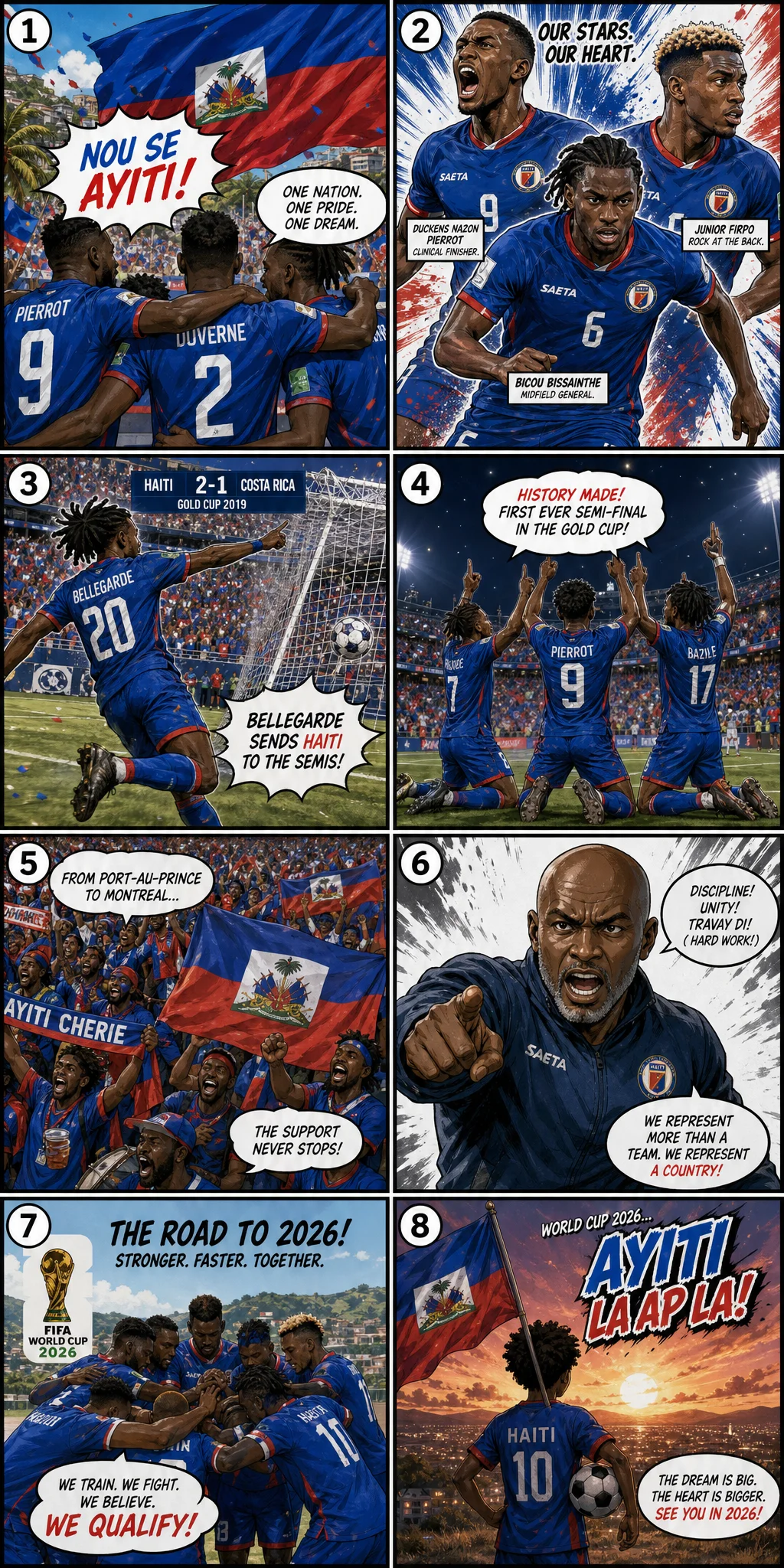
8-panel comic about Haiti national football team and their journey to the 2026 FIFA World Cup.
Published: June 5, 2026
Haiti National Football Team: The Grenadiers' Indomitable Spirit
The Haiti national football team, known as "Les Grenadiers" — The Grenadiers — carries the flag of the world's first Black republic onto the football pitch with pride, passion, and a history of overcoming seemingly insurmountable odds. Haiti's football story is inseparable from the nation's story: one of revolution, independence, struggle, and an unquenchable spirit that has survived poverty, natural disasters, and political turmoil. Their qualification for the 2026 FIFA World Cup, joining the expanded 48-team field, represents a triumph of resilience and a moment of hope for a nation that has known too much hardship.
HISTORICAL FOUNDATIONS
Football arrived in Haiti in the early twentieth century, brought by French cultural influence and quickly adopted by a population that discovered in the sport a reflection of its own character: creative, resilient, and fiercely proud. The Fédération Haïtienne de Football was founded in 1904, making it one of the oldest football federations in the Americas, and Haiti joined FIFA in 1934.
Haiti's golden football memory dates to the 1974 World Cup in West Germany. That qualification campaign, achieved under the brutal dictatorship of François "Papa Doc" Duvalier and his son Jean-Claude "Baby Doc," was fraught with political complexity. The regime used the team's success for propaganda purposes, but the players themselves — led by stars like Emmanuel Sanon, Philippe Vorbe, and Henri Francillon — were genuine talents who earned their place among the world's best.
The defining image of Haiti's 1974 World Cup came in the match against Italy. Emmanuel Sanon, Haiti's greatest-ever footballer, scored a goal that ended Dino Zoff's world-record 1,142-minute streak without conceding an international goal. Though Haiti lost the match 3-1, Sanon's strike — bursting through the Italian defense to beat the legendary goalkeeper — was an act of symbolic defiance, a small nation announcing to the world that it belonged on football's greatest stage. Haiti lost all three group matches, but the experience of competing at the World Cup became an indelible part of the nation's football identity.
LEGENDS OF THE GRENADIERS
Emmanuel Sanon remains Haiti's football immortal. His goal against Italy in 1974, his career at Beerschot in Belgium, and his legacy as the standard against which all Haitian footballers are measured have secured his place in the sport's history. Sanon scored 47 international goals, a record that stood for decades, and his journey from the streets of Port-au-Prince to World Cup immortality inspired generations of young Haitians to dream.
Philippe Vorbe, the elegant midfielder who provided the assist for Sanon's historic goal, represented the technical quality and creative vision that characterizes Haitian football at its best. His ability to control the tempo of a match, to deliver passes that others could only attempt, made him the midfield conductor of Haiti's golden generation.
Joe Gaetjens, while technically not playing for Haiti — he represented the United States in the 1950 World Cup — was born in Haiti and scored the goal that defeated England 1-0 in one of the World Cup's greatest ever upsets. His life ended tragically; he was arrested by the Tonton Macoutes, Duvalier's secret police, in 1964 and never seen again, his family believing he was killed for his political activism. His story serves as a reminder of the intersection between football, politics, and human rights that has shaped Haitian history.
THE MODERN ERA
Haitian football has faced immense challenges in the decades since 1974. Political instability, poverty, and the catastrophic 2010 earthquake that devastated Port-au-Prince and killed over 200,000 people have created obstacles that would have extinguished football programs in less resilient nations. The Haitian Football Federation's headquarters was destroyed in the earthquake, along with much of the country's football infrastructure.
Despite these challenges, Haiti has continued to produce talented footballers. The Haitian diaspora — concentrated in the United States, Canada, and France — has provided a pipeline of players who carry Haitian heritage into professional football. Many current national team regulars were born or developed in the diaspora, creating a team that bridges Haiti's domestic reality and its global community.
The current squad features professional players based primarily in North America and Europe's second-tier leagues, along with emerging talents from the domestic Championnat National. The team's athleticism, individual creativity, and collective fighting spirit — the hallmarks of Haitian football — remain evident. Goalkeepers and defenders who have developed in North American professional environments bring organizational discipline, while attacking players retain the improvisational flair that has always characterized Caribbean football.
The youth national teams have produced encouraging results in CONCACAF competitions, suggesting that the talent pipeline, while not comparable to the region's wealthier nations, continues to flow. Haiti's Under-20 and Under-17 teams have made World Cup appearances, providing valuable international experience for the next generation.
FOOTBALL AND HAITIAN CULTURE
In Haiti, football is more than entertainment — it is a lifeline, a source of dignity and hope in a nation where daily life can be a struggle for survival. The passion for the sport transcends Haiti's profound economic inequality, with barefoot children on dusty fields in Cité Soleil dreaming the same dreams as their counterparts in the comfortable suburbs of Pétion-Ville.
Match days transform Haitian communities. Radios crackle with commentary, televisions in cafes and bars draw crowds that spill onto sidewalks, and when the Grenadiers score, the celebrations echo through streets often filled with hardship. The national team's colors — blue and red, the colors of the Haitian flag — are worn with a pride rooted in the nation's revolutionary history, the memory of Toussaint Louverture and Jean-Jacques Dessalines, the leaders who defeated Napoleon's armies and established the first independent Black nation in the Western Hemisphere.
The Haitian domestic league, while under-resourced, maintains a passionate following. Clubs like Violette AC, Racing Club Haïtien, and AS Capoise represent community identities and provide pathways for talented young players who cannot access the diaspora opportunities that have become essential to the national team's talent pipeline.
THE PATH FORWARD
Haiti's qualification for the 2026 World Cup is, in itself, a victory. For one of the poorest nations in the Western Hemisphere to compete in football's most glamorous tournament — to stand on the same pitch as nations with budgets that dwarf Haiti's entire football federation spending — is a testament to human resilience and sporting merit.
The practical challenges are significant. Infrastructure, preparation resources, and the depth of the player pool all lag behind World Cup standards. Haiti will not advance deep into the tournament; that is not the measure of success for this campaign. Success is being present, competing with dignity, and providing a moment of joy and national unity for a population that has endured more than most of the world can comprehend.
The tactical approach will emphasize defensive organization, physical competitiveness, and the counter-attacking threat posed by athletic forwards who can trouble any defense on the break. Set pieces will be crucial — moments where organization and desire can neutralize talent gaps. The mental challenge of competing at the World Cup level, of not being overwhelmed by the occasion, will be as significant as the physical and tactical challenges.
For Haiti, the 2026 World Cup is a symbol. It represents the possibility of progress, the visibility of a nation often forgotten by global media except when disaster strikes, and the enduring power of sport to provide hope. The Grenadiers march to North America carrying their nation's flag and its history — a history of revolution, struggle, and survival against overwhelming odds. That, above any result on the pitch, is their victory.