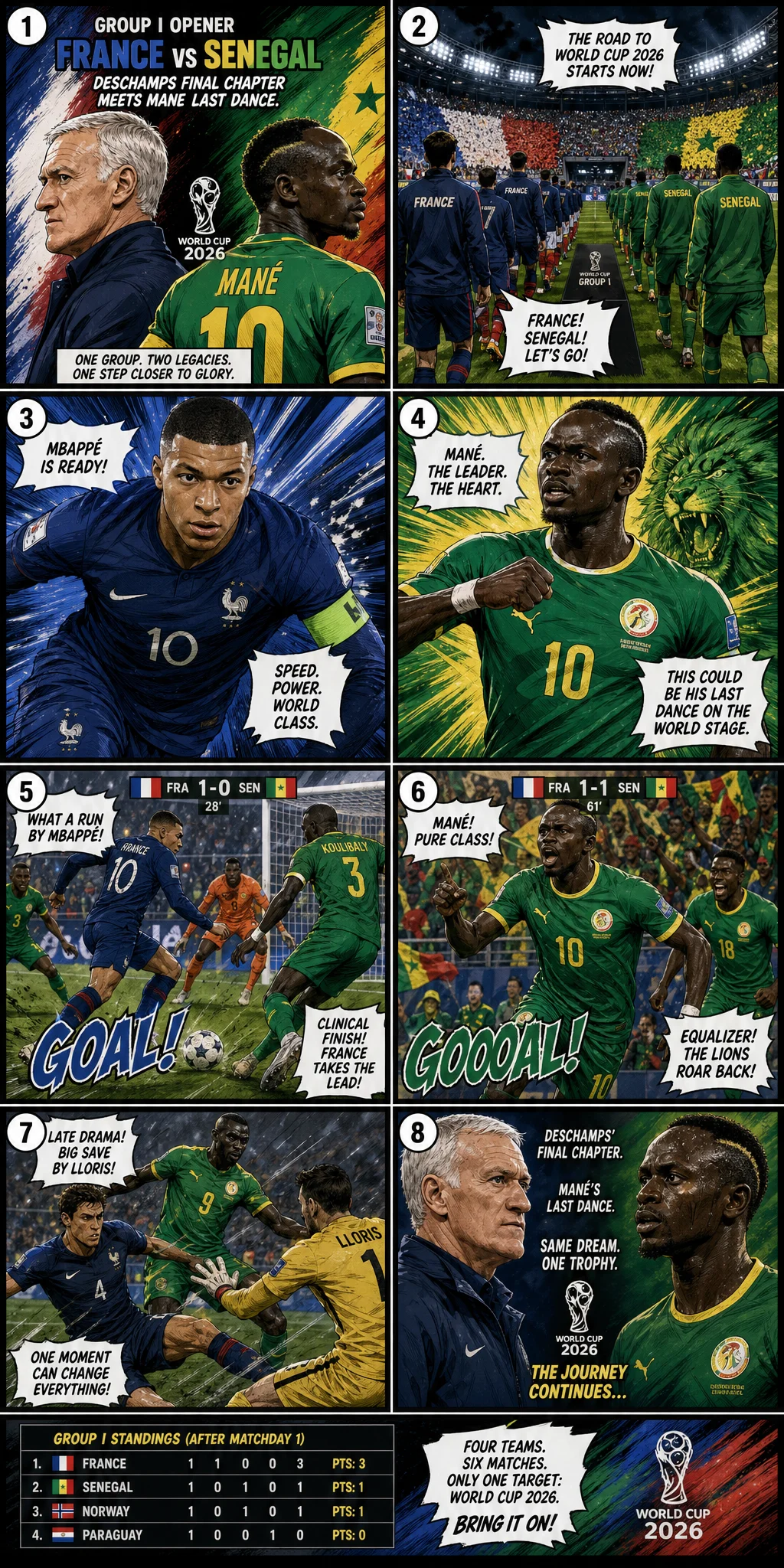
France vs Senegal: Group I Opener — Deschamps Final Chapter Meets Mane Last Dance
2026 FIFA World Cup Group I: France vs Senegal tactical preview. Didier Deschamps coaches his final tournament against Pape Thiaw's Lions of Teranga. Mbappe captains the two-time champions; Sadio Mane plays his last World Cup. MetLife Stadium, 82,500 capacity.
Published: June 6, 2026
France vs Senegal: Deschamps' Final Dance, Mane's Farewell Overture
Three days to kickoff. MetLife Stadium in East Rutherford, New Jersey — the steel bowl built for the New York Giants and Jets — is about to host its first World Cup match. Group I, branded the "Group of Death" by every preview writer on the planet, begins here. France versus Senegal. An echo of the 2002 World Cup opener, when Papa Bouba Diop slid the ball into the net in Seoul and the reigning champions fell 1-0. Twenty-four years later, these two nations meet again.
France: The Final Chapter of Pragmatism
Didier Deschamps — the only man to lift the World Cup as both player (1998) and manager (2018) — will step down after this tournament. Fourteen years, one World Cup, one runners-up medal, one Nations League. His legacy is secure. But the question that has shadowed his entire tenure reaches its crescendo here: when you possess the deepest attacking pool in world football, is your system too conservative?
The answer is partially written in his squad selection. Deschamps brought nine forwards to North America — Mbappe, Dembele, Olise, Doue, Barcola, Cherki, Thuram, Akliouche, Mateta. This is a statement. Kylian Mbappe enters his third World Cup with twelve goals, four shy of Klose's all-time record. He captains the side. But for the first time in his international career, he is not the sole focal point. Ousmane Dembele arrives as the reigning Ballon d'Or winner after leading PSG to Champions League glory. Michael Olise at Bayern Munich has redefined what a modern No. 10 looks like. Bradley Barcola's pace and Desire Doue's creativity give Deschamps bench options that would start for any other nation.
Yet the foundation remains defensive. William Saliba and Dayot Upamecano form arguably the tournament's strongest centre-back partnership. Aurelien Tchouameni is now the midfield conductor — with Camavinga omitted, his role expands from partner to commander. N'Golo Kante, at 36, still covers every blade of grass; his presence liberates Tchouameni to progress the ball forward.
Formation: 4-3-3 that collapses into a 4-4-2 defensive block out of possession. Full-backs Theo Hernandez and Jules Kounde provide width, but Deschamps rarely commits both forward simultaneously. His match-management philosophy: control the game, not the ball. France are not afraid to concede possession; they are afraid of losing defensive structure.
Senegal: The Golden Generation's Last Stand
Pape Thiaw succeeded Aliou Cisse at the helm. His 4-3-3 is a different animal from Deschamps' version: more vertical, more reliant on wide speed, more willing to risk in transition.
Sadio Mane — Senegal's all-time top scorer, former Liverpool and Bayern star — has confirmed this will be his final international tournament. At 34, playing in Saudi Arabia, his legs no longer carry him the full 90 at peak intensity. But his football intelligence — when to cut inside, when to draw defenders, when to release Nicolas Jackson — remains the operational axis of Senegal's attack.
Kalidou Koulibaly captains the back line. At 34, with stints at Chelsea, Napoli, and Al-Hilal, his reading of the game is elite, but the physical reality of facing Mbappe's pace is inescapable. Moussa Niakhate (Lyon) provides mobility alongside him. Edouard Mendy — the 2021 Champions League winner — is the last line. His form in this tournament will directly determine whether Senegal escapes this group.
The midfield three is Senegal's most interesting layer: Idrissa Gueye's destruction, Pape Matar Sarr's box-to-box range, and Pape Gueye's technical linkage. Clear division of labor — one destroys, one runs, one passes. But opposite them stands Tchouameni, Kante, and Rabiot — and in experience and technical quality, Senegal are outmatched.
Key Battles
The decisive tactical contest is on the flanks. Mbappe, cutting inside from the left, runs directly at Koulibaly's zone. If Koulibaly steps tight, Mbappe's burst beats anyone one-on-one. Deschamps' likely solution: Dembele stretches width on the right, forcing Senegal's defensive line to expand horizontally, creating the one-on-one isolation Mbappe feasts on.
In return, Mane will hunt the space behind Jules Kounde on the French right. Kounde is accustomed to a high line at Barcelona, but whether the Saliba-Upamecano axis can rotate to cover his forward runs is an open question. Kante's lateral coverage is critical here — he is the structural glue.
Prediction
France's depth and experience gap are too large. Senegal's golden generation is on the wrong side of the age curve. They can make France uncomfortable for a twenty-minute spell, but sustaining intensity for 90 minutes is a different proposition. A reasonable outcome: France by two, clean sheet. But if the score stays 0-0 through 30 minutes — and Mendy's shot-stopping makes that plausible — Thiaw's side will test French concentration with Mane and Ismaila Sarr's pace after the 70th minute. The ghost of 2002 lingers. But the 2026 France is not the 2002 France. Deschamps' last dance begins with a win.