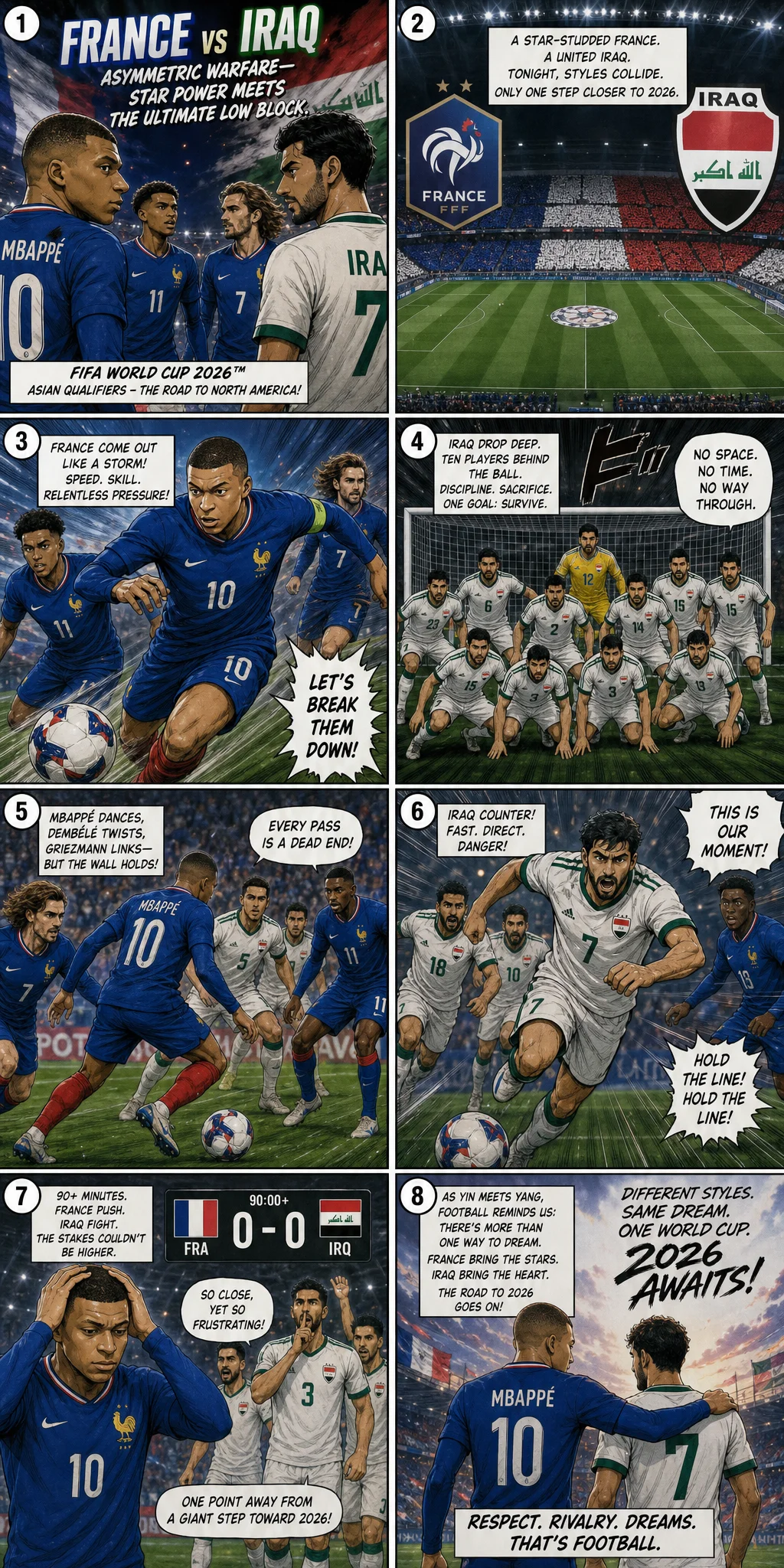
France vs Iraq: Asymmetric Warfare — Star Power Meets the Ultimate Low Block
2026 FIFA World Cup Group I: France vs Iraq tactical preview. Deschamps must solve Arnold's defensive puzzle. Mbappe tests Iraq's 4-4-2 wall. Zidane Iqbal and Aymen Hussein lead Iraq's resistance. Lincoln Financial Field, Philadelphia, 67,594 capacity.
Published: June 6, 2026
France vs Iraq: Asymmetric Warfare — Star Power Meets the Ultimate Low Block
June 22, Philadelphia. Lincoln Financial Field — home of the Eagles, where fans pride themselves on being the roughest in America — hosts one of the tournament's most lopsided matchups on paper. France versus Iraq. Two-time World Cup winners, Ballon d'Or holders, the most expensive attacking roster in global football. Opposite them: Iraq, back at the World Cup after 40 years, ranked well outside the top 70, with "avoid humiliation" as a realistic starting goal. But this is precisely where football gets interesting. When one team parks everyone behind the ball, star power must be measured differently.
Deschamps and the Low-Block Problem
Didier Deschamps' system is built on defensive solidity, but his France have often looked blunt against deep blocks — opponents who station all eleven players within 30 meters of their own goal. This is not a personnel problem; it is structural. France's 4-3-3 relies on individual wide breakthroughs to generate crossing opportunities, but with nine defenders packed into the box, even Mbappe's dribble success rate yields limited real threat.
Deschamps' solution: drop Tchouameni deeper — almost between the center-backs to form a back three in build-up — forcing Iraq's midfield line to step forward. Once Iraq's midfield takes that step, France's front four — Mbappe, Dembele, Olise, Thuram — can receive and turn in the "pocket space" between Iraq's midfield and defensive lines. This is the key mechanism for breaking a low block: not forcing entry from wide areas, but penetrating vertically through the center.
Iraq's Survival Mathematics
Graham Arnold knows his team cannot compete with France in open play. His game plan will be built on precise arithmetic: limit France's touches inside the penalty area, force Mbappe to receive only outside the box, ensure a minimum of seven Iraqi defenders in the box for every French cross. This is not football romanticism — it is mathematics.
Iraq's set pieces remain the only variable. If the score is still 0-0 at 60 minutes — not a fantasy, Iraq achieved this against Spain in a pre-tournament friendly — Arnold will instruct Hussein and Al-Ammari to seek every possible dead-ball situation. Iraq scored over 40% of their goals from set pieces in Asian qualifying. Against France, that is a statistic Deschamps cannot ignore.
Prediction
France will have over 70% possession. That is not a prediction; it is physics. But whether Deschamps' side can break the deadlock early enough defines the texture of this match. A goal before 30 minutes — and France's attacking quality makes this highly probable — turns the contest into an exercise in damage limitation for Iraq. But if Iraq survive to halftime — and Arnold's team has proven over the past twelve months that they can — this night in Philadelphia could be tighter than any French supporter is willing to admit. Reasonable: France by three, clean sheet. But unreasonable scripts are what the World Cup does best.