Scotland: Journey to 2026
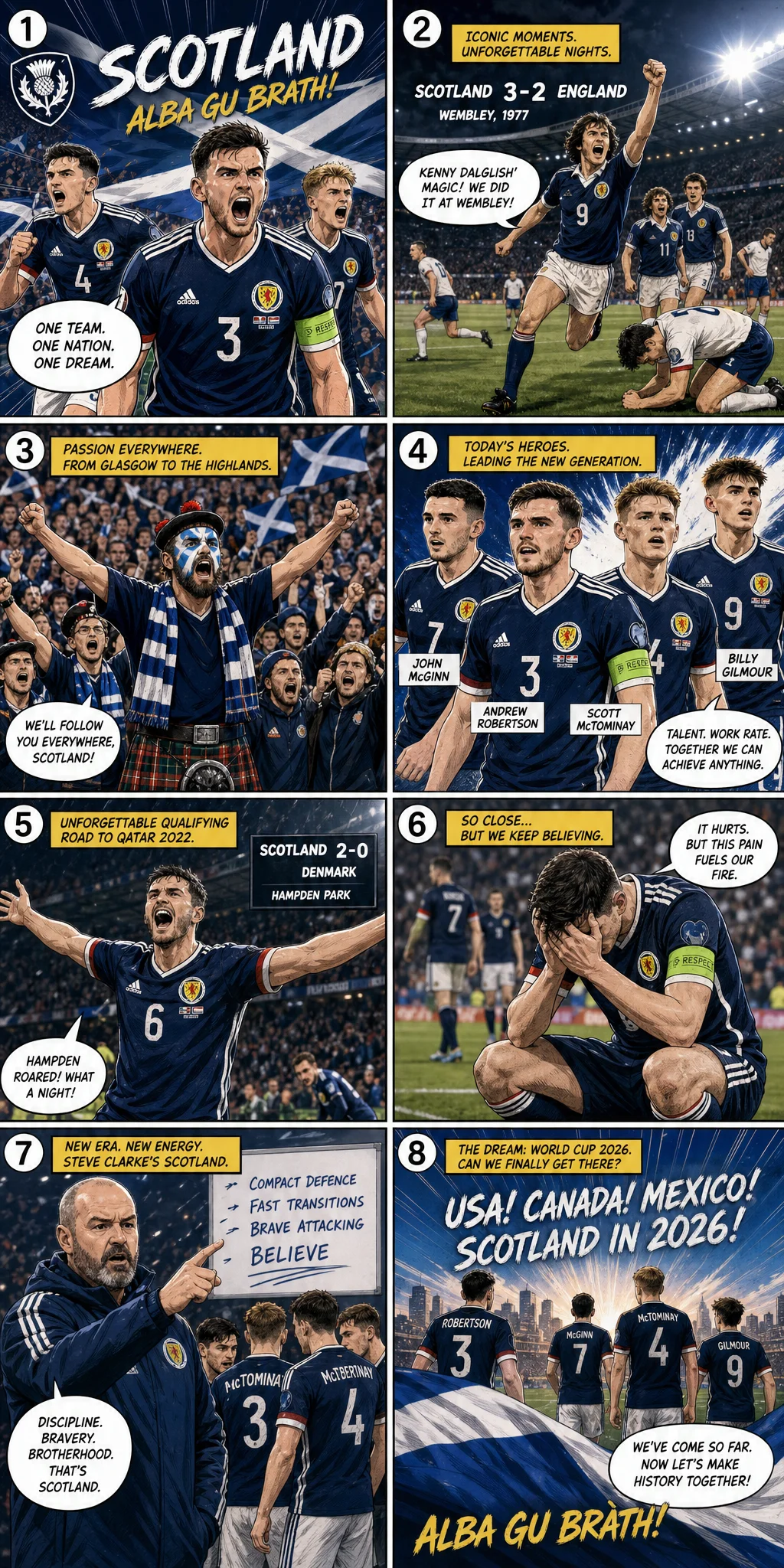
8-panel comic about Scotland national football team and their journey to the 2026 FIFA World Cup.
Published: June 5, 2026
Scotland National Football Team: The Tartan Army's Brave Return
The Scotland national football team, backed by the "Tartan Army" — one of world football's most colorful and devoted supporter cultures — carries the hopes of a proud football nation that has waited far too long for World Cup relevance. Scotland's qualification for the 2026 FIFA World Cup ends a drought that stretched back to 1998, a generation of near-misses and heartbreaks finally giving way to celebration. The nation that gave the world the passing game, the modern offside rule, and some of football's most passionate supporters is back where it belongs.
HISTORICAL FOUNDATIONS
Scotland's claim to football history is as legitimate as any nation's. The world's first international football match was played between Scotland and England in 1872 at Hamilton Crescent in Glasgow, a goalless draw witnessed by 4,000 spectators. The Scottish Football Association, founded in 1873, is the second oldest in the world. Scotland invented the passing game — the short, quick combinations that replaced the individual dribbling of early football — and exported this tactical innovation to England and beyond through the "Scotch Professors," the wave of Scottish players who moved south to professional clubs in the late nineteenth century.
The early decades of international football saw Scotland as a genuine power. The annual Home Championship against England, Wales, and Ireland was the era's premier international competition, and Scotland won it outright 24 times. But the World Cup, when it arrived in 1930, was initially treated with suspicion by the Scottish football establishment, which declined to participate in the first three tournaments. This isolationism, born of a prickly pride and a reluctance to be seen as subordinate to FIFA rather than the Home Nations' authority, delayed Scotland's World Cup debut until 1954.
Scotland's World Cup history has been defined by glorious failure. Eight appearances — 1954, 1958, 1974, 1978, 1982, 1986, 1990, and 1998 — all ended without progression beyond the group stage, a record of consistent near-miss that has become woven into Scottish football's self-deprecating identity. The 1974 team in West Germany, featuring legends like Billy Bremner, Kenny Dalglish, and Denis Law, went undefeated but was eliminated on goal difference. The 1978 campaign in Argentina was perhaps the most painful — manager Ally MacLeod's pre-tournament confidence building impossible expectations, followed by defeat to Peru and a draw with Iran that produced one of British football's most quoted headlines: "Ally's Tartan Army — End of the World."
LEGENDS OF THE TARTAN
Kenny Dalglish, "King Kenny," stands alone as Scotland's greatest footballer. His 102 caps (shared record) and 30 international goals only hint at his greatness. At Celtic he won everything Scottish football offered; at Liverpool he became an icon, winning six league titles and three European Cups as a player, then more as player-manager. Dalglish's intelligence — the back-to-goal hold-up play, the perfectly weighted passes, the goals scored with either foot in the tightest spaces — represented the highest expression of Scottish football's technical tradition.
Denis Law, the "King of the Stretford End" at Manchester United and the only Scottish player to win the Ballon d'Or (1964), scored 30 goals in 55 international appearances. His partnership with Dalglish in the 1974 World Cup team was brief — Law's career was winding down as Dalglish's was ascending — but the symbolic passing of the torch from one Scottish great to another was powerful.
Jimmy Johnstone, the diminutive winger voted Celtic's greatest ever player by the club's supporters, was the artist of the Lisbon Lions who won the 1967 European Cup. His dribbling ability — weaving through defenders on heavy Scottish pitches, controlling balls that bounced unpredictably — was sublime. Graeme Souness, the midfield general who dominated for Liverpool in the late 1970s and early 1980s, brought steel, passing range, and a winner's mentality. Jim Baxter, the playboy genius of the 1960s, once tormented England at Wembley while casually playing keepy-uppy — a moment of insolent brilliance that Scottish fans still cherish.
THE MODERN ERA
The long absence from World Cups — spanning the entire careers of an entire generation of Scottish footballers — was a source of national sporting anguish. Qualification campaigns repeatedly followed the same pattern: promising starts, encouraging performances against stronger opponents, and devastating setbacks against teams Scotland was expected to beat. The play-off defeats, the last-minute goals conceded, the mathematical permutations that never quite added up — these became the annual Stations of the Cross for Scottish football supporters.
The current Scotland squad represents a blend of Premier League experience and emerging talent. Andrew Robertson, the Liverpool left-back and national team captain, has been one of the world's best in his position for nearly a decade — his overlapping runs, crossing, and leadership providing Scotland with a world-class foundation. Kieran Tierney, the versatile Arsenal defender, offers tactical flexibility and defensive quality whether deployed at left-back or center-back in a back three.
Scott McTominay, the Manchester United and Napoli midfielder, has become Scotland's most reliable goalscorer from midfield — his late-arriving runs into the box, physical presence, and improving composure in front of goal have made him indispensable. John McGinn, the Aston Villa midfielder with the distinctive backside and deceptive strength, provides creativity, work-rate, and an infectious personality that lifts those around him. Billy Gilmour, the diminutive midfielder who learned his craft at Chelsea before moving to Brighton and then Napoli, offers the technical security and passing intelligence that allows Scotland to control possession against quality opponents.
FOOTBALL AND SCOTTISH CULTURE
Football's place in Scottish culture is difficult to overstate. The Old Firm derby between Celtic and Rangers divides Glasgow — and Scotland — along religious, political, and cultural lines that extend far beyond sport. The intensity of this rivalry, its historical roots in the Irish immigration of the nineteenth century and the sectarian divisions that followed, makes it one of world sport's most socially significant fixtures. For many Scots, football allegiance is inherited, not chosen — a marker of identity as fundamental as accent or surname.
The Scottish national team provides a different kind of identity: a shared Scottishness that transcends the Celtic-Rangers divide. When Scotland plays, supporters from both sides of the Old Firm wear the same dark blue, sing the same songs, and share the same anxious hope. The Tartan Army's reputation as traveling supporters — friendly, self-deprecating, prone to wearing kilts in improbable weather — has been earned over decades of following their team to distant defeats and occasional triumphs.
The domestic game, while overshadowed financially by the English Premier League, maintains deep community roots. Clubs like Aberdeen, Hearts, Hibernian, and Dundee United have passionate local followings and histories of European competition that connect them to the broader football world. The Scottish football landscape — from the Premier League to the junior leagues of Ayrshire and Fife — provides the cultural foundation upon which the national team's support rests.
THE PATH FORWARD
Scotland enters the 2026 World Cup determined not merely to participate but to compete. The team's recent performances in European Championship qualification and the Nations League have demonstrated that Scotland can match mid-tier European opponents and trouble superior sides on the right day. The tactical approach emphasizes defensive organization, midfield industry (a traditional Scottish strength), and wide attacks through Robertson and the emerging full-back talents.
Progression from the group stage — something Scotland has never achieved in eight previous attempts — is the realistic and historic target. The team's collective spirit, the experience of its Premier League-based core, and the tactical preparation led by the coaching staff provide genuine grounds for optimism. The expanded tournament format offers a more forgiving group stage structure, and Scotland's ability to raise its performance against stronger opposition — rather than being dragged down to the level of weaker teams, as has historically been the case — could prove decisive.
For Scotland, the 2026 World Cup is about more than results. It is about belonging — reclaiming a place at football's top table after an absence so long that an entire generation has no memory of seeing their nation at a World Cup. The Tartan Army will travel to North America in their thousands, filling stadiums with noise, color, and the self-deprecating humor that makes Scottish supporters beloved wherever they go. Scotland is back. And this time, the goal is not just to arrive — but to stay.