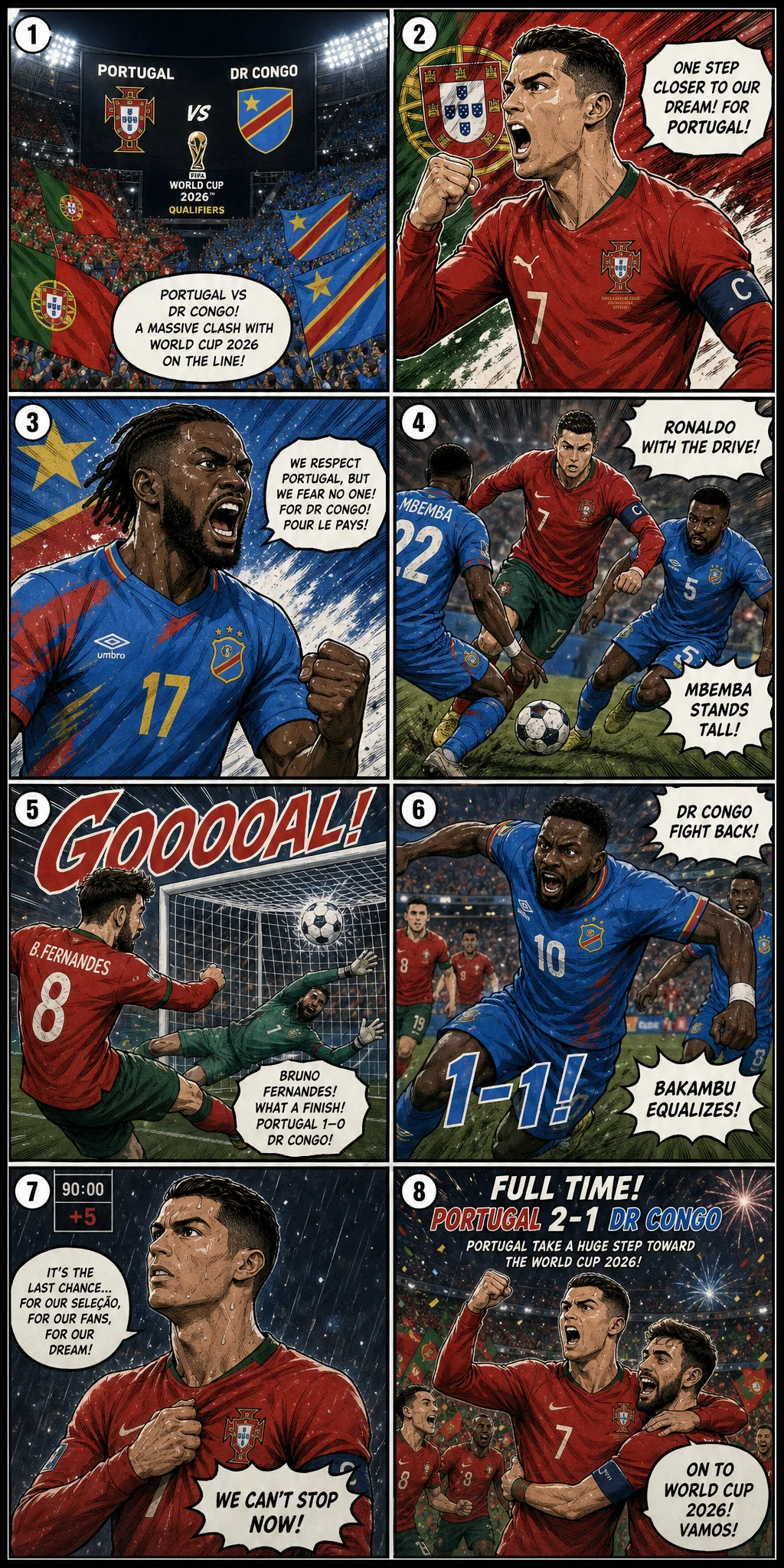
Portugal vs DR Congo: The Empire and the Return — Group K Tactical Preview
2026 FIFA World Cup Group K tactical preview — Portugal vs DR Congo, NRG Stadium, Houston. Portugal golden generation (Ronaldo 6th World Cup, Fernandes, Leao, Dias) faces DR Congo returning after 52 years (Wissa, Wan-Bissaka, Mbemba). Analysis of formations, key matchups (Leao vs Wan-Bissaka), coaching philosophies (Martinez vs Desabre), and the historical echo of Zaire 1974.
Published: June 6, 2026
Portugal vs DR Congo: The Empire and the Return — Group K Tactical Preview
June 14, 1974. Parkstadion, Gelsenkirchen. A team called Zaire walked out to face Yugoslavia. It was Zaire's first — and for fifty-two years, only — appearance at a World Cup. The image that endured was not of a goal or a victory, but of defender Mwepu Ilunga charging out of the wall to boot the ball away before a Brazilian free-kick could be taken. It became an emblem of how African football was seen at the World Cup: not defined by strength, but by naivety.
Fifty-two years later, the Leopards are back. It is not the same team. It is not even the same country. Zaire is dead; the Democratic Republic of Congo has been reborn. And the opponent for their return is a nation undergoing its own historical inflection: Portugal.
Roberto Martinez's Portugal enters this match carrying something the Selecao has never before possessed — genuine squad depth. Not the kind where two or three world-class players are supported by competent deputies. The kind where every position has at least two high-quality options. Ruben Dias and Goncalo Inacio at centre-back. Vitinha and Joao Neves in midfield. Bruno Fernandes and Bernardo Silva as creative engines. Rafael Leao and Pedro Neto on the wings. This is a squad built for a tournament — not for one match, but for seven.
But let us return to Congo. Sebastien Desabre — a Frenchman who never played professional football, who coached in Tunisia, Morocco, and the French lower divisions — has spent four years turning the Leopards into what he calls "a team that is very difficult to beat." It sounds like a backhanded compliment, but in a World Cup group stage, it is a survival strategy. Desabre's 4-2-3-1 is anchored by two holding midfielders — Noah Sadiki and Edo Kayembe — forming a mobile wall in front of the back four. Ahead of them, Yoane Wissa arrives from a Premier League season at Newcastle United with five goals and seven assists, giving Congo's attack something it has never had before: output validated at the highest level.
The presence of Aaron Wan-Bissaka is a tactical curiosity of the highest order. A right-back born in England, developed in the English academy system, capped for England U20 and U21 — now representing the country of his parents' birth. He is, by some metrics, the best one-on-one defender in world football. The kind of defender who can make Rafael Leao disappear for ninety minutes. If there is a decisive individual battle in this match, it is on that flank: Leao's explosive power against Wan-Bissaka's spider-legged tackling. A man who cannot be dribbled past, against a man who must dribble past everyone.
Congo's attacking hopes rest on Wissa's feet, but their soul resides in the chest of Chancel Mbemba — the Lille centre-back and captain whose winning goal against Cameroon in the African playoffs is the kind of moment that gets carved into a wall somewhere in Kinshasa. Beside him, Axel Tuanzebe offers Premier League-calibre defensive experience. Goalkeeper Lionel Mpasi's performance in the intercontinental playoff against Jamaica — including multiple extra-time saves — is the direct reason the Leopards are here.
But Portugal's question is not whether they can win. It is how they choose to win. Martinez's Nations League triumph in 2024-25 showcased two different Portugals: one that controls tempo through Vitinha's passing, and one that destroys opponents in transition through the speed of Leao and Neto. The variable — always — is Cristiano Ronaldo. Forty-one years old. Sixth World Cup. His season at Al-Nassr — thirty-one goals in the Saudi Pro League — confirms that the finishing instinct remains. But his overall influence has shifted from "centre of the system" to "weapon for specific moments." Martinez manages him as a match-state tool: on when a goal is needed, rested when a lead must be protected.
The weight of history hangs over this match, but it presses differently on each team. For Portugal, history is a series of "almosts": the 2004 European Championship final lost at home to Greece, the 2006 World Cup semi-final, the 2016 European Championship triumph — then the 2022 quarter-final exit. This generation of talent — Fernandes, Bernardo, Dias, Leao — will feel incomplete without a World Cup. For Congo, the weight is simpler: fifty-two years of waiting. Merely by standing on the pitch, they have already won.
But Desabre will not let his players think that way. His Congo side that reached the 2023 AFCON semi-finals was not a team that came to "participate." They came to disrupt rhythms, destroy structures, and find seams on the counter. The question is: what is Portugal's Plan B when their possession game is kept at arm's length by Congo's compact block? The answer may lie in Bruno Fernandes's late runs into the box, a set-piece, or one touch from Ronaldo in the penalty area.
Prediction: Portugal should win. They have better players in every position — except, perhaps, the Wan-Bissaka versus Leao matchup. But the history of World Cup group-stage openers — particularly against African opposition — adds a layer of uncertainty to any prediction. Portugal 2-0. But the story the scoreline cannot tell is this: one team is trying to write a legend, the other is rewriting its own existence.