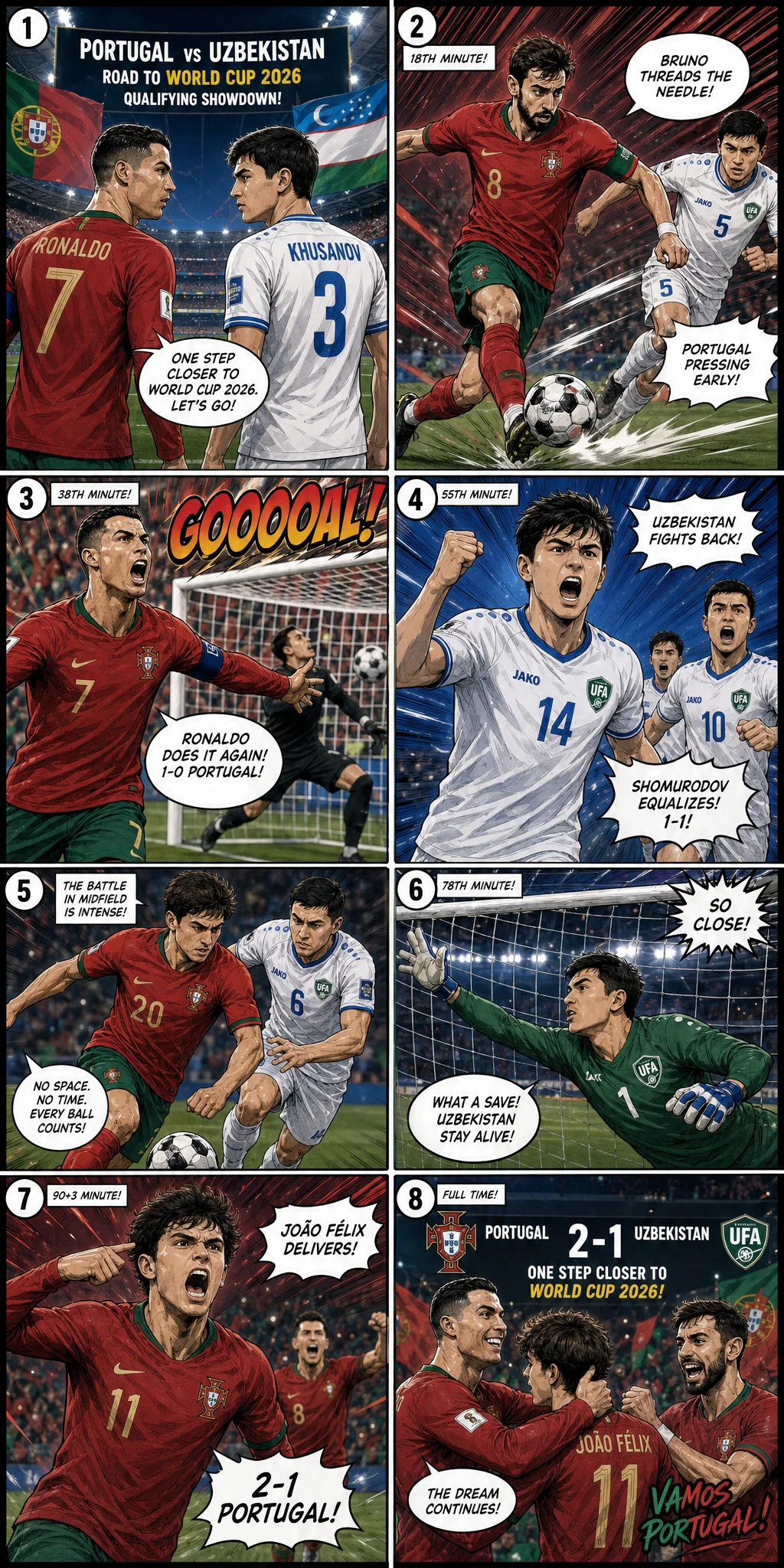
Portugal vs Uzbekistan: The System Gap and the Structural Problem — Group K Tactical Preview
2026 FIFA World Cup Group K tactical preview — Portugal vs Uzbekistan, NRG Stadium, Houston. Martinez 4-3-3 vs Cannavaro 3-4-2-1 low block. Data-driven analysis of possession structure, counter-attack lanes, and Uzbekistan defensive record (6 goals conceded in 10 qualifiers). Khusanov vs Ronaldo set-piece battle.
Published: June 6, 2026
Portugal vs Uzbekistan: The System Gap and the Structural Problem — Group K Tactical Preview
Put the two squads on paper and the gap is structural, not emotional. Portugal's twenty-six-man roster contains over twenty players at clubs in Europe's top five leagues. Uzbekistan's twenty-six contains two — Abdukodir Khusanov at Manchester City, and Eldor Shomurodov with prior experience in Italy and France. The remainder are spread across Iran, the UAE, Turkey, and the Uzbek domestic league. This is not a slight — it is data. And data is the only meaningful starting point for understanding this match.
But football matches are not won by addition; they are won by space. The question is not "are Portugal's players better than Uzbekistan's" — the answer to that is trivially obvious — but rather "in which spatial zone will Portugal's system defeat Uzbekistan's system."
Start with Portugal's possession structure. Martinez's 4-3-3 becomes an asymmetrical 3-2-5 in the build-up phase: Joao Cancelo inverts from right-back into midfield alongside Vitinha to form the double pivot; Nuno Mendes provides width on the left; Bruno Fernandes and Bernardo Silva find pockets between the lines. On paper, this gives Portugal a five-versus-four overload in the opposition half — provided Uzbekistan's midfield line can be pulled apart by Fernandes and Bernardo rotating positions.
Uzbekistan's defensive plan will almost certainly be Cannavaro's signature 5-4-1 low block. Khusanov, as part of the back three, provides the pace to cover balls played behind for Ronaldo — an essential insurance policy. In midfield, Otabek Shukurov and Odiljon Hamrobekov form the first pressing line — but they will not press high. Across two goalless draws against Iran in qualifying, Uzbekistan demonstrated the ability to keep Asia's best attack scoreless for a full one hundred and eighty minutes. The core principle: the distance between the two banks of four rarely exceeds ten metres, and the wide players are instructed to tuck inside and protect the half-spaces.
There is a counter-intuitive data point here: Uzbekistan's expected goals in qualifying was just 0.87 per match, but their actual goals scored was 1.50 per match. This suggests either unusually clinical finishing or goals clustered from a small number of high-quality counter-attacks — and the data points to the latter. Shomurodov's individual xG outperformance of 0.23 per match indicates a counter-attacking system designed around his movement patterns. Abbosbek Fayzullaev's dribbling from the left is the primary counter-attacking launch point — he averaged 2.1 successful take-ons per match in qualifying, primarily from receiving the ball near the halfway line and driving forward.
Portugal's defensive structure has one known vulnerability against this deep-defend-and-counter pattern: the space Cancelo vacates when he inverts. If Uzbekistan's left wing-back Khojiakbar Alijonov can advance the moment Portugal loses possession, he has a window to receive a long diagonal before Cancelo can recover. This is Uzbekistan's likeliest moment of threat — not through constructed attacks, but through transition-catching.
But Portugal has a countermeasure. Joao Palhinha — if he starts — or Samu Costa, deployed as the holding midfielder, has the primary task of filling the right-sided space Cancelo leaves when possession is lost. In the Nations League, Portugal restricted opponents' counter-attacking xG to below 0.3 per match against low-block sides. If Uzbekistan cannot create at least two high-quality transition moments, their probability of scoring approaches zero.
The other attacking route is set-pieces. Khusanov is a weapon on attacking set-pieces — his heading ability contributed two goals in qualifying. But Portugal's defensive set-piece record under Martinez is among Europe's best — the aerial dominance of Ruben Dias and Goncalo Inacio means the first contact usually belongs to red and green.
Prediction: Portugal 3-0. The rhythm will follow a pattern: Portugal with over seventy percent possession, Uzbekistan disciplined in their defensive half, and likely only one goal in the first half — most probably from a set-piece or a Bruno Fernandes strike from distance. In the second half, as Uzbekistan's defensive concentration begins to fray — the Houston humidity in June is a genuine physical factor — Portugal's second and third goals will come from Rafael Leao's introduction off the bench and Cancelo's overlapping deliveries. Uzbekistan deserve respect — their defensive numbers in qualifying are real — but Portugal's systemic complexity exceeds what they are equipped to process.