United States: Journey to 2026
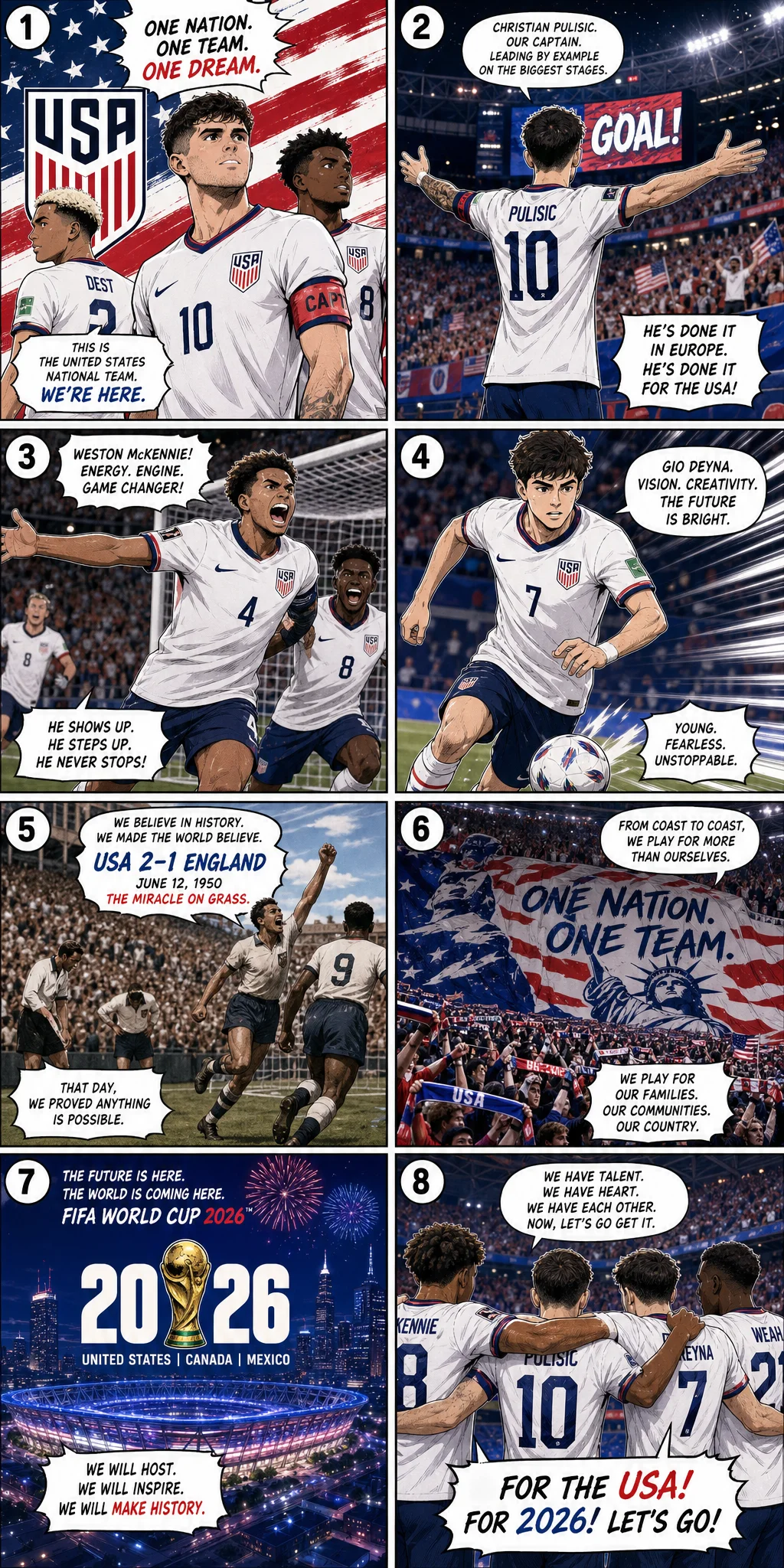
8-panel comic about United States national football team and their journey to the 2026 FIFA World Cup.
Published: June 5, 2026
United States National Football Team: The Stars and Stripes Ascending
The United States men's national football team, known as the "USMNT," enters the 2026 FIFA World Cup as a co-host nation and a program that has been systematically building toward this moment for a generation. The tournament on home soil — shared with Canada and Mexico — represents the culmination of decades of investment in youth development, professional infrastructure, and the slow, patient construction of a football culture in a nation long defined by other sports. For American soccer, 2026 is not merely a tournament; it is a proving ground.
HISTORICAL FOUNDATIONS
The United States possesses a surprisingly deep football history. The US Soccer Federation, founded in 1913, is among the world's older governing bodies, and the national team competed in the inaugural 1930 World Cup in Uruguay, reaching the semi-finals — still the best World Cup finish by a team from outside Europe or South America. The 1950 World Cup produced American soccer's foundational myth: the 1-0 victory over England in Belo Horizonte, Brazil, a result so improbable that English newspapers initially assumed the reported score was a typographical error. Joe Gaetjens, the Haitian-born striker, scored the winning goal and became an American sporting legend.
For decades after 1950, American soccer existed on the margins of both global football and domestic sports culture. The North American Soccer League brought Pelé, Franz Beckenbauer, and Johan Cruyff to American shores in the 1970s, but the league's collapse in 1984 left the sport without a professional foundation. The 1990 World Cup appearance — the first in 40 years — was a product of the growing youth soccer movement and the collegiate system, but the team was outclassed in Italy, losing all three matches.
The 1994 World Cup, hosted by the United States, changed everything. Record attendances, the successful launch of Major League Soccer, and the national team's progression to the Round of 16 (including a memorable 2-1 victory over Colombia) provided proof of concept. The 2002 quarter-final run in South Korea and Japan — including a 2-0 victory over Mexico in the Round of 16 and a narrow 1-0 quarter-final loss to Germany that featured a clear handball on the goal line by Torsten Frings — remains the program's high-water mark.
LEGENDS OF THE STARS AND STRIPES
Landon Donovan stands as the most accomplished male player in American soccer history. His 57 international goals and 58 assists are USMNT records, and his career was defined by moments of high drama — the last-minute goal against Algeria in 2010 that sent the US through to the knockout stage, his penalty-kick mastery, his four World Cup appearances. Donovan's decision to play the majority of his club career in MLS, rather than testing himself in Europe's top leagues, remains a subject of debate about American soccer's developmental ceiling.
Clint Dempsey, "Deuce," brought a distinctly American swagger to the game — a Texan who freestyled with his friends, rapped his own lyrics, and played with a fearless creativity that European football sometimes struggles to accommodate. His 57 international goals (tied with Donovan), his successful Premier League career at Fulham and Tottenham, and his tendency to score goals of audacious quality made him a folk hero.
Claudio Reyna, the midfield general who captained the US at two World Cups and played for Bayer Leverkusen, Rangers, Sunderland, and Manchester City, was arguably the most technically complete American player of his generation. Tab Ramos, John Harkes, and Tony Meola were pioneers of the 1990s who proved Americans could compete internationally. Tim Howard's record-setting 16-save performance against Belgium in the 2014 World Cup Round of 16 — a losing effort that felt heroic — and his long Premier League career at Everton established the modern American goalkeeper template.
THE MODERN GOLDEN GENERATION
The current USMNT represents the most talented cohort in the program's history, the product of a player development system that has been reconstructed from its foundations. Christian Pulisic, the "Captain America" who became the first American to play in and win the UEFA Champions League with Chelsea, is the team's creative talisman. His dribbling, vision, and increasing maturity as a leader at AC Milan make him the player around whom the American attack orbits.
Weston McKennie, the versatile Juventus midfielder, provides physical presence, aerial threat, and a competitive intensity that energizes his teammates. Tyler Adams, when fit, is the midfield anchor — a defensive midfielder whose reading of the game, tackling, and distribution make him the tactical linchpin. Gio Reyna, Claudio's son, carries perhaps the highest creative ceiling in the American player pool — a midfielder of exceptional technical quality whose career at Borussia Dortmund and beyond has been slowed by injuries. Yunus Musah, Timothy Weah, and Folarin Balogun — the latter a product of the English youth system who represents the US through family heritage — have added depth to an attack that can match most international opponents.
The defensive unit features Antonee Robinson, the Fulham left-back whose pace, crossing, and one-on-one defending have made him one of the Premier League's most effective full-backs. Sergiño Dest, the Dutch-born right-back at PSV Eindhoven and Barcelona before that, provides attacking thrust and technical quality on the opposite flank. The center-back pairing, anchored by Tim Ream's experience and the emergence of younger options, continues to develop.
FOOTBALL AND AMERICAN CULTURE
Soccer's place in American culture has been transformed over the past three decades. Youth participation rates — particularly among girls, driven by Title IX and the success of the women's national team — have made soccer one of the country's most-played sports, even as the professional game has struggled for television ratings and cultural prominence relative to football, basketball, and baseball.
Major League Soccer has grown from a ten-team league playing in oversized American football stadiums to a 30-club competition with soccer-specific venues, robust academy systems, and increasing global credibility. The arrival of Lionel Messi at Inter Miami in 2023 accelerated the league's profile, but the long-term health of American soccer depends on the developmental pipeline rather than superstar marketing.
The supporters' culture — led by groups like the American Outlaws — has matured from a niche subculture into a visible and audible presence at national team matches. The atmosphere at recent World Cup qualifiers in cities like Columbus, Cincinnati, and Austin has demonstrated that American soccer possesses a passionate, knowledgeable, and growing fan base. The 2026 World Cup on home soil will introduce the sport to an even broader American audience, providing a generational opportunity for soccer to claim a larger share of the nation's sporting attention.
THE 2026 OPPORTUNITY
As co-hosts, the United States enters the 2026 World Cup with automatic qualification and the advantages of home support. Matches will be played in NFL stadiums filled with American supporters, an atmosphere that the program has rarely experienced at this level. The absence of international travel, the familiarity of surroundings, and the energy of a home World Cup provide competitive advantages that the team expects to leverage.
Expectations are higher than for any previous American World Cup campaign. The Round of 16 is the minimum acceptable outcome. A quarter-final appearance — matching the 2002 achievement — is the realistic ambition. Anything beyond that would represent a historic breakthrough for American men's soccer. The pressure on this generation, and particularly on Christian Pulisic as captain, will be immense.
The tactical identity under the current coaching staff has evolved toward a possession-oriented, high-pressing style that reflects the team's athletic advantages and technical growth. The US aims to control matches — not merely survive them — a philosophical shift from the counter-attacking pragmatism of previous American World Cup campaigns. Whether this approach can succeed against elite opposition remains the central question.
For American soccer, 2026 is the moment of arrival. The infrastructure is in place, the talent pool is deeper than ever, and the stage is set. The Stars and Stripes are ascending — and the world is about to witness what American soccer has become.