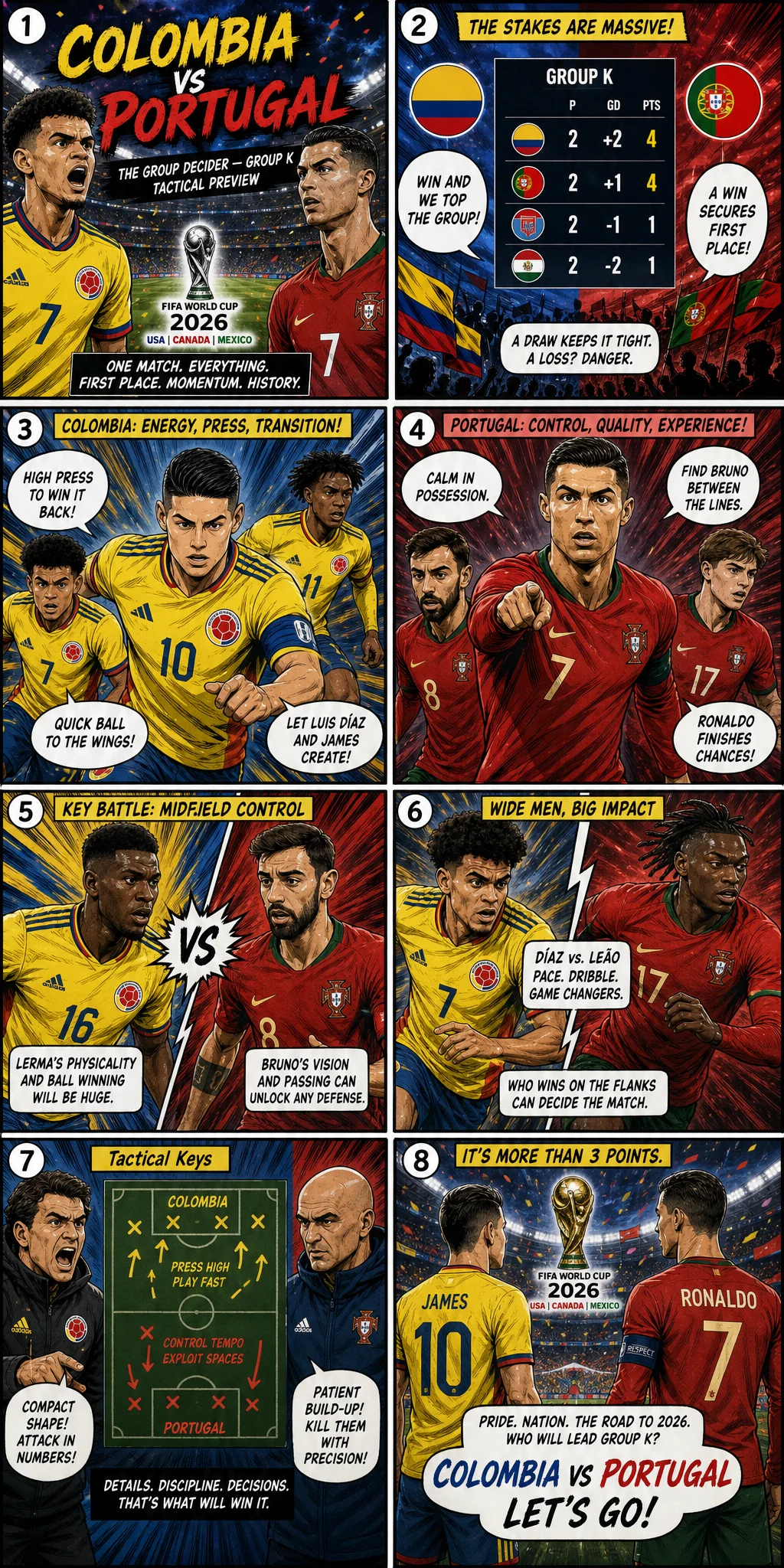
Colombia vs Portugal: The Group Decider — Group K Tactical Preview
2026 FIFA World Cup Group K decider — Colombia vs Portugal, Hard Rock Stadium, Miami. Group winners likely decided here. Martinez 4-3-3 vs Lorenzo 4-2-3-1 tactical chess match. Diaz vs Dalot, Bruno Fernandes creative threat, Ronaldo tournament management. Colombia transition defence vulnerability analysis. Semi-final quality group stage match.
Published: June 6, 2026
Colombia vs Portugal: The Group Decider — Group K Tactical Preview
This is the only match in Group K where both sides possess genuinely knockout-round-calibre squads. If the first two matchdays go as expected — Portugal beating Congo and Uzbekistan, Colombia doing the same — then this Miami night determines who advances as group winners and who enters the Round of 32 with a demonstrably harder path. The stakes are not merely prestige but tournament trajectory.
Start with the formation matchup. Lorenzo's 4-2-3-1 and Martinez's 4-3-3 appear symmetrical on paper, but their actual operation reveals asymmetry. Colombia's attack is built on a specific sequence: create an overload on the right (Munoz overlapping, Arias tucking inside), compress the opponent's defensive weight to that side, then use a rapid diagonal switch — usually from James or Rios — to isolate Luis Diaz one-against-one on the left. This sequence produced thirty-four percent of Colombia's goals across eighteen qualifying matches.
Portugal's defensive response to this pattern will revolve around Diogo Dalot — likely to start at right-back ahead of Cancelo precisely to counter Diaz. Dalot's season at Manchester United (2.3 tackles per match, 1.8 interceptions) showcased a more conservative, defence-first full-back profile than Cancelo. He is not here to participate in the attack — he is here to survive. Ahead of him, Bernardo Silva's defensive awareness (his pressing distance covered at Manchester City ranks in the top tenth percentile for midfielders) provides a double insurance layer.
But Colombia's tactical problem is not attacking — it is defensive transition. Portugal demonstrated in the Nations League that they are among the world's most lethal transition attackers. When Vitinha releases Bruno Fernandes within one second of a turnover, when Rafael Leao requires three steps to go from stationary to full speed, the question becomes: can Colombia's double pivot — Lerma and Rios — recover their defensive shape the moment possession is lost? The data is concerning: thirty-nine percent of the goals Colombia conceded in qualifying came from opposition transitions — the highest proportion of any team in South America's top ten.
The striker selection will be a critical variable. Lorenzo may start Luis Javier Suarez — his twenty-eight-goal season at Sporting CP gives him the confidence of form — but his movement patterns, which are predominantly central, may play directly into Ruben Dias's strengths. Dias is at his best against traditional number nines — his positioning and physical engagement are elite. If Colombia needs to change the rhythm, Juan Camilo "Cucho" Hernandez — a more mobile forward willing to receive the ball in wide areas — could be the more effective option in the second half.
Portugal's attacking approach will centre on a single question: how to isolate and attack Colombia's left-back position. Johan Mojica has been solid for Bologna, but he has never faced an attacking midfielder who drifts into the right half-space with the frequency and intent of Bruno Fernandes. If Fernandes pulls Mojica out of position, then Pedro Neto or Francisco Conceicao cutting inside from the right will find seams in Colombia's defensive line. This is the pattern Martinez has drilled repeatedly — diagonal crosses from the right half-space toward the far post, targeting Ronaldo's heading or Leao's late runs.
Ronaldo's role deserves its own discussion. His average minutes in the Nations League were sixty-two — not because he cannot complete ninety, but because Martinez maximises his impact as a "match-defining-moment" weapon. The final fifteen minutes of the first half and the opening fifteen of the second — these are Ronaldo's most physically threatening windows. Colombia's centre-back pairing — Davinson Sanchez and Jhon Lucumi — were breached by headers only once across the entirety of qualifying. But Ronaldo's heading is not ordinary heading — his leap timing and aerial suspension, even at forty-one, can rewrite those statistics.
The match rhythm: the first half will be cautious — both sides testing the other's defensive structure, neither willing to gift transition opportunities. Goals are more likely a second-half product — either Portugal breaking through around the sixtieth minute through sustained possession pressure, or Colombia catching a moment of misalignment in Portugal's defensive line on the counter. Set-pieces may be decisive — both teams rank in the top three of their respective continents for set-piece efficiency.
Prediction: Portugal 2-1. This will be the highest-quality, most tactically complex match in Group K. Both teams are equipped to control different phases of the game. But Portugal's individual quality in the decisive positions — specifically Bruno's decision-making at the edge of the box and Ronaldo's finishing instinct in the penalty area — will prove decisive on a night that demands precision. Were this a knockout tie, it would belong in the semi-finals.