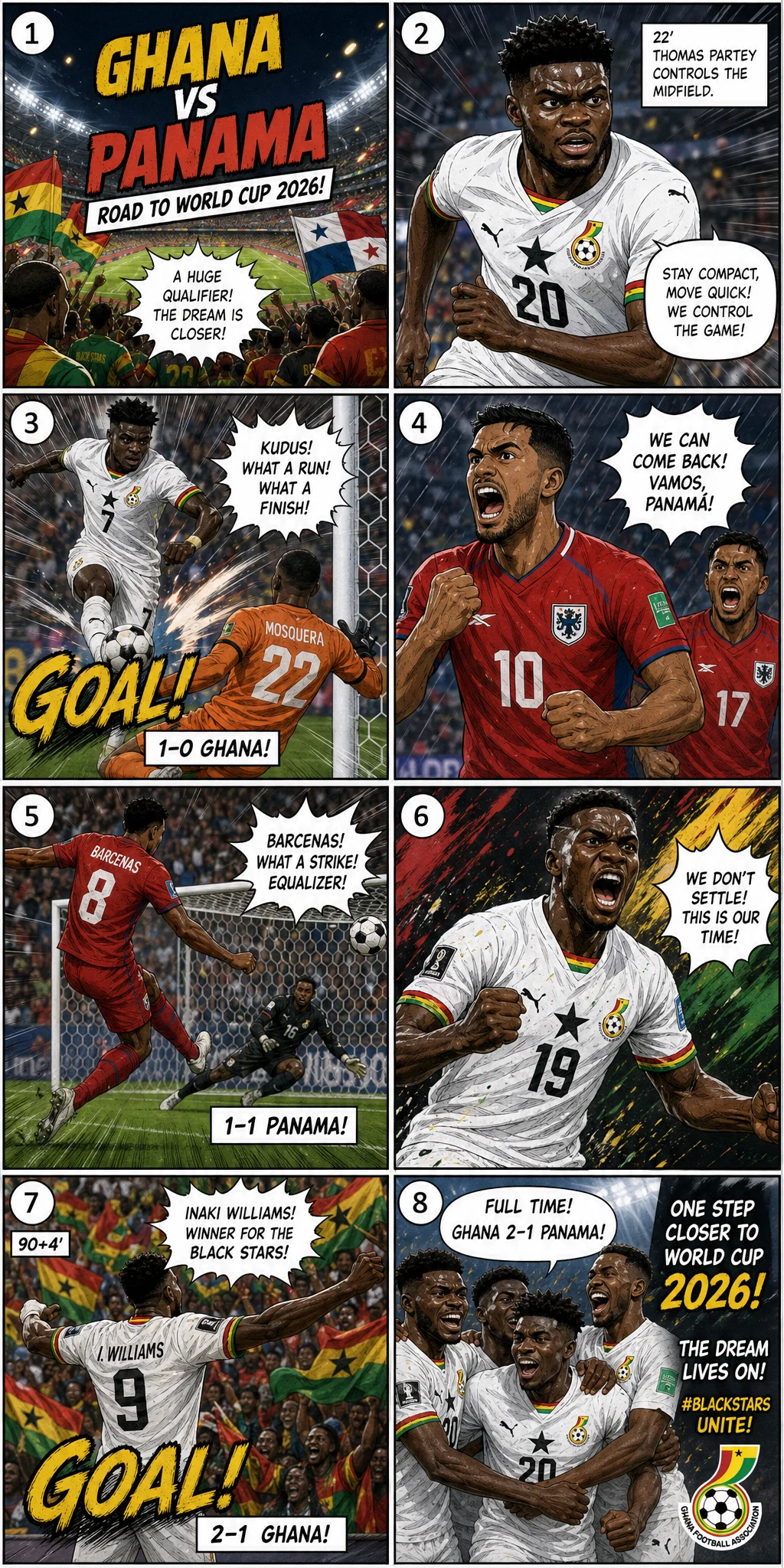
Ghana vs Panama
Carlos Queiroz took over Ghana only sixty days ago, adopting compact defense as his survival principle. Thomas Christiansen has coached Panama for six years, with a mature system. These two underdog teams are going all out for knockout-stage hopes at BMO Field in Toronto.
Published: June 6, 2026
Ghana vs Panama: A Survivor's Chess Match
This fixture will not lead any mainstream headline. England versus Croatia kicks off earlier the same evening, hoarding every spotlight. But at BMO Field in Toronto, two nations will play a match that arguably captures the essence of a World Cup more honestly — two countries that know they are not favourites, staking everything on a shot at the knockout stage.
Carlos Queiroz has had less than two months with this Ghana squad. That timeframe alone dictates his tactical choices: no complex possession structure can be installed, so what you will see is a team built on defensive compactness above all else. The baseline 4-2-3-1 collapses into a 4-5-1 upon losing possession — Thomas Partey and Elisha Owusu form the first breakwater in the double pivot, while both wide players (Sulemana or Nuamah) tuck in level with the full-backs. Queiroz's career across Iran and Egypt has proven one thing: he does not need possession to control a game. What he needs is for every pass the opponent attempts in Ghana's half to meet resistance.
But Ghana's attacking unit carries a structural flaw. Mohammed Kudus is injured — his absence creates a creativity vacuum. Jordan Ayew, operating behind the striker, has been guilty of "trying to do everything himself" (per ESPN's analysis of the Wales friendly), disrupting attacking rhythm. Antoine Semenyo is the primary threat: his explosive transitions and post-duel shooting ability have been repeatedly validated in the Premier League. But he requires support — Inaki Williams' vertical runs and Abdul Fatawu Issahaku's right-sided dribbling are among the few "unstructured" weapons in Queiroz's system.
Panama's Thomas Christiansen has been in charge for nearly six years — rare stability in international football. His asymmetrical 4-2-3-1 is a mature product: right-back Amir Murillo (Besiktas) is the engine of the entire attacking system, his overlapping runs and crossing quality having created more chances than any other player in CONCACAF qualifying. The left flank is far more conservative — Eric Davis rarely crosses the halfway line, ensuring three defenders remain in place during transitions. Captain Anibal Godoy anchors the space in front of the back four, while Adalberto Carrasquilla's fitness — a groin injury sustained in the Liga MX final — will directly determine Panama's midfield connectivity.
Both teams view this as a must-get-points opportunity. Ghana hold the stronger squad on paper — Partey, Semenyo, Williams all feature regularly in Europe's top five leagues — but Queiroz's preparation time has been minimal and the attacking-defensive balance remains uncalibrated. Panama's system is more mature, their players' "automatisms" the product of six years' accumulation. Prediction: a low-scoring draw, or Ghana by a single goal. Either outcome, this will be a closer match than the scoreline suggests.