The Referee Had a Few Drinks After Work
How semi-automated offside technology, 500Hz IMU chip balls, and 12-camera skeletal tracking are reshaping the role of the human referee at the 2026 FIFA World Cup.
Published: June 6, 2026
# The Referee Had a Few Drinks After Work
November 22, 2022. Qatar. Argentina versus Saudi Arabia.
The moment Lautaro Martínez put the ball in the net, he turned and ran. His teammates swarmed him. The entire Lusail Stadium shook — the Argentine end, at least.
Then, nothing happened.
Not exactly nothing. Referee Slavko Vinčić didn't blow his whistle. He didn't run to the VAR monitor on the sideline. He didn't even take the whistle out of his mouth. He just stood there, right hand pressed gently to his earpiece, looking like a man listening to a very long voice message — his expression somewhere between "I knew it" and "alright, go on then."
The stadium screen lit up with what became the iconic image of the 2022 World Cup: a 3D skeletal animation. Twenty-nine glowing data points mapped along Lautaro's body. The offside line slicing through his shoulder. The margin? Official word: "millimeters."
Martínez looked at the screen. Tilted his head. No rage. No chasing the referee. Just a tilt of the head. There was a whole era ending in that tilt. When you can't even find the right target for your anger — what are you supposed to do? Yell at a pile of data? Get furious at a machine?
On my couch, my phone buzzed. A friend: "So offside is decided by computers now?"
I typed back: "You've got it backwards. The computer measures. Then it tells the ref. Then the ref decides whether to believe it."
He didn't reply. Probably still thinking about it.
Two years later, in 2024, I found myself in a London pub with a former Premier League linesman. Retired now. Walks his dog. Watches football. Writes the occasional newspaper column. I asked him what he thought about SAOT — Semi-Automated Offside Technology.
"You're saying I'm out of a job?" He grinned.
"No, I'm saying you held a flag for twenty years, and now an AI does it ten seconds faster."
He took a sip of his beer. Thought about it. "When we raised the flag, back in my day, it came from a feeling you can't really describe. You're watching the midfielder play the pass, tracking the last defender's foot out of the corner of your eye, and at the same time reading the moment the striker starts his run. You don't see it frame by frame. You see the whole thing. Sometimes you put the flag up because you know he was off. SAOT doesn't do that. SAOT doesn't know anything. SAOT just measures."
Another sip. "So my question is — is football a measuring game, or a judging game?"
I didn't answer. The pub TV was showing Champions League highlights. A winger burst off the last defender's shoulder. Impossible to see with the naked eye. VAR didn't intervene. Goal. The whole pub cheered.
The former linesman pointed at the screen. "See that? SAOT would have flagged it. Shoulder was probably two centimeters off. But nobody — nobody — wants to see a goal like that get disallowed."
## The real question isn't "is AI coming." It's "who decides what football is."
Let me tell you how the 2026 system actually works. Not because it's complicated — your iPhone has a more complex architecture, honestly — but because everyone gets the emphasis wrong.
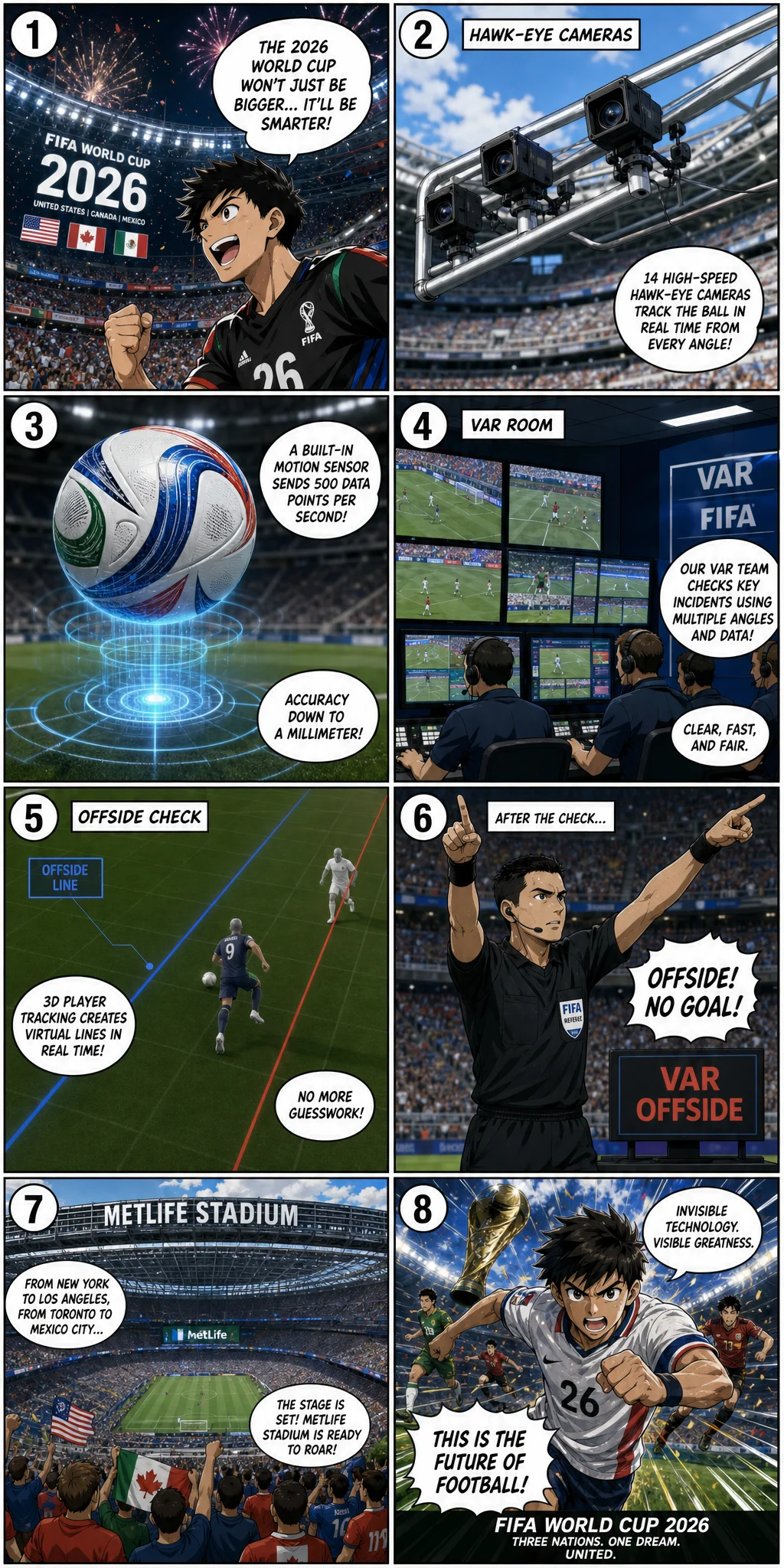
Twelve tracking cameras hang under the stadium roof. These are not broadcast cameras. The difference between them is roughly the gap between a home toaster and the thermal control system on a space station. They track 29 skeletal points on 22 players simultaneously, 50 times per second. Wrist. Ankle. Tip of the shoulder. Center of the knee. Precise enough that you could rotate each player's wireframe skeleton 360 degrees on screen.
Meanwhile, inside the Adidas match ball sits a 14-gram sensor. Don't call it a chip. It's a fully-fledged inertial measurement unit — three-axis accelerometer, three-axis gyroscope. It's suspended at the exact center of the ball on a set of elastic MEMS filaments. Spin it. Smash it. Doesn't matter. The sensor stays untouched, pinging the system 500 times per second: "touched ... touched ... touched." Until the final "touched" — and the system knows the moment of contact to within half a millisecond.
Let that sink in. A human blink takes about 100 milliseconds. In that same window, the sensor has collected 50 data points and concluded that the tip of a striker's right toe was three millimeters ahead of the defender's shoulder.
But here's the part that actually matters.
The AI sends its verdict to the VAR operations room — a darkened space that looks more like a nuclear submarine control center than anything connected to sport. Behind the screens sits a human being. Living, breathing, drinking coffee, probably didn't sleep well last night. They look at the red line. They judge whether it's drawn correctly. When they nod — only then — does the message reach the referee's earpiece.
Notice the order: the AI measures. The human believes.
FIFA has never called this an "automatic offside system." They added one word. Semi. Semi-Automated. Those four letters are not a compromise from the marketing department. They're the result of more than two years of debate inside the referees' committee. Pierluigi Collina — the most famous bald head and the calmest mind in football officiating — said it during a 2022 technical briefing, in that tone of his that leaves no room for argument: "The final decision will always rest with the referee."
Always. In an era where everything is accelerating toward automation, that word lands almost like a manifesto.
## 2014 to 2026: A road you can't turn back on — just not the one you think
Line up the last decade-plus of refereeing technology side by side, and you'll notice something fascinating. The arguments never went away. They just changed direction.
2014, Brazil. Goal-line technology makes its debut. The logic was as simple as one plus one equals two. Did the ball fully cross the line? Yes → buzz. No → silence. Frank Lampard, had this existed in 2010, would have a World Cup goal to his name — but that's a different story.
The point is: GLT generated exactly zero controversies. Not one. Because it answers a question of pure fact. Did the ball go in or not? There's no "I think," no "in my opinion." Physical facts don't require a conversation.
2018, Russia. VAR arrives. This is where the trouble starts.
The VAR intervention standard is "clear and obvious error." Sounds reasonable. Here's the thing: what counts as clear? Who defines obvious? A referee with fifteen years in the Premier League and a referee with three years in La Liga can look at the same replay and reach entirely different conclusions. This is not a machine problem. This is a human cognition problem. We're just built this way.
2022, Qatar. SAOT enters the stage. It fixes the slowest part of VAR — the manual drawing of offside lines. A process that used to take 70 seconds gets compressed to 25. Accuracy approaches perfection. And you know what happened?
People started protesting something entirely different.
"A toe ahead by three millimeters counts as offside? This wasn't what the rule was made for."
"Disallowing goals like this is destroying football."
"Too precise is unfair."
Do you see the irony?
In 2018, people complained VAR wasn't precise enough. In 2022, people complained SAOT was too precise. Technology didn't eliminate controversy — it just moved the argument from "was he actually offside?" to "should this kind of offside even be called?"
Those are two completely different questions. The first is a measurement problem. Machines can solve that. The second is a philosophical problem. No algorithm on earth can answer it.
## The 14-gram sensor: the main character nobody talks about
Almost everything written about SAOT focuses on the AI, the cameras, the 3D animations. But the component that most deserves a close-up photograph is something you can't even see with the naked eye.
Fourteen grams. The weight of a two-euro coin. Suspended at the dead center of a match ball that costs €150.
Calling it a "chip" makes people picture a passive RFID tag — the kind of sticker you see on merchandise at a department store security gate. It's not. It's a complete spatial awareness device. It measures acceleration in three dimensions simultaneously — up-down, left-right, forward-back — plus angular velocity around all three axes. Six degrees of freedom. Five hundred times per second. Put this thing in an airplane and it's part of the navigation system. FIFA put it in a football.
Here's a detail you might not have considered: before the IMU existed, "the moment of contact" was a surprisingly fuzzy legal concept.
Picture this: a midfielder plays a long ball. Somewhere in the VAR room, an operator pauses the video. Then they scroll back, frame by frame — "This one? No, go back one. Still wrong, forward one." At 50 frames per second, the gap between frames is 20 milliseconds. A ±2 frame selection error means ±40 milliseconds. On a striker sprinting at full speed, 40 milliseconds translates to maybe four or five centimeters of body movement. And those four or five centimeters? The difference between onside and offside.
The IMU deletes this multiple-choice problem. Not because it's smarter. Because it's faster. It samples at 500Hz — one data point every two milliseconds. At that resolution, "the moment of contact" stops being a video screenshot you squint at. It becomes an inflection point on a curve. A physical signal. A waveform event.
As my retired linesman friend put it: "We used to guess the moment of contact. Now the machine finds the moment of contact. The gap between those two sentences — that's the biggest single leap in the history of football officiating."
## So what happens to referees?
If you were hoping I'd say "the profession will be extinct by 2030" — sorry. That's not how this ends.
Referees aren't disappearing. But what the word "referee" means is about to change completely.
In the 1970s, when commercial airliners first got autopilot systems, pilots panicked. They thought: the plane flies itself now, so we're getting laid off. But that's not what happened. Pilots weren't fired. Their job changed. Today's pilot isn't "flying the plane" — they're managing a constellation of automated subsystems talking to each other, monitoring dozens of instruments, ready to take over the moment anything in the automation chain breaks.
World Cup referees are walking the same path. They're just wearing running shoes instead of aviation boots.
The 2026 referee, in the middle of a match, is processing something like this: in one ear, the VAR team's voice (human channel); in front of them, the game unfolding in real time (eyes channel); on the sideline LED, SAOT's verdict popping up any second (AI channel); and in the ball — or more accurately, streaming from it — a data feed they can't even perceive at a speed they can't comprehend (machine channel).
Four streams. One person. Ninety minutes.
Collina says "the final decision rests with the referee." It's a good line. But the weight of the word "final" — in a world with 500Hz sensors — isn't what it was twenty years ago. Not even close.
The role that's actually been transformed the most — and this might surprise you — isn't the main referee. It's the assistant referee.
The act of raising the flag is shifting from a craft into a ritual.
In the SAOT world, after the AI has flagged the offside, the assistant doesn't "discover" it. They're "informed" of it. Then they raise the flag — delayed by a few seconds, because the protocol says "let the attack finish first." It's like receiving a text notification, then standing up and announcing its contents to your entire office. You're not discovering new information. You're performing a decision the system has already made.
Twenty years ago, this was completely different. Twenty years ago, an assistant referee was genuinely using their naked eyes, from forty yards away, to judge a spatial relationship measured in centimeters. That was a craft. A skill that took thousands of hours to master.
Craft becoming ritual. This isn't machines replacing humans. This is the content of human work undergoing a qualitative transformation.
But the last thing my retired linesman friend said — this is the part I can't stop thinking about:
"You know what I miss the most? Not the flag. The look. An experienced linesman, with one well-timed glance, can defuse a confrontation that's about to explode. You pick your moment — not too early, not too late. You walk up to the player who's about to say something he'll regret. You don't look at the foul he committed. You look at his eyes. And sometimes, you say — 'Hey. Your two kids are in the stands today, right?' — and you walk away."
"SAOT doesn't do that. SAOT will never ask about your kids while you're shoving an opponent."
He put down his glass. Stood up.
"So no, I'm not worried about machines replacing us. What I'm worried about is — the machines are so perfect that we forget football was never supposed to be."
---
That's the real story of the 2026 AI refereeing system. Not "how powerful the machines are." Not "how obsolete human referees have become." It's this: when you can measure to the millimeter and detect contact to the half-millisecond, what happens to the human part of football?
The offside rule was written for people running around on grass. Its language is fairness, not precision. So when a toe is three millimeters ahead — tell me. Which part of "fairness" does that violate?
This isn't a technology problem.
This is a question about whether football's soul still wants to be a soul.