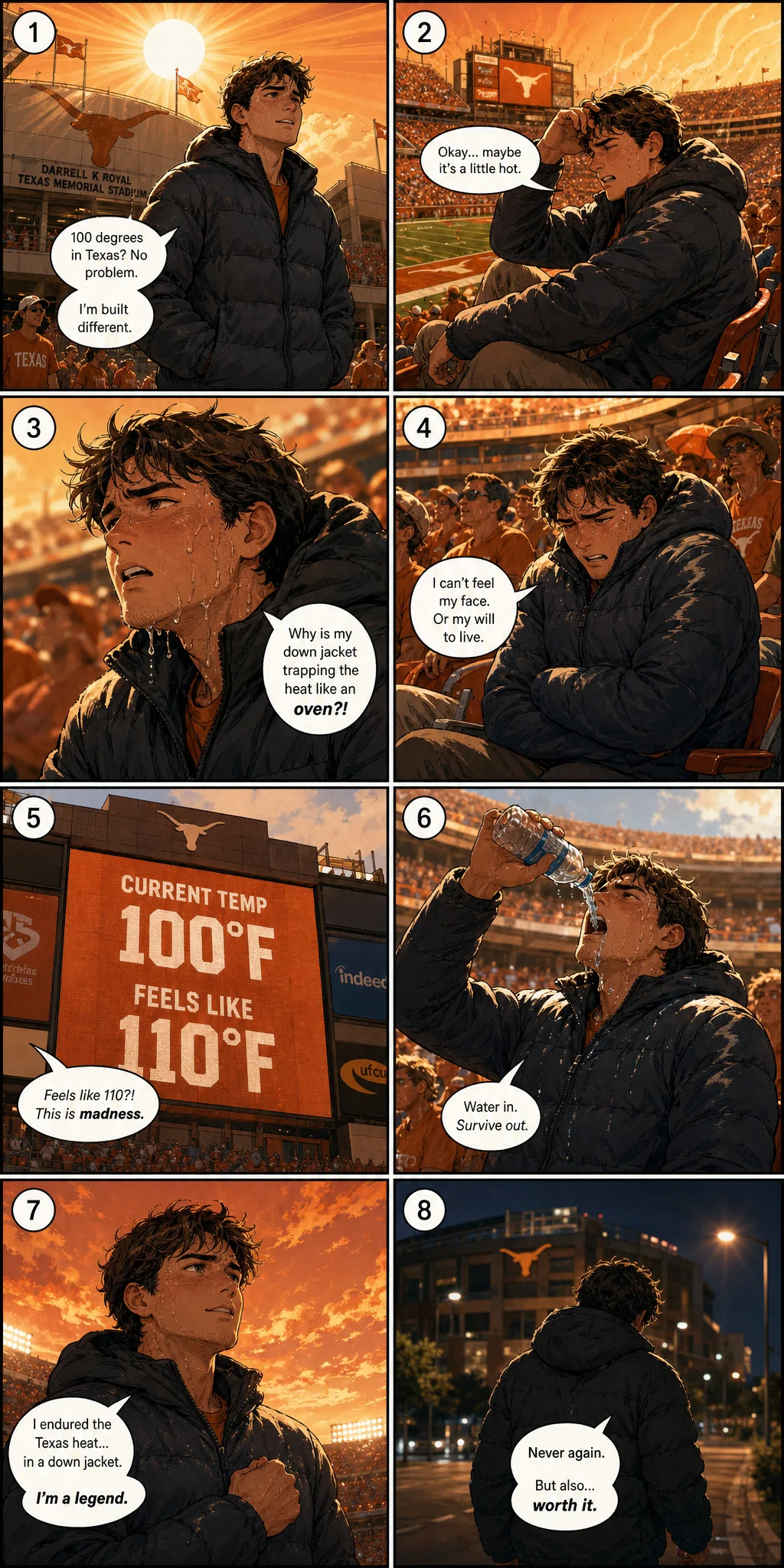
I Wore a Down Jacket in a Texas Stadium
How Qatar 2022's stadium cooling revolution — spot cooling, under-seat diffusers, stratified airflow — is being adapted for the three-climate challenge of 2026 across USA, Canada, and Mexico.
Published: June 6, 2026
# I Wore a Down Jacket in a Texas Stadium
June 23, 2026. Two in the afternoon. Arlington, Texas.
Outside: 41 degrees Celsius. The heat shimmering off the asphalt like a layer of clear jelly that someone forgot to put in the fridge. Cars in the parking lot baking to the point where touching the steering wheel is a genuine health risk. The second I climbed out of my rental, my skin felt like a sheet of baking paper sliding into a hot oven — not pain, exactly, more like the premonition of fire.
I walked through the doors of AT&T Stadium.
Five seconds.
My t-shirt went from "appropriate clothing choice" to "regrettable mistake" to "completely irrelevant." Because the moment that door sealed behind me — the air, I don't know how to describe it. Not "cold." Cold is what you feel walking into a 7-Eleven. This was something else. A temperature calculated by engineers. Applied evenly from every direction. Wrapping around your body in a way that made the outside world — the real world, the 41-degree world — disappear like a bad dream.
An old man in cowboy boots was buying a hot dog next to me. He glanced over — I was probably still standing there with my mouth half open — and grinned.
"First time?"
"First time in summer."
"Well, you hang tight. Second half gets colder. They're worried about the grass."
## What Qatar taught us
Before the 2022 World Cup kicked off, the entire planet was laughing.
"You're playing a World Cup in the desert? You want players to run in 45-degree heat?"
"Air-conditioned stadiums? Sounds like pointing a desk fan at the Sahara."
Then the tournament started. Then everyone shut up.
I'm not saying Qatar's AC system was flawless. Some stadiums got so cold that spectators were buying jackets at the gift shop. Some had weird temperature layers — winter at ankle level, summer above the scalp. But on the whole: a country in the middle of a desert, where summer temperatures routinely hit fifty degrees Celsius, successfully kept eight stadiums between 21 and 24 degrees. Twenty years ago, this sentence would have been science fiction.
The key figure is a Sudanese-born engineer named Saud Abdulaziz Abdul Ghani. Everyone calls him "Dr. Cool." He spent thirteen years in a lab at Qatar University working on one question: how do you create a microclimate suitable for extreme human exertion inside an environment that is aggressively unsuitable for any human exertion whatsoever?
The answer wasn't "add more air conditioning." The answer was rethinking how air itself moves.
## Don't imagine a bigger AC unit. Imagine sitting inside a designed wind.
The standard logic for cooling a stadium goes like this: big ducts in the roof. Blow cold air downward. Here's the problem. Cold air is heavier than warm air. You blow cold air from above, it sinks. The warm air rises. Net result: the stands are freezing, the pitch is an oven, and the technical area feels like a sauna. Also — a football stadium is not a sealed box. Your carefully chilled air leaks out through every gap between the stands in about five seconds.
Qatar's solution — later branded as "spot cooling" — is a completely different philosophy.
Don't blow from the roof. Blow from under the seats. A small vent beneath every single seat. Cold air rises from your ankles — but because it's heavier than the warm air around you, it stays right where you are. Pooled around your body. Exactly enough. Then, as it slowly warms up and becomes lighter, it naturally drifts upward, where a large recirculation system under the stands pulls it back in — cools it down again — and sends it back to your feet.
This is called "stratified cooling." You're only cooling the bottom two meters. The twenty meters of empty air above the stands? Let it boil. Nobody's sitting up there.
What about the grass on the pitch?
Along the sidelines, every few meters, there's a nozzle bigger than a basketball. It blasts cold air at a precisely calculated angle across the surface of the turf. Not downward — downward would interfere with the flight of the ball. Horizontally. A carpet of cold air gliding just above the blades of grass. The ball rolls normally. The players sprint normally. The grass stays at 22 degrees.
Dr. Cool has a line I can't get out of my head. He said: "We are not cooling the stadium. We are cooling the people and the grass inside the stadium."
Read that twice. He's not cooling the building. He's cooling what's inside the building. An open-air stadium — five hundred meters long, two hundred wide, forty meters high — is theoretically a cooling engineer's worst nightmare. And his response was: I'll worry about the bottom two meters. The rest can take care of itself.
That one sentence tells you how much energy the old way of thinking was wasting.
## 2026: Not a Qatar copy. A three-front climate war.
Qatar's problem was single and extreme: desert, hot, dry. The 2026 World Cup's problem is that three different countries' climates are happening to you simultaneously.
Monday you're officiating at Estadio Azteca in Mexico City — altitude 2,250 meters, thin air, brutal direct sun, players gasping after fifteen minutes. Thursday you're at NRG Stadium in Houston — sea level, ninety percent humidity, like running inside a dumpling steamer. The following Monday you're at BMO Field in Toronto — June, Canada, 19 degrees, gusting wind, rain possible at any moment.
No single cooling solution can solve all three of these. So they're not using one.
Texas and Florida domed stadiums (AT&T Stadium, NRG Stadium, Hard Rock Stadium in Miami): These venues already have roofs and HVAC systems. The 2026 plan is to retrofit them with Qatar-style under-seat diffusers, upgrading from "the whole building's pretty cool" to "the critical zones are precisely controlled." AT&T Stadium's engineering team ran a test in 2024 — 38 degrees outside, 22 degrees at pitch level, temperature difference between any two points under three degrees. Dr. Cool himself was reportedly brought in as a consultant.
Mexico's open-air stadiums (Azteca, BBVA): High altitude. Wind. No roof. You don't really need cooling. Your actual problems are UV exposure and dehydration. The solution isn't air conditioning. It's kickoff times. Every Mexico match is scheduled for late afternoon or evening. This has nothing to do with technology. Everything to do with common sense.
Canada's semi-enclosed venues (BC Place has a retractable roof, BMO Field is fully open): June in Vancouver and Toronto — you're less worried about heat than about rain and sudden cold snaps. BC Place's roof closes in twenty minutes. Underneath: a geothermal heating system. Yes — heating. In June. In Canada. You might need to keep the grass warm.
The gap between these three climate conditions, inside a single World Cup, is an unprecedented logistical challenge. But it's also an opportunity. If 2026 can maintain consistent match quality across these conditions — no heat-enforced cooling breaks, no matches postponed because the grass died — then this multi-climate cooling strategy proves football can be played anywhere. Not because the weather cooperates. Because the engineers didn't go home.
## What fascinates me most isn't the technology. It's who gets to host now.
Look at the list of World Cup hosts before 2022. Europe. South America. Asia (Japan and Korea). Africa (South Africa). Apart from South Africa and 2014 Brazil — and yes, parts of Brazil in June are technically winter — there isn't a single genuinely "extreme heat" country on that list.
Not because those countries didn't want to host. Because they couldn't. Not a money problem. A biology problem. Summer is too hot. Players would collapse. FIFA wouldn't allow it.
Qatar 2022 and the upcoming 2026 prove the same thing: if you can keep the temperature inside the stadium at 22 degrees — regardless of whether it's a 45-degree desert or 90-percent-humidity Houston outside — the threshold for hosting rights fundamentally changes.
Saudi Arabia is bidding for 2034. Without Qatar's AC revolution first, that bid wouldn't have made it past the opening round. Now? All they have to say is: "We'll use Dr. Cool's system. The upgraded version." And the committee starts nodding.
The Middle East. North Africa. India. Southeast Asia — entire regions FIFA used to skip because the weather was too hot. They're all back at the table now. Not because the Earth got cooler. Because humans finally figured out how to build a small refrigerator inside an oven.
There's another side to this story, obviously. The energy consumption is staggering. Qatar's eight stadiums used the equivalent of a small city's weekly electricity during the tournament. The 2026 three-country plan doesn't require every venue to be fully sealed and cooled the way Qatar did — but a few of those Texas domes were already energy monsters in the summer before you added World Cup-level cooling demands. The line between sustainability and comfort is currently being held together by fossil fuels. FIFA has promised 2026 will be the greenest World Cup in history. That promise, held up next to a Texas summer electricity bill, has a certain dramatic tension to it.
## Epilogue: buy the down jacket
Back at AT&T Stadium. The old man in cowboy boots — I later learned he's been a season ticket holder since the building opened in 2009 — told me a story.
"Super Bowl, 2011. Halftime show was the Black Eyed Peas. You know what it was outside that night? Minus five. Icing. Roof was closed. Inside: 21 degrees. Fergie's up there singing, eighty thousand people in t-shirts. Nobody remembered it was snowing."
He swallowed the last bite of his hot dog.
"So, kid — you're asking me if air conditioning is part of football now?"
He pointed at the thin metal grilles tucked under the seats all around us. The ones you barely notice.
"I'll tell you. The 2026 World Cup isn't gonna be won by the team that plays the best football. It's gonna be won by the team that handles the cold air best."
He winked. Walked off.
I was still wearing my down jacket. In 41-degree Texas. In summer.
The future of football is a puffy jacket you never know if you'll need. Bring it anyway.