Paraguay: Journey to 2026
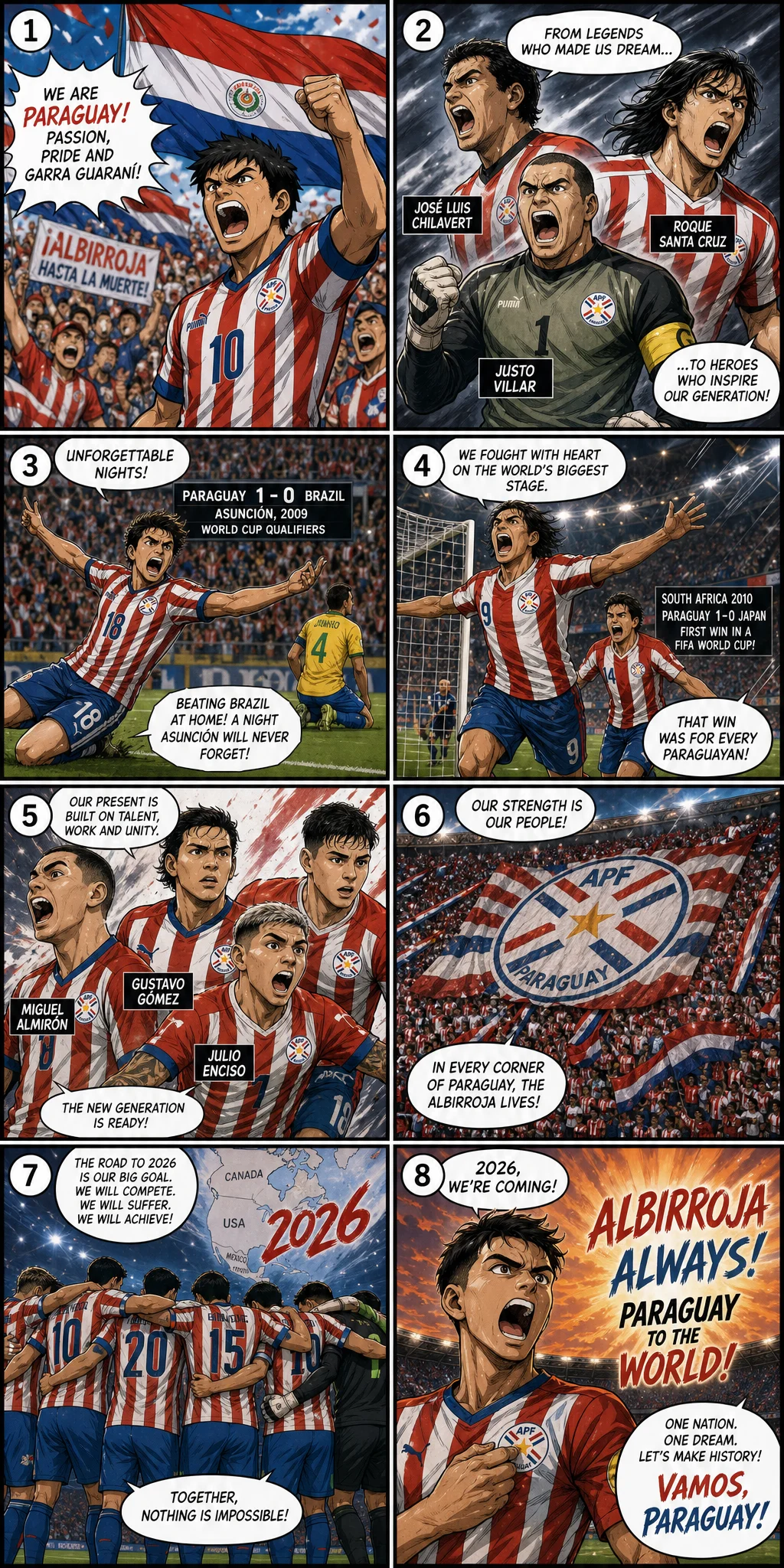
8-panel comic about Paraguay national football team and their journey to the 2026 FIFA World Cup.
Published: June 5, 2026
Paraguay National Football Team: The Guarani Spirit in the Beautiful Game
The Paraguay national football team, known as "Los Guaraníes" — a reference to the indigenous Guarani people whose language and culture remain central to Paraguayan identity — and "La Albirroja" — The White-and-Red — punches far above its demographic weight in South American football. A nation of just over seven million people, landlocked and historically impoverished, Paraguay has established itself as one of CONMEBOL's most respected and difficult opponents. Their qualification for the 2026 FIFA World Cup continues a tradition of resilience, tactical discipline, and a distinctive footballing identity forged in the heat of South America's most demanding qualifying competition.
HISTORICAL FOUNDATIONS
Football arrived in Paraguay in the late nineteenth century, introduced by a Dutch physical education teacher named William Paats who had fallen in love with the game in Europe. Paats founded the first football club, Club Olimpia, in 1902, and organized the first matches in Asunción, planting seeds that would grow into one of South America's most distinctive football cultures. The Paraguayan Football Association was founded in 1906, and the country joined CONMEBOL as a founding member.
Paraguay's early international football was defined by South American regional competition. The Copa América — in which Paraguay has finished as runner-up six times and champion twice, in 1953 and 1979 — provided an arena where the small nation could measure itself against the continent's giants. Paraguay's 1953 Copa América triumph, featuring the legendary goalkeeper Marcelino Vargas, announced the country's arrival as a competitive football force.
World Cup qualification proved elusive until the modern era. Paraguay made its World Cup debut in 1930 as an invited participant, competing in the inaugural tournament in Uruguay, but regular qualification only began in 1986. Since then, Paraguay has been a near-constant presence at football's highest level, qualifying for the 1998, 2002, 2006, and 2010 tournaments — a record of consistency that few nations of its size can match.
The 2010 World Cup in South Africa represented Paraguay's greatest achievement. Under Argentine coach Gerardo Martino, La Albirroja won its group ahead of Italy, Slovakia, and New Zealand, then defeated Japan on penalties in the Round of 16 — a match of unbearable tension that ended with Paraguay reaching the quarter-finals for the first time in its history. The quarter-final against eventual champions Spain was a 1-0 defeat, but Paraguay had announced itself to the global football audience as a nation of extraordinary defensive organization and competitive spirit.
LEGENDS OF THE GUARANI
José Luis Chilavert stands as Paraguay's most iconic footballer — and one of the most unique figures in the sport's history. A goalkeeper who scored 62 career goals through penalties and free-kicks, Chilavert was a personality of volcanic intensity, a leader who commanded his penalty area and his team with equal ferocity. His three World Cup appearances (1998, 2002) and his status as captain of the national team made him the face of Paraguayan football during its most successful era. Chilavert's belief that goalkeepers should be attacking weapons, not merely defenders, challenged football's positional conventions and inspired a generation.
Roque Santa Cruz, the elegant striker whose career at Bayern Munich, Blackburn Rovers, and across Europe spanned nearly two decades, is Paraguay's all-time leading goalscorer with 32 international goals. Tall, technically gifted, and intelligent in his movement, Santa Cruz represented the more glamorous, European-facing dimension of Paraguayan football, even as injuries limited the full expression of his talent.
Carlos Gamarra, the central defender who anchored Paraguay's defense for over a decade, was the embodiment of the nation's defensive tradition — disciplined, physical, tactically intelligent, and virtually impossible to beat in the air despite not being the tallest center-back. His 110 caps made him one of the most experienced international defenders in South American history.
Salvador Cabañas, the prolific striker whose career was tragically cut short when he was shot in the head in a Mexico City bar in 2010, was on the verge of becoming Paraguay's greatest ever forward. His 2007 South American Footballer of the Year award, won while playing for América in Mexico, had established him as the continent's premier striker before violence intervened.
THE MODERN ERA
Paraguay enters the 2026 World Cup with a team that honors the nation's traditional strengths — defensive organization, physical competitiveness, and set-piece threat — while incorporating more progressive attacking elements. The domestic Primera División, anchored by the historic rivalry between Club Olimpia and Cerro Porteño, continues to produce talented players who then migrate to Argentina, Brazil, Mexico, and Europe.
The current squad features a blend of domestically developed players and European-based professionals who bring technical refinement and tactical sophistication. The defensive unit remains the team's foundation — Paraguay expects to be difficult to break down, regardless of the opponent. Central defenders cultured in the Guarani tradition of intelligent positioning and physical commitment provide the platform upon which the team's tournament hopes rest.
The midfield combines defensive steel with increasingly creative passing, while the forward line features options who can threaten in transition and from set pieces — the latter remaining a signature Paraguayan weapon. The goalkeeper position, Chilavert's legacy domain, continues to produce reliable performers.
FOOTBALL AND PARAGUAYAN CULTURE
Football in Paraguay is a national obsession that rivals religion in its capacity to unite and divide. The superclásico between Olimpia and Cerro Porteño, both based in Asunción, divides families, friendships, and workplaces with an intensity that foreign observers often underestimate. Olimpia's three Copa Libertadores titles — most recently in 2002 — are among the proudest achievements in Paraguayan sporting history.
The Guarani language, spoken alongside Spanish by the majority of Paraguayans, gives Paraguayan football a unique cultural texture. The football vocabulary of the terraces — the insults, the encouragements, the tactical debates — is often conducted in Guarani, connecting the modern sport to the nation's pre-Columbian heritage. This bilingual football culture is unique in world football and reflects Paraguay's distinctive national identity.
Football serves as a vehicle for social mobility in a country with high poverty rates and limited economic opportunities. Young talents from rural communities and the working-class neighborhoods of Asunción's outskirts see football as a pathway to economic security — for themselves, their families, and often their extended communities. The remittances sent home by Paraguayan footballers playing abroad form a small but meaningful part of the national economy.
THE PATH FORWARD
Paraguay's goal at the 2026 World Cup is to recapture the spirit of 2010 — to be the team that no one wants to play, the opponent that makes favorites uncomfortable, the underdog that threatens to bite. A Round of 16 appearance would represent success; a quarter-final run would match the nation's greatest achievement and be celebrated as a triumph.
The tactical identity is well-established and unlikely to change: absorb pressure, defend as a collective, and strike with efficiency when opportunities arise. Paraguay will not dominate possession or overwhelm opponents with attacking talent. The nation's footballing philosophy — rooted in the Guarani concept of "garra," a fierce, indomitable fighting spirit — values resilience over elegance, effectiveness over aesthetics.
For Paraguay, the 2026 World Cup is an opportunity to remind the football world that South America's smallest nation remains one of its most competitive. The Guarani spirit — forged in a landlocked nation that has survived wars, political turmoil, and economic hardship — finds its expression on the football pitch. La Albirroja does not surrender. That is the Paraguayan way.