His Body Is a Machine That Got Hacked
How post-match recovery tech borrowed from NASA and Navy SEALs combines with the one thing machines cannot fix.
Published: June 6, 2026
# His Body Is a Machine That Got Hacked
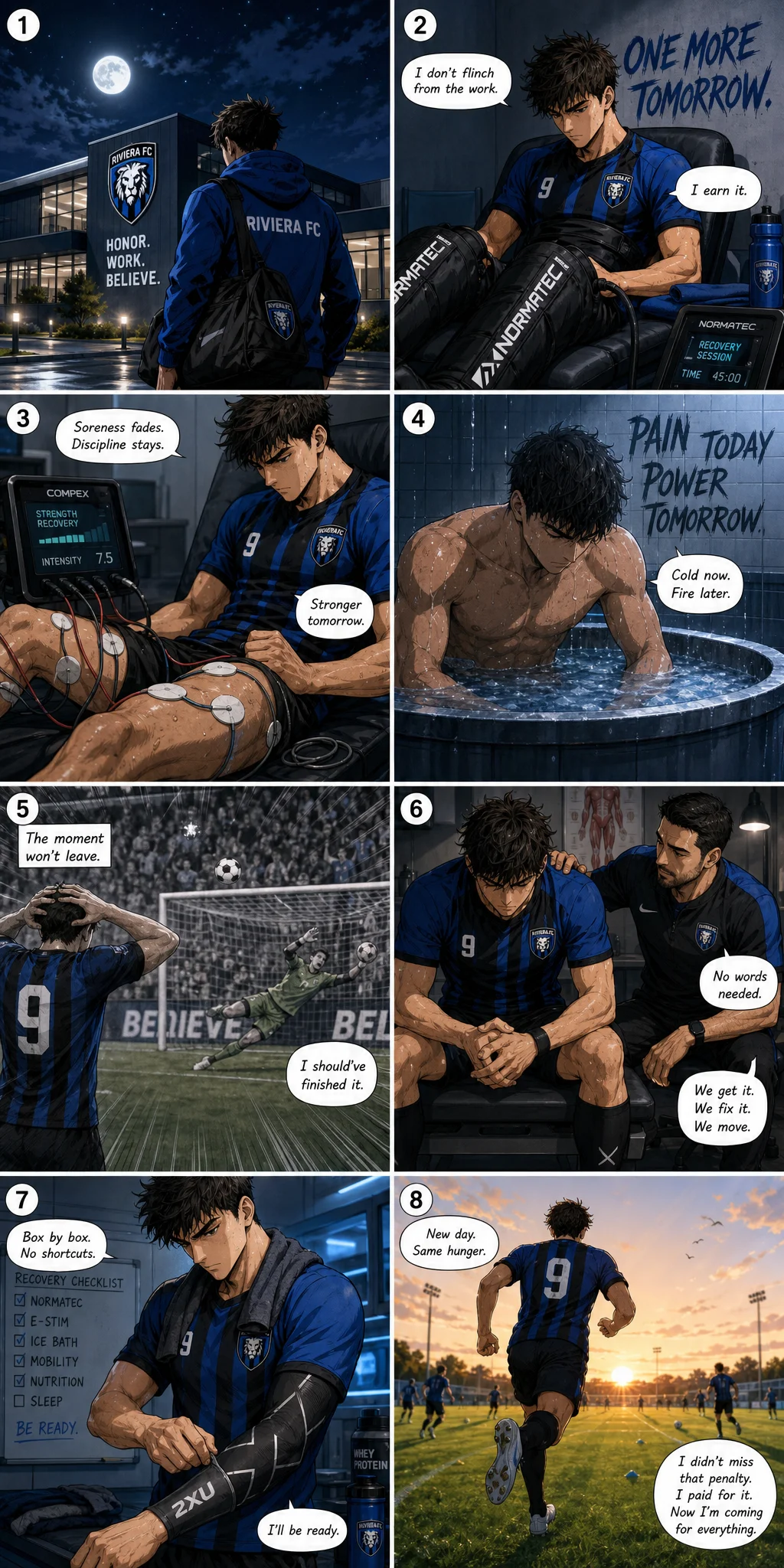
June 28, 2026. 1am. Visitors' dressing room, Lincoln Financial Field, Philadelphia. The match ended two and a half hours ago. Most players are long gone to the hotel. One man remains — a forward, name withheld — lying on a fold-down recovery chair. Both legs encased in black compression sleeves from the knee down. Six wireless electrodes on his chest. A nearly invisible earbud in his left ear. A pulse oximeter clipped to his right index finger.
He doesn't look like a man who just played 90 minutes of a World Cup knockout match. He looks like a patient undergoing a sleep study. But ask his team's director of sports science, and he'll tell you: these two hours after the final whistle matter more than the match itself for whether a player can start the next one.
"The 24 hours post-match — that's the window when your body shifts from 'destroyed' to 'rebuilding.' How you use that window determines whether you're 85 percent or 95 percent three days later. That 10 percent, in a World Cup knockout, is the difference between scoring and chasing."
The compression sleeves pump in three cycles per minute — from ankle to knee, driving venous blood back toward the heart. Pneumatic compression. Ten years ago, only hospitals had this. Now every World Cup team's equipment truck carries a dozen units. The six electrodes do two things at once: monitor heart rate variability (HRV), the most reliable real-time fatigue indicator in sports science, and deliver NMES — neuromuscular electrical stimulation — low-frequency current making his quads and hamstrings contract microscopically, squeezing metabolic waste out of muscle fibres into the lymphatic system. The earbud plays pink noise mixed with Delta-wave frequencies, pulling his brainwaves from post-match hyper-alert down into parasympathetic repair mode. It sounds like wind on a beach. He doesn't care. He's half asleep. The pulse oximeter feeds a single number to the physio's iPad: SpO2. If it drops below 94 percent over the next thirty minutes — flagged in some research as a precursor to hidden overtraining — tomorrow's recovery plan gets adjusted.
"How does it feel?" the physio asks. "Like my legs have been taken over by a very gentle robot." "Good. That means it's working."
If this sounds like astronaut gear, that's because it is. Pneumatic compression was invented by NASA in the 1970s to prevent blood pooling in astronauts' legs during microgravity. NMES was developed by the Soviet space program in the 1960s to maintain muscle mass on long-duration missions. Delta-wave audio induction was researched by US Navy SEALs in the 2000s to help special forces sleep between combat operations. None of this was invented for football. Football just borrowed all of it, crammed it into an equipment truck, and fired it up at 1am on a striker lying flat on his back.
"Were these things even around ten years ago?" I asked the sports science director. "They were around. They just weren't in the same room. Pneumatic compression was in a hospital. NMES was in a physio lab. Delta-wave induction was in a military research facility. Putting them all together, running them simultaneously, and convincing a man who just played 90 minutes to let machines and electrodes work on him for another two hours — that's the real advance of the last decade. Not the technology. The application."
Every team at the 2026 World Cup now travels with a post-match recovery station — compression, electrostim, cryo chambers, infrared saunas, nutrition dosed to the gram. But there's one thing none of this equipment can do. You can't use a machine to make a striker forget the penalty he missed in the 89th minute. The hardest part of recovery isn't the muscles. It's the brain. "Can you measure that? Mental fatigue?" I asked. Long silence. "We can measure his HRV. We can measure his cortisol, if the budget's high enough — most aren't — we can even do EEG. But those numbers just tell us he's stressed. We already know he's stressed. What we need to know is — how to help him." Another silence. "The answer is: you walk over. You sit on that bed. You don't say anything. You just sit." "That's not sports science." "No," he said. "That's football."
The machine that got hacked — the striker in compression sleeves, electrodes, beach-wind audio, sensor on his finger — opened his eyes at 2am. The physio walked over. Glanced at the iPad. "Your legs will be fine by morning," he said. "What about my head?" The physio put the iPad down. "You missed a penalty. You're hurting. You should be hurting. It means you care." He stood up. Put a hand on the striker's shoulder. "And you'll score the next one."