Türkiye: Journey to 2026
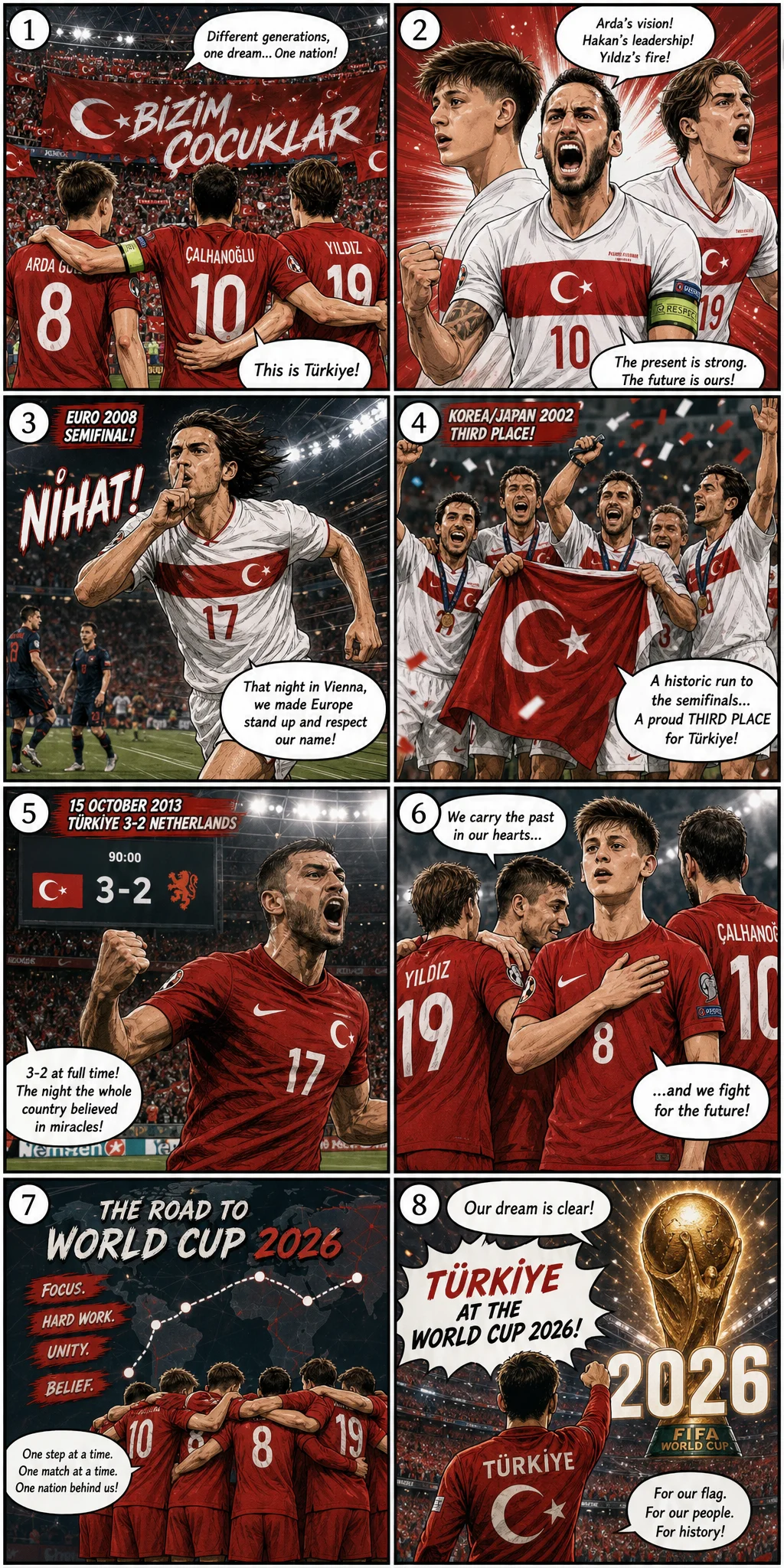
8-panel comic about Türkiye national football team and their journey to the 2026 FIFA World Cup.
Published: June 5, 2026
Türkiye National Football Team: The Crescent-Stars' Passionate Quest
The Türkiye national football team, known as "Ay-Yıldızlılar" — The Crescent-Stars — represents one of international football's most passionate and unpredictable forces. A nation that bridges Europe and Asia, Türkiye brings to the football pitch the intensity of its fabled home support, the technical quality of its domestic league, and the ambition to reclaim the glory of its golden generation. Türkiye's qualification for the 2026 FIFA World Cup marks a return to the global stage and an opportunity for a new generation to write its own chapter in the nation's football history.
HISTORICAL FOUNDATIONS
Football arrived in the Ottoman Empire in the late nineteenth century, introduced by English merchants, sailors, and residents in the cosmopolitan quarters of Istanbul (then Constantinople) and Izmir (Smyrna). The first Turkish football clubs were founded by non-Muslim minorities — Greeks, Armenians, and Levantines — before Turkish Muslims established their own teams in the early 1900s. The legendary Galatasaray, founded in 1905 by students of Galatasaray High School, and Fenerbahçe, founded in 1907, emerged during this period and would become the twin pillars of Turkish football.
The Turkish Football Federation was founded in 1923, the same year as the Republic of Türkiye itself, linking the sport to the new nation's modernizing project. Türkiye made its World Cup debut at Switzerland 1954, qualifying through a controversial playoff against Spain and then competing creditably in a tournament that included a 7-0 victory over South Korea before a 7-2 defeat to West Germany that eliminated the team.
The 1954 appearance would remain Türkiye's only World Cup experience for nearly half a century. The decades between saw Turkish clubs achieve European success — Galatasaray's 2000 UEFA Cup and UEFA Super Cup triumphs remain the high point of Turkish club football — but the national team consistently fell short of World Cup qualification. The domestic league, passionate and well-supported, did not produce the depth of talent needed to navigate European qualifying campaigns.
THE 2002 GOLDEN GENERATION
The 2002 World Cup in South Korea and Japan stands as the defining moment of Turkish football history. Under coach Şenol Güneş, a team featuring legendary figures like Hakan Şükür, Rüştü Reçber, and a young, emerging talent reached the semi-finals, defeating co-hosts South Korea 3-2 in the third-place match to claim the bronze medal. It remains the greatest achievement in Turkish football history.
The campaign featured defining individual performances. Hakan Şükür, Türkiye's all-time leading goalscorer, netted the fastest goal in World Cup history — 10.8 seconds into the third-place match against South Korea. Rüştü Reçber, the goalkeeper with the distinctive warpaint under his eyes, produced heroic saves throughout the tournament. İlhan Mansız's golden goal against Senegal in the quarter-final — a moment of improvisational brilliance completed with his weaker left foot — sent Türkiye to the semi-finals. Hasan Şaş, the dynamic winger who scored against Brazil and terrorized defenses throughout the tournament, was named to the All-Star team.
The semi-final against Brazil in Saitama was a 1-0 defeat, but the tournament had transformed perceptions of Turkish football. A nation of 70 million people, famous for the intimidating atmosphere of its stadiums, had demonstrated that it could compete with and defeat the world's best. The images of millions celebrating in the streets of Istanbul, Ankara, and across the country introduced the world to the depth of Turkish football passion.
LEGENDS OF THE CRESCENT-STARS
Hakan Şükür, "The Bull of the Bosphorus," scored 51 goals in 112 international appearances, making him Türkiye's most prolific international goalscorer. His club career — primarily at Galatasaray, with spells at Torino, Inter Milan, Parma, and Blackburn Rovers — was decorated with domestic titles and the 2000 UEFA Cup. Şükür's aerial dominance, clinical finishing, and longevity made him the reference point for Turkish striking excellence.
Rüştü Reçber earned 120 caps as Türkiye's goalkeeper, his international career spanning from 1994 to 2012. His commanding presence, reflex saves, and leadership made him the goalkeeper against whom all subsequent Turkish keepers are measured. A brief spell at Barcelona in 2003-04, while not successful, signified the respect his 2002 World Cup performances had earned.
Emre Belözoğlu, the diminutive midfielder whose career took him from Galatasaray to Inter Milan, Newcastle United, Fenerbahçe, and Atlético Madrid, represented Turkish football's technical tradition — intelligent passing, close control, and a competitive edge that sometimes boiled over. Tugay Kerimoğlu, the elegant midfielder who became a cult hero at Blackburn Rovers, combined technical sophistication with a ferocious shooting ability. Arda Turan, the creative force of Turkish football in the 2010s, won La Liga and reached the Champions League final with Atlético Madrid before a disappointing spell at Barcelona. His patriotism and passion for the national team never wavered.
THE MODERN ERA
Türkiye enters the 2026 World Cup after a period of reconstruction and renewal. The national team experienced disappointment in the 2010s, missing the 2010, 2014, 2018, and 2022 World Cups — a drought that felt interminable for a nation accustomed to the memory of 2002. The domestic Süper Lig, while financially powerful and attracting international stars in the latter stages of their careers, has at times prioritized imported talent over domestic player development.
The current squad features a compelling blend of European-based stars and emerging domestic talent. Hakan Çalhanoğlu, the Inter Milan midfielder and national team captain, has developed into one of the world's most complete midfielders — a deep-lying playmaker with exceptional passing range, set-piece mastery, and the tactical intelligence honed in Serie A. His evolution from an attacking midfielder to a deep-lying orchestrator mirrors the team's tactical maturation.
Emerging talents playing across Europe's top leagues provide a depth of quality that recent Turkish teams have lacked. Young forwards with pace and technical ability, creative midfielders being developed in Germany, England, and Italy, and a defensive unit increasingly exposed to elite-level competition form the core of a team with genuine potential. The Türkiye Under-21 and youth national teams have produced encouraging results in European competitions, suggesting that the talent pipeline is flowing more productively than in previous cycles.
FOOTBALL AND TURKISH CULTURE
Football in Türkiye is a cultural phenomenon that extends far beyond sport. The intensity of supporter culture — the flares, the choreographed tifos, the deafening noise of packed stadiums — is legendary. The phrase "Welcome to Hell," displayed on banners at Galatasaray's Ali Sami Yen Stadium for visiting European opponents, captured the intimidating, intoxicating, occasionally frightening atmosphere that Turkish supporters create. Matches between Galatasaray, Fenerbahçe, and Beşiktaş, the "Big Three" of Istanbul, divide the nation's largest city along lines of class, neighborhood, and identity.
The relationship between football and politics in Türkiye is complex and often contentious. Club presidents, federation officials, and political figures move between football and politics in ways that reflect the sport's centrality to Turkish public life. The national team, when successful, provides a rare unifying force — a team that supporters of all clubs can embrace without reservation.
The Turkish diaspora in Germany, the Netherlands, Belgium, and across Europe has been a critical source of football talent. Players raised in European youth systems, eligible for both their country of birth and Türkiye, have often chosen the Crescent-Stars — a decision with cultural, familial, and career implications that reflect the broader experience of Turkish communities in Europe.
THE PATH FORWARD
Türkiye's goal at the 2026 World Cup is straightforward: emerge from the group stage and advance as far as passion, quality, and the football gods will allow. The team possesses the midfield quality, through Çalhanoğlu and his supporting cast, to control matches against many opponents. The attacking options provide the goal threat that Turkish teams have historically generated. The question is whether the defensive organization and mental discipline — attributes that have occasionally deserted Turkish teams in critical moments — will hold under tournament pressure.
The tactical approach under the current coaching staff emphasizes possession through midfield, wide attacking variation, and a defensive structure that reduces the vulnerability to counter-attacks that has plagued Turkish teams. The set-piece threat, with Çalhanoğlu's delivery and the aerial presence of central defenders and forwards, provides a reliable route to goals.
For Türkiye, the 2026 World Cup is an opportunity to announce the arrival of a new generation and to honor the legacy of 2002. The Crescent-Stars carry the passion of 85 million Turks and the hopes of a football nation that believes, with justification, that it belongs among the world's elite. In the stadiums of North America, the red-and-white crescent flag will fly, the chants will thunder, and Türkiye will fight — as it always does — with heart on sleeve and fire in belly.