Two Teams Walk Into a Match. Neither Wants to Win.
The evolution of the World Cup's darkest art — how modern collusion isn't a handshake, it's a calculated strategy of risk-aversion.
Published: June 6, 2026
# Two Teams Walk Into a Match. Neither Wants to Win.
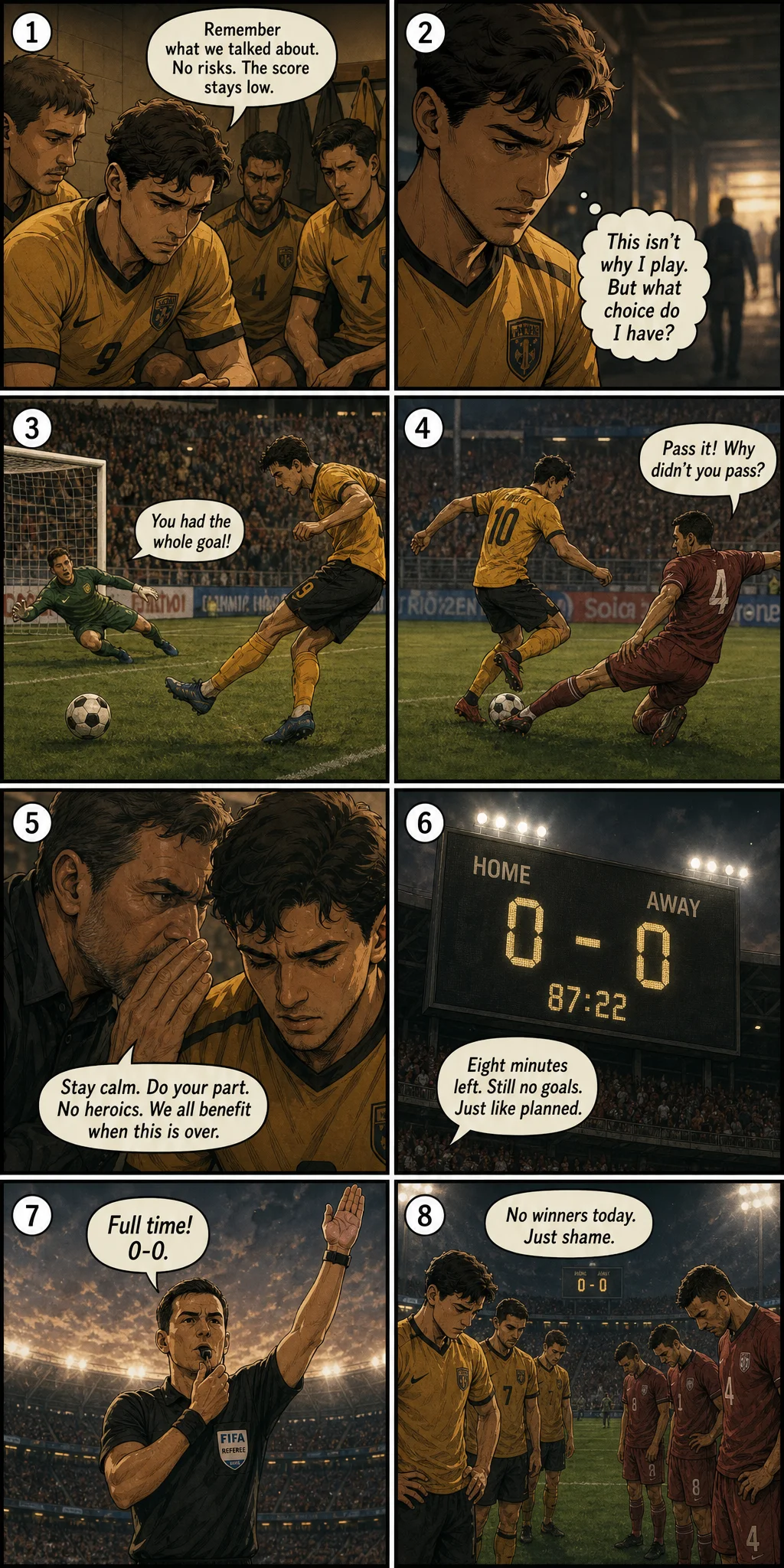
Final group match. 8pm. Two teams — between them, a draw and the right result in the other match means both advance. A win for either side helps one, possibly eliminates the other. What do they play for?
The old collusion was simple: both need a draw, so nobody tries too hard. Defenders pass sideways. Forwards don't press. The crowd whistles. Everyone knows. Nobody can prove it. The 2026 version isn't a handshake. It's calculus. "The coach never said don't win," a player told me. "He said keep possession, don't take risks, maintain compact shape. If a counter-attack opens up — you can go, but go while keeping shape. He didn't say don't win. He just made winning impossible inside that framework." Modern collusion isn't designed. It's calculated. Two teams independently arriving at the same risk-averse strategy, producing a draw that suits both. Nobody broke a rule. Nobody can be punished.
An old fan next to me watched his team pass sideways for eighty-five scoreless minutes. In the 85th minute, he stood up. I expected fury. He just raised his hands and gave one slow clap. Then sat down. "I don't know if I want us to win," he said. "If we win, we finish first and play that group's second — a much harder opponent. If we draw, we finish second and our knockout path is easier. When did you start hoping your team wouldn't win?" He wasn't asking me. He was asking football.