Germany: Journey to 2026
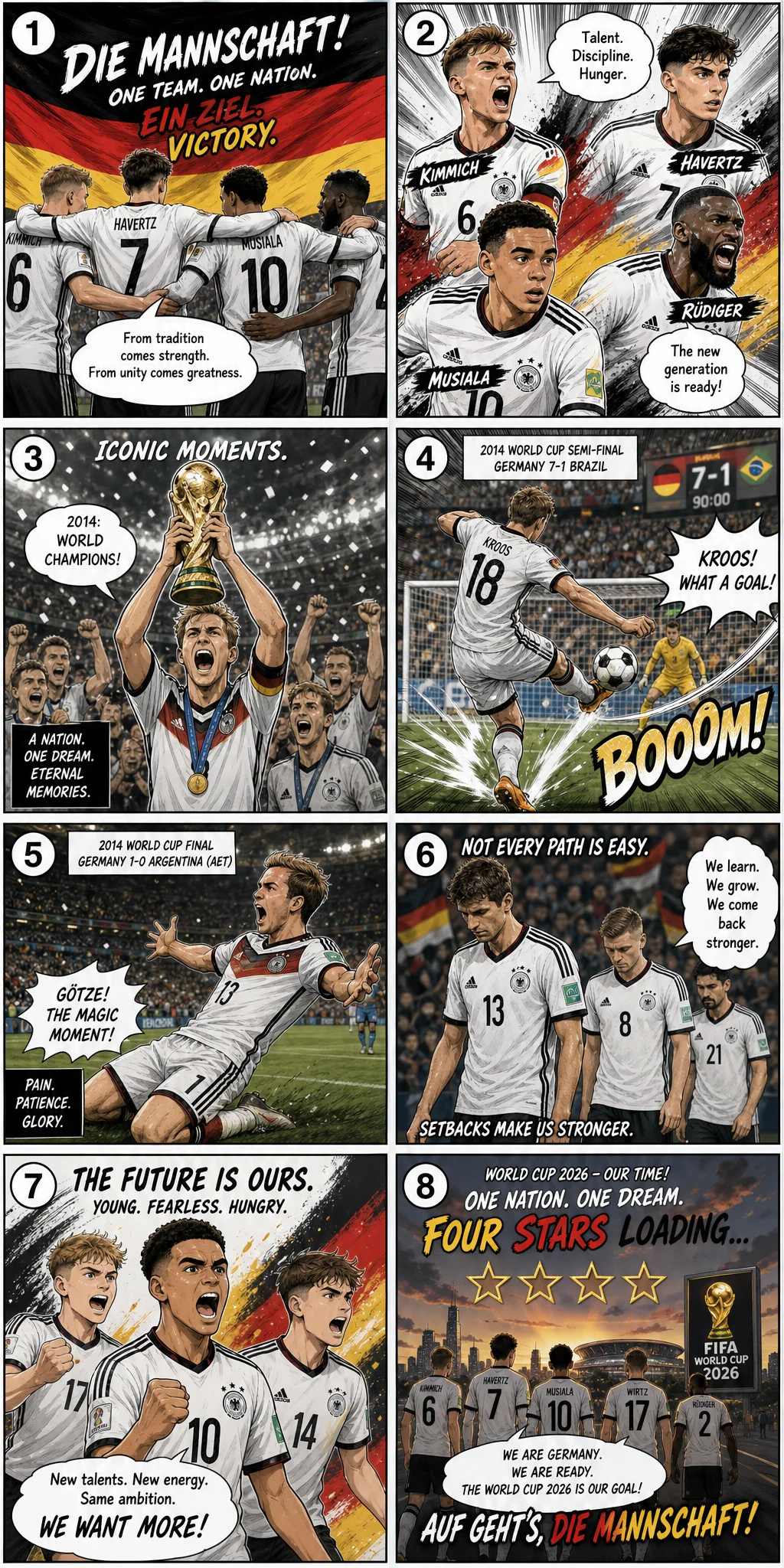
8-panel comic about Germany national football team and their journey to the 2026 FIFA World Cup.
Published: June 5, 2026
Germany National Football Team: The Mannschaft's Relentless Machine
The Germany national football team, known as "Die Mannschaft" — The Team — and "Nationalelf" — National Eleven — represents one of football's most formidable institutions. Four World Cup titles, three European Championships, and a relentless competitive mentality have made Germany synonymous with tournament success. The country that produced Franz Beckenbauer, Gerd Müller, and Lothar Matthäus enters the 2026 FIFA World Cup seeking to reassert its dominance after a period of unusual turbulence, driven by a new generation determined to restore German football to its accustomed place at the summit.
HISTORICAL FOUNDATIONS
The German Football Association (DFB) was founded in 1900 in Leipzig, and the national team quickly established itself as a European power. Germany's early international football was shaped by the political turbulence of the twentieth century — excluded from international competition after World War I, then manipulated by the Nazi regime in the 1930s. The post-war division of Germany into East and West created two separate football traditions, with West Germany's 1954 World Cup victory — the "Miracle of Bern" — serving as the symbolic rebirth of a nation shattered by war.
The 1954 final against Hungary, the "Mighty Magyars" who had not lost a match in four years and had thrashed West Germany 8-3 in the group stage, remains one of football's most analyzed matches. West Germany's 3-2 victory, played in driving rain with Adidas's revolutionary screw-in studs providing crucial traction, transformed German national psychology. Helmut Rahn's winning goal — "Aus dem Hintergrund müsste Rahn schießen — Rahn schießt — Tor!" went the radio commentary — is the most famous moment in German football history, marking the nation's return to the community of nations.
West Germany won the European Championship in 1972 and the World Cup in 1974, the latter on home soil with a team featuring Beckenbauer, Müller, Paul Breitner, and Sepp Maier. The 1974 final victory over the Netherlands — Johan Cruyff's "Total Football" losing to German efficiency — established the competitive dynamic between the two neighbors that would define European football for decades. The "Miracle of Bern" generation had given way to the "Bayern Munich" generation, and German football's institutional excellence — the combination of athletic power, tactical intelligence, and psychological resilience — became the global benchmark.
Italy 1990 delivered West Germany's third World Cup, with Lothar Matthäus as the driving force of a team that blended defensive solidity with attacking quality. The final against Argentina, a 1-0 victory on a Brehme penalty, was the last World Cup match of the divided Germany. By the time of the next tournament, reunification had created a single German football nation, merging the talents of East and West.
Brazil 2014 produced the crowning achievement of modern German football: a 7-1 semi-final demolition of the host nation in Belo Horizonte, a result so shocking that it seemed to occur in an alternate reality. Toni Kroos and Sami Khedira's two goals in 69 seconds — the most devastating sequence of German efficiency ever witnessed — transformed the Mineirão Stadium into a theater of disbelief. The final against Argentina in the Maracanã, settled by Mario Götze's chest-and-volley in extra time, delivered Germany's fourth star. Joachim Löw's decade-long project — a systematic rebuild of German football after the disappointing early 2000s — had reached its zenith.
LEGENDS OF THE MANNSCHAFT
Franz Beckenbauer, "Der Kaiser" — The Emperor — redefined what a defender could be. His invention of the libero role — a sweeper who initiated attacks from deep, who carried the ball forward with regal authority — changed football tactics permanently. Captain of the 1974 World Cup-winning team, coach of the 1990 World Cup-winning team, and the architect of Germany's 2006 World Cup hosting bid, Beckenbauer's influence on German football is unmatched.
Gerd Müller, "Der Bomber" — The Bomber — was the most lethal goalscorer in football history before records became statistical obsessions. His 68 goals in 62 international matches, his 365 Bundesliga goals for Bayern Munich, his ability to score from any angle in any situation — Müller was pure, instinctive finishing genius. His winning goal in the 1974 World Cup final was characteristically Müller: a half-turn in heavy traffic, a shot struck from an impossible angle, and the ball in the net.
Lothar Matthäus captained Germany to the 1990 World Cup and earned 150 caps, the most in German history. His 1990 Ballon d'Or recognized a footballer who could dominate from midfield or defense, whose shooting from distance was a constant threat, and whose competitive intensity set the standard for his teammates. Miroslav Klose's 16 World Cup goals — the most in tournament history — speak to a career of extraordinary longevity, consistency, and the knack for scoring when it matters most.
THE MODERN TRANSITION
Germany enters the 2026 World Cup in a period of renewal. The early exits from the 2018 and 2022 World Cups — both group-stage eliminations, an unprecedented failure for German football — prompted deep institutional soul-searching. The DFB's academy system, once the envy of the world, had fallen behind. The national team's playing style, once defined by relentless pressing and rapid transitions, had become ponderous.
The response has been comprehensive. The appointment of a new coaching generation, the systematic integration of younger players, and a tactical modernization have begun to yield results. The current squad features established stars at their peak and emerging talents who represent the future.
Jamal Musiala and Florian Wirtz, born within months of each other in 2003, represent the creative core of the new Germany. Musiala's close control, dribbling in tight spaces, and ability to unlock defenses with individual brilliance have made him one of football's most exciting young talents at Bayern Munich. Wirtz, the Bayer Leverkusen playmaker whose return from an ACL injury coincided with his club's unbeaten Bundesliga season, combines vision, passing precision, and goalscoring from midfield. Their partnership — two players who can operate between the lines, who see passes others cannot, who make their teammates better — is the foundation upon which German hopes rest.
Joshua Kimmich has evolved from Philipp Lahm's heir at right-back into a midfield leader whose versatility, passing range, and competitive intensity define the team's engine room. İlkay Gündoğan's experience, intelligence, and Champions League-winning pedigree at Manchester City provide the composure that tournament football demands. The defensive unit, anchored by Antonio Rüdiger's athleticism and leadership, has been rebuilt with a blend of experience and youth. Marc-André ter Stegen continues the German goalkeeping tradition — the lineage from Sepp Maier through Oliver Kahn and Manuel Neuer to the present day.
FOOTBALL AND GERMAN CULTURE
Football's place in German society reflects the nation's broader character: organized, community-centered, and deeply embedded in local identity. The 50+1 rule, which ensures that club members retain majority control of Bundesliga clubs, represents a unique commitment to democratic governance in an era of billionaire ownership and sovereign wealth funds. Match-day attendance in the Bundesliga is among the highest in world football, with affordable tickets and standing terraces maintaining the connection between clubs and communities.
The national team serves as a reflection of Germany's evolving self-conception. The 2014 World Cup victory — won by a team featuring players of Turkish, Tunisian, Ghanaian, and Polish heritage — was celebrated as a symbol of a multicultural Germany that had moved beyond the ethnic nationalism of its past. The team's subsequent struggles, and the public debates they generated about identity, immigration, and national pride, revealed that football remains a site where Germany negotiates its understanding of itself.
The infrastructure of German football — the 1,000+ DFB-accredited academies, the licensed coaches, the regional development centers — is the product of a deliberate national investment following the disappointing 1998 and 2000 tournaments. The current rebuilding project is a similar institutional response, an acknowledgment that footballing excellence requires constant renewal.
THE PATH FORWARD
Germany enters every tournament among the favorites, and 2026 is no exception. The early exits of 2018 and 2022 have been processed, analyzed, and addressed. The question is whether the new generation — Musiala, Wirtz, and their contemporaries — is ready to carry the weight of German football's expectations, to perform under the pressure that has broken more talented teams than history remembers.
The tactical approach has been modernized: more positional fluidity, more risk in possession, a return to the aggressive pressing that characterized German football at its best. The team will seek to dominate matches through technical quality and collective intensity — the traditional German strengths, updated for the contemporary game.
For Germany, the World Cup is never about participation. It is about winning the matches that matter, surviving the moments of crisis that every tournament presents, and being present when the trophy is lifted. The Mannschaft has been here before — more often and more successfully than almost any other nation. The relentless machine has been rebuilt. Now it must perform.