Curaçao: Journey to 2026
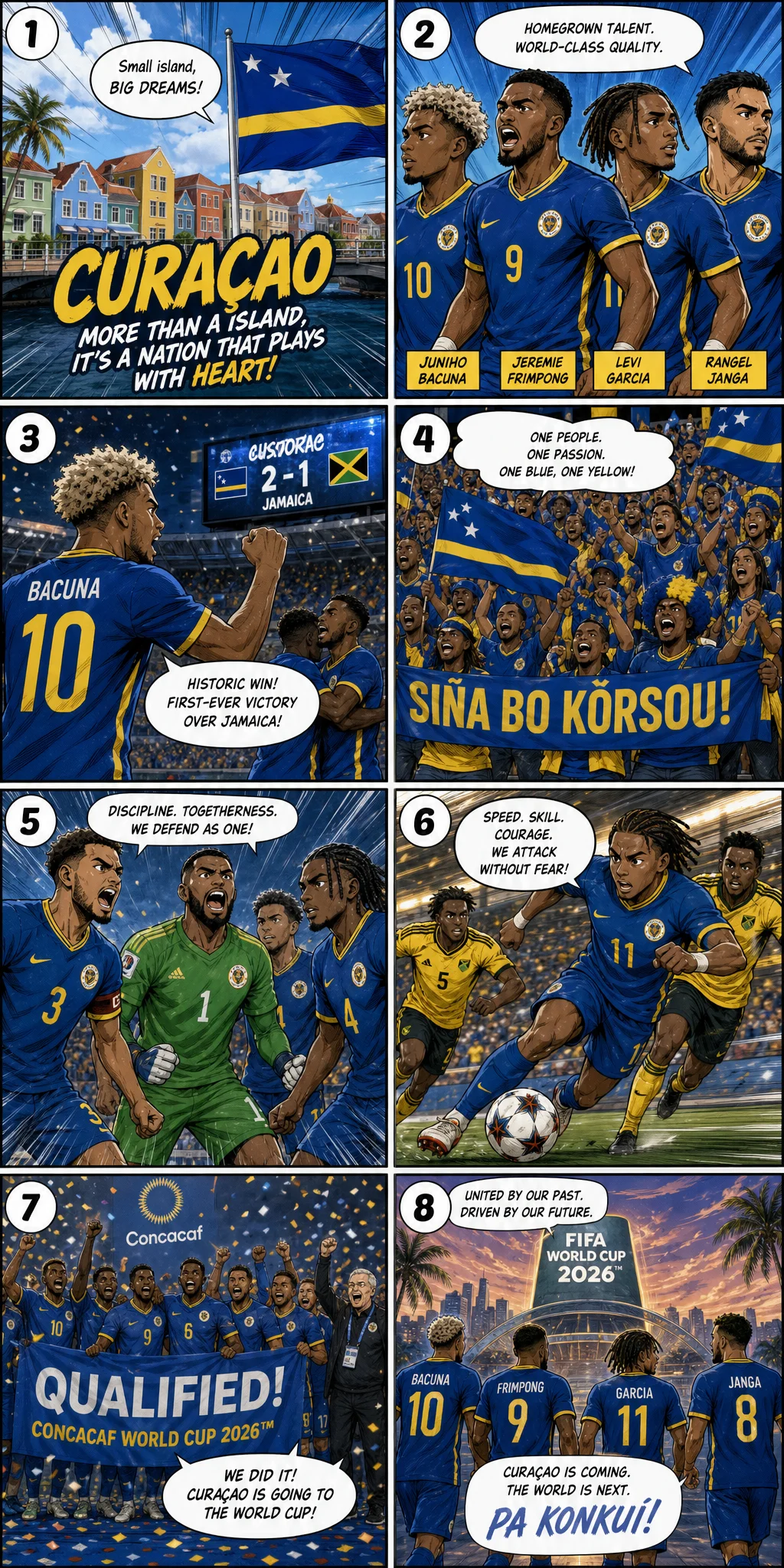
8-panel comic about Curaçao national football team and their journey to the 2026 FIFA World Cup.
Published: June 5, 2026
Curaçao National Football Team: The Caribbean Island Dreaming Big
The Curaçao national football team represents one of the most remarkable stories in international football — a small Caribbean island of approximately 150,000 people that has produced a football team capable of competing at the highest levels of CONCACAF and, now, reaching the FIFA World Cup. Curaçao's journey from the margins of global football to the 2026 tournament is a testament to strategic vision, the power of diaspora connections, and the beautiful game's capacity to exceed any reasonable expectation.
HISTORICAL FOUNDATIONS
Football arrived in Curaçao, as in much of the Caribbean, through European colonial influence. The island, a constituent country within the Kingdom of the Netherlands, developed its own football culture through the twentieth century, with local clubs forming the backbone of the sport's development. The Curaçao Football Federation was founded in 1921, making it one of the oldest football governing bodies in the Caribbean.
For most of its football history, Curaçao competed as part of the Netherlands Antilles, the Dutch Caribbean territory that also included Aruba, Bonaire, Sint Maarten, Sint Eustatius, and Saba. The Netherlands Antilles national team achieved notable results, including a third-place finish at the 1963 CONCACAF Championship and Olympic football appearances in 1952. The team's most famous moment came in CONCACAF competition, where they consistently performed above the level expected of a Caribbean minnow.
The dissolution of the Netherlands Antilles in 2010 changed the football landscape. Curaçao became a constituent country within the Kingdom of the Netherlands, and its football team inherited the Netherlands Antilles' FIFA membership and competitive record. This continuity provided a foundation upon which a new football identity could be built.
The transformation of Curaçaoan football began with a strategic decision to leverage the island's unique advantage: its status as part of the Kingdom of the Netherlands. Curaçaoans hold Dutch passports, and the Netherlands is home to a significant Curaçaoan diaspora community. Players of Curaçaoan descent who had been developed in the Dutch professional football system — including the famed Ajax academy and other Eredivisie clubs — could be recruited to represent the island, dramatically elevating the talent level available to the national team.
THE DIASPORA REVOLUTION
The strategy of recruiting diaspora players transformed Curaçao's competitive prospects. Under the management of Dutch coaches who understood both the European professional system and the Caribbean context, the team began attracting players who had been developed in the Netherlands but whose family roots traced back to Curaçao. These players, many of whom had represented the Netherlands at youth level but faced limited prospects of reaching the senior Dutch national team, found in Curaçao an opportunity to play international football at a meaningful competitive level.
The results were dramatic. Curaçao won the 2017 Caribbean Cup, defeating Jamaica in the final — a result that announced the island's arrival as a serious CONCACAF competitor. Qualification for the 2017 and 2019 CONCACAF Gold Cups followed, with the team reaching the quarter-finals in 2019. These performances established Curaçao as one of the Caribbean's strongest teams and a legitimate contender for World Cup qualification in the expanded tournament format.
The diaspora model has its critics — questions about national identity, about the authenticity of a team composed largely of European-born and European-developed players representing a Caribbean island — but the rules are clear and universal. FIFA eligibility regulations permit players to represent the nation of their parents' or grandparents' birth, and Curaçao has exercised this right no differently than dozens of other nations that draw on diaspora communities.
THE CURRENT TEAM
Curaçao's squad features professionals based primarily in the Netherlands, with additional representation from leagues across Europe and North America. The team's playing style reflects its Dutch influences — emphasis on possession, tactical flexibility, and technical proficiency — adapted to the physical and pace-driven demands of CONCACAF competition.
The goalkeeper position has been a strength, with players developed in the Eredivisie's demanding environment providing reliability at the back. The defensive unit, while not possessing the individual quality of elite CONCACAF nations, compensates through organization and collective discipline. Midfield is the team's strongest area, with technically proficient players who can control possession and dictate tempo against regional opponents. The forward line combines Dutch-trained technique with Caribbean flair — a fusion that produces unpredictable and occasionally devastating attacking sequences.
The team's depth — a traditional weakness for small nations — has been partially addressed by the diaspora pipeline. While Curaçao cannot match the squad depth of larger CONCACAF nations, the pool of Dutch-based eligible players provides more options than most Caribbean competitors can access.
FOOTBALL AND CURAÇAOAN CULTURE
Football occupies a central place in Curaçao's social and cultural life. The island's small size — just 444 square kilometers — means that the national team's successes and failures are felt intimately by the entire population. When Curaçao plays, the island stops. Bars, restaurants, and public squares fill with supporters wearing the blue and yellow of the national team. The celebrations following Caribbean Cup and Gold Cup victories have been among the largest public gatherings in the island's recent history.
The domestic league, the Curaçao Promé Divishon, features clubs with deep community roots — CRKSV Jong Holland, RKSV Centro Dominguito, and others that have existed for decades as centers of neighborhood identity. While the domestic league does not produce players at the level required for international competition, it provides the grassroots foundation of the sport's popularity.
The relationship between Curaçao and the Netherlands — colonial, cultural, and familial — is reflected in football. The players who return to represent the island, most of whom were born and raised in the Netherlands, experience a unique form of homecoming. They reconnect with grandparents, with extended family, with a culture that is theirs by heritage if not by daily experience. Their presence on the island for international matches brings families together and strengthens bonds across the Atlantic.
THE PATH FORWARD
Curaçao's qualification for the 2026 World Cup — benefiting from the expanded 48-team format and CONCACAF's increased allocation of spots — is a historic achievement for one of the smallest nations ever to reach the tournament. The team's presence at the World Cup is, in itself, a victory — proof that strategic thinking, diaspora engagement, and footballing ambition can overcome the limitations of size and resources.
Competitive expectations must be realistic. Curaçao will not advance from the group stage; it will face opponents with vastly greater resources, deeper talent pools, and generations of World Cup experience. Success will be measured by competing with dignity, by scoring a goal (a historic first for the island), by providing moments of joy for a population of 150,000 that has dreamed of seeing its flag fly at football's greatest tournament.
The tactical approach will emphasize the possession-based, tactically intelligent football that reflects the team's Dutch training. Defensive organization will be paramount — conceding early goals could produce the kind of scorelines that damage morale and national pride. Counter-attacks and set pieces will provide the limited scoring opportunities that must be maximized.
For Curaçao, the 2026 World Cup is about visibility and validation. The smallest nation in the tournament — smaller than many cities that have produced World Cup players — will stand alongside the giants of global football. The island's flag, its anthem, its people will be introduced to a global audience. That, more than any result, is the triumph. The Caribbean island dared to dream big — and the dream became reality.