Five Stars, Five Wounds
Brazil has won the World Cup 5 times - more than any nation. But behind each star on the famous yellow shirt lies a wound, a scar, and a story of a nation that can never stop chasing its own legend.
Published: June 6, 2026
# Five Stars, Five Wounds: Brazil's Eternal Hangover
Outside the Maracanã in Rio de Janeiro, there's a wall. Not an ordinary wall — it's engraved with the name of every Brazilian player worth remembering. I was standing in front of it when an old man in flip-flops walked up and pointed at one name with his coconut water.
"Pelé. 1958. A skinny seventeen-year-old who hadn't even started shaving. Two goals in the final. The Swedes had no idea who he was. After the match, the King of Sweden came down from the stands to shake his hand. Seventeen years old. Shaking hands with a king. What do you do when you've just done something bigger than your entire person?"
"I don't know," I said.
"He cried. Not the holding-it-in kind. The kind where you sit down on the grass, bury your face in your knees, and your whole body shakes. The first time the world saw Pelé — he was crying." He raised his coconut water in a toast. "That was Brazil's first star."
## Five stars. Five times you thought you knew the story.
1958, Sweden. A seventeen-year-old and the most underestimated Brazil side in history — yes, 1958 Brazil were not favourites, they were a bundle of neurotic geniuses who had never won anything — walked into the final and beat the hosts 5-2. After that match, Brazilians placed Pelé and Garrincha into a brand-new category. Not "star." Not "legend." Something closer to "national offering."
1962, Chile. Pelé tore his groin in the second group match. In that era, sports medicine meant "lie down and see if you can run again." He couldn't. But Garrincha could. Garrincha — how do you describe Garrincha? His right leg bent inward, his left leg bent outward. Walking normally caused him pain. But when he ran, defenders never knew where he'd go, because Garrincha himself didn't know. He scored twice each in the semifinal and the final. Brazil's second star. Afterwards, someone found him kissing a local fan behind the dressing room. He wasn't celebrating. He said he was just "happy." Garrincha's happiness was Brazil's狂欢.
1970, Mexico. This is the Brazil you watch in grainy YouTube compilations — Pelé, Jairzinho, Rivelino, Tostão, Carlos Alberto. Final: 4-1 against Italy. The last goal — Carlos Alberto charging from the edge of the box to smash the ball into the bottom corner — has been called "the ultimate team goal": nine Brazilian players, eight consecutive passes, from their own penalty area to the opponent's net. That Brazil side wasn't a team. It was a symphony. Third star. Brazil kept the Jules Rimet trophy permanently — not "you won it, you take it home," but "you've won it three times, it's yours now." The only nation on earth.
1994, USA. I was twelve. My dad woke me at 4am to watch the final — Brazil vs Italy, 120 minutes, 0-0. The most agonising and beautiful match I've ever seen. Roberto Baggio — Italy's hero — skied the final penalty. He stood there, head down. I've remembered that image for thirty years. Brazil's fourth star. Romário had said before the tournament: "I will score in the final." He didn't. But he lifted the trophy. Romário's confidence and Baggio's tragedy, on the same pitch, in the same match. That's football.
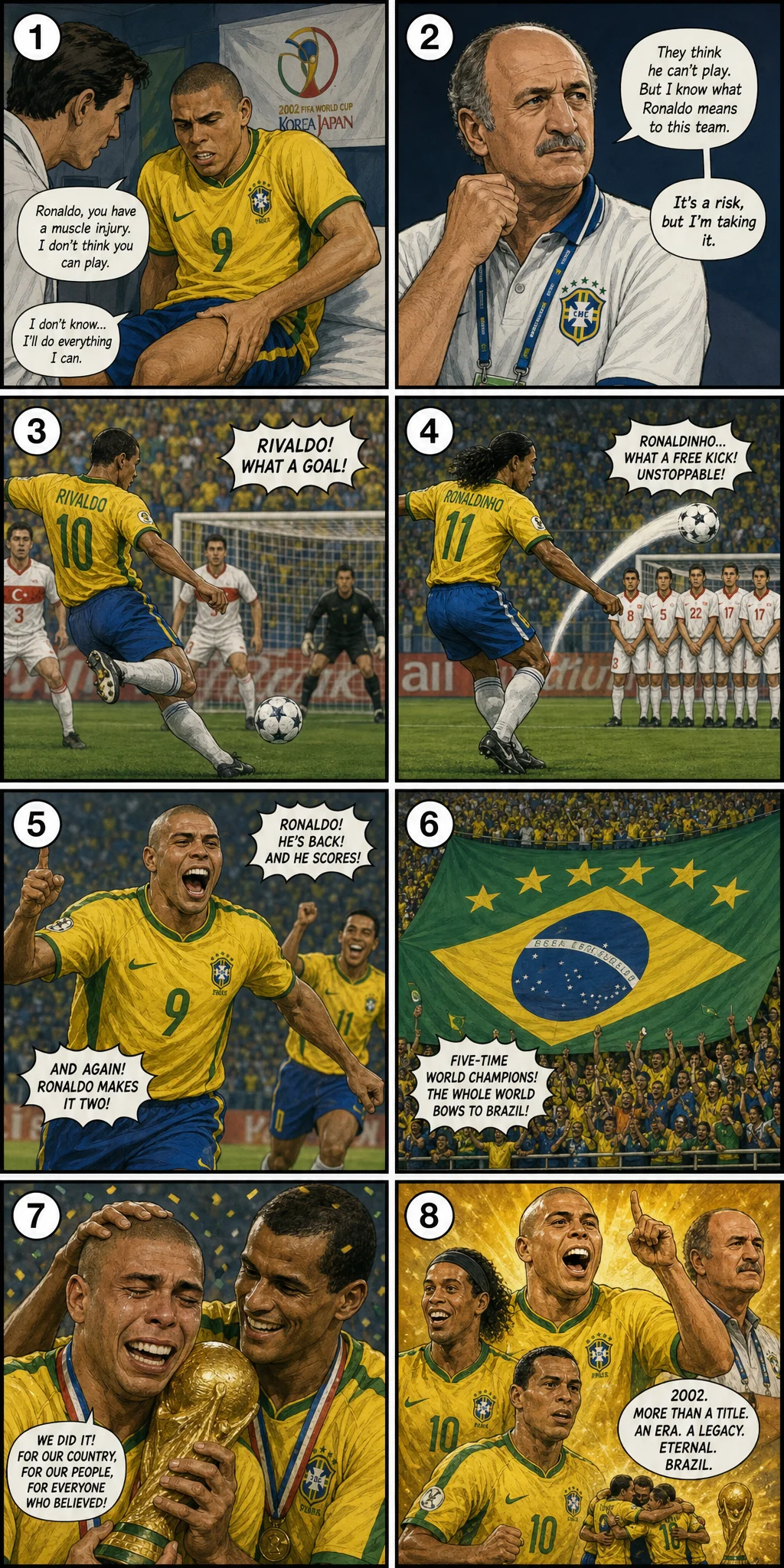
2002, Japan and Korea. Ronaldo — not Cristiano, the bald one with the gap in his front teeth — had suffered a mysterious seizure hours before the 1998 final, foaming at the mouth, scratched from the starting lineup. Brazil lost 0-3 to France. Medical science still debates whether it was epilepsy, a panic attack, or something unexplainable. Then he came back. 2002: seven matches, eight goals, including two in the final against Germany. Ronaldo never explained what happened four years earlier. He just picked up the trophy and kissed it. Fifth star.
## But here's the thing — Brazilians aren't proud. They're afraid.
I asked a Brazilian journalist in a Rio bar: "You have five stars. What more do you want?" His answer — verbatim:
"Every star is a wound. 1958 proved we weren't soft. 1962 proved we could win without Pelé. 1970 proved we were the best in the world — and then we waited twenty-four years. Twenty-four years without a title. Brazilian children grew up watching tapes of 1970, thinking that's what football was supposed to look like. But they never saw it live. They lived in the shadow of a legend, and that third title — they never witnessed it with their own eyes."
He sipped his beer. "1994's star was pain relief. 2002's star was release. Not pride. Pain relief and release — that's what Brazilians feel about five stars. Not 'look how great we are.' It's 'thank God we didn't waste Pelé's legacy.'"
Before leaving the Maracanã, I passed the wall again. The sun had shifted. Names in shadow. Pelé. Garrincha. Romário. Ronaldo. And countless names you've never heard — the ones who scored a header in the final five minutes of a qualifier to drag Brazil into the tournament, then were forgotten forever.
Five stars on the shirt. Beneath the fabric, scars you can't see.
The coconut-water man was gone. His empty cup sat on the steps. The wind caught it, rolled it in a circle, and stopped.
Like a ball that never crossed the line.