Côte d'Ivoire: Journey to 2026
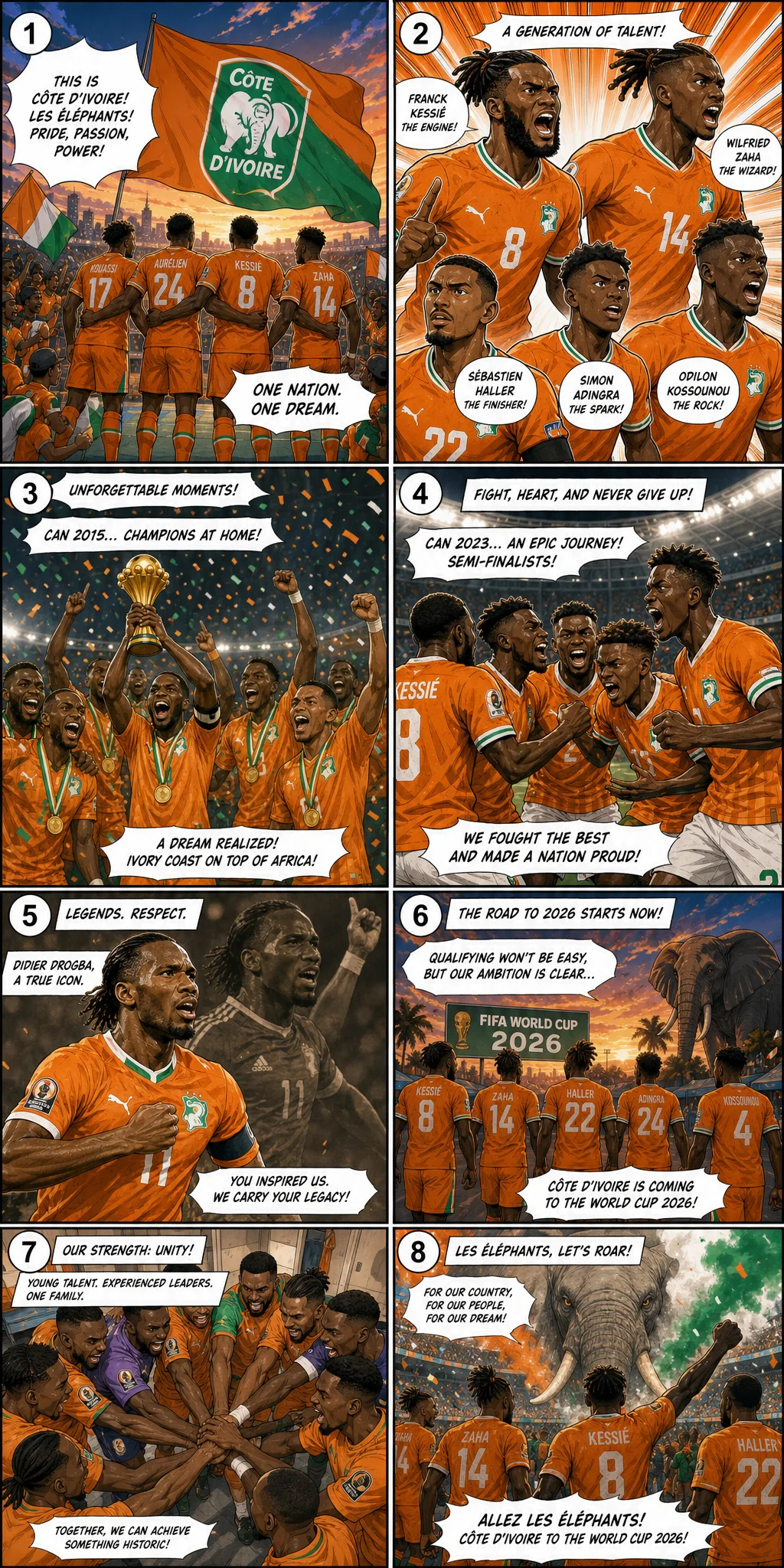
8-panel comic about Côte d'Ivoire national football team and their journey to the 2026 FIFA World Cup.
Published: June 5, 2026
Côte d'Ivoire National Football Team: The Elephants' Golden Trail
The Côte d'Ivoire national football team, known as "Les Éléphants" — The Elephants — represents one of African football's most consistently talented nations. With a production line of world-class players that stretches from the mid-2000s golden generation to the current squad, Côte d'Ivoire has established itself as a fixture in African and global football. The 2026 FIFA World Cup offers the Elephants an opportunity to fulfill the promise that their extraordinary talent has long suggested — to advance deeper into the tournament than any Ivorian team before them.
HISTORICAL FOUNDATIONS
Football arrived in Côte d'Ivoire during the French colonial period in the early twentieth century, spreading through the coastal cities of Abidjan, Grand-Bassam, and San-Pédro. The Fédération Ivoirienne de Football was founded in 1960, the year of independence, and the national team quickly established itself as a force in West African football. The country's first major international success came with victory at the 1992 Africa Cup of Nations, defeating Ghana on penalties in the final after a goalless draw that stretched through extra time.
Côte d'Ivoire made its World Cup debut at Germany 2006, entering the tournament with one of the most talented squads in African football history. Didier Drogba, Yaya Touré, Kolo Touré, Emmanuel Eboué, and Didier Zokora formed a core of players competing at the highest levels of European club football. The team was drawn into a brutally difficult group alongside Argentina, the Netherlands, and Serbia and Montenegro. Côte d'Ivoire lost to Argentina 2-1 in their opening match — a performance that demonstrated they could compete with the world's best — and to the Netherlands by the same scoreline. A 3-2 victory over Serbia and Montenegro in their final match provided a measure of consolation, but the "Group of Death" had claimed another victim.
The 2010 and 2014 World Cups followed a similar pattern. Côte d'Ivoire qualified comfortably from Africa, arrived at the tournament with a squad full of European-based stars, and exited in the group stage — each time placed in a challenging group that, with better luck or more clinical finishing, might have been navigated. The 2010 team featured Drogba playing with a protective cast on his broken arm, injured just weeks before the tournament, and the emotional images of the captain leading his team despite the injury became the tournament's defining Ivorian memory.
LEGENDS OF THE ELEPHANTS
Didier Drogba stands as the greatest Ivorian footballer of all time and one of the most important figures in African football history. His career at Chelsea — where he scored 164 goals, won four Premier League titles, and scored the equalizing header and winning penalty in the 2012 Champions League final — made him a global superstar. But Drogba's significance to Côte d'Ivoire transcends football. In 2005, after the national team qualified for its first World Cup, Drogba used a live television interview to fall to his knees in the dressing room and beg the warring factions in Côte d'Ivoire's civil war to lay down their arms. The conflict, which had divided the country along north-south lines, was resolved within months — a testament to football's unique power in Ivorian society and Drogba's singular moral authority.
Yaya Touré, Drogba's long-time teammate and successor as the team's most influential player, redefined what an African midfielder could be. His combination of physical power, technical excellence, and goalscoring instinct — particularly during his peak years at Manchester City, where he scored 20 Premier League goals from midfield in the 2013-14 season — made him one of the world's most complete footballers. Four consecutive African Footballer of the Year awards (2011-2014) recognized his sustained excellence.
Kolo Touré, Yaya's older brother, was the defensive rock of the golden generation — an intelligent, athletic center-back who played for Arsenal, Manchester City, and Liverpool during a Premier League career that spanned over a decade. Salomon Kalou, the versatile forward who won the Champions League with Chelsea in 2012 alongside Drogba, provided goals and creativity throughout his international career. Gervinho, the electric winger with the distinctive forehead and explosive dribbling, brought unpredictability and flair to the Ivorian attack for over a decade.
THE MODERN ERA
Côte d'Ivoire enters the 2026 World Cup with a new generation determined to surpass the achievements of its predecessors. The current squad blends experienced professionals with emerging talents who represent the latest products of Ivorian football's remarkable talent pipeline. The domestic Ligue 1, anchored by historic clubs like ASEC Mimosas — whose famed Académie Mimosifcom has produced many of the nation's greatest players — and Africa Sports, continues to develop technically proficient young footballers who then migrate to European leagues.
Sébastien Haller, the powerful striker who overcame testicular cancer to return to elite football and score the winning goal for Côte d'Ivoire in the 2023 Africa Cup of Nations final on home soil, is the current team's spiritual leader. His journey from a cancer diagnosis in 2022 to lifting the continental trophy in 2024 is one of sport's most inspiring stories — resilience, faith, and determination personified.
Franck Kessié, the dynamic midfielder who starred for AC Milan and Barcelona before moving to the Saudi Pro League, provides box-to-box energy, physical presence, and an increasing goal threat. His penalty in the 2023 AFCON final — struck with the composure of a player who has experienced football's highest levels — secured Côte d'Ivoire's third continental title. Seko Fofana, the midfield powerhouse and national team captain, combines technical quality with leadership and the ability to drive his team forward from central areas.
The current attacking options include Simon Adingra, the Brighton winger whose pace and directness caused problems throughout the 2023 AFCON, and emerging forwards developed in European academies who provide depth and tactical flexibility. The defensive unit, historically a vulnerable area for Ivorian teams, has shown improved organization and resilience.
FOOTBALL AND IVORIAN CULTURE
Football in Côte d'Ivoire is a national obsession that bridges ethnic, religious, and regional divisions. The sport provides a rare arena of shared identity in a country that has experienced political instability and occasional armed conflict since the 1990s. Drogba's 2005 plea — and the subsequent cessation of hostilities — demonstrated football's unique moral authority and its capacity to influence events far beyond the pitch.
The ASEC Mimosas academy model — identifying talented youth from across West Africa, providing education and elite football training, and exporting players to European clubs — has influenced talent development across the continent. ASEC alumni include not only Ivorian stars but also players from neighboring countries who developed in Abidjan before launching European careers. This model represents one of African football's most successful talent development systems.
Match days in Abidjan, Bouaké, and San-Pédro transform communities. Radios and televisions broadcast matches to audiences that gather in homes, bars, and public spaces. The national team's distinctive orange jerseys — the color of the Ivorian flag — are worn with pride across the country. When the Elephants win, the celebrations spill into streets that are often burdened with economic hardship and political tension. Football provides moments of collective joy that transcend daily struggles.
THE PATH FORWARD
Côte d'Ivoire enters the 2026 World Cup with a talented, confident squad riding the momentum of the 2023 AFCON triumph. The expanded tournament format provides more opportunities for African teams to advance, and Côte d'Ivoire's combination of individual quality and growing collective cohesion makes them a candidate to progress beyond the group stage.
The tactical approach emphasizes physical power in midfield, creativity from wide positions, and the goalscoring threat of Haller and the supporting attackers. Set pieces — a traditional Ivorian strength, leveraging the team's physical advantages — will be a critical weapon. The team's ability to manage the emotional intensity of World Cup matches, to maintain tactical discipline while expressing individual flair, will determine how far the Elephants can advance.
For Côte d'Ivoire, the 2026 World Cup is an opportunity to write the chapter that has eluded the nation through three previous tournament appearances: progression beyond the group stage, a place in the knockout rounds, a chance to demonstrate that Ivorian football's golden generation has a worthy successor. The Elephants march to North America carrying the hopes of a football-mad nation and the legacy of Drogba, Yaya Touré, and the giants who came before. The golden trail continues.