South Africa: Journey to 2026
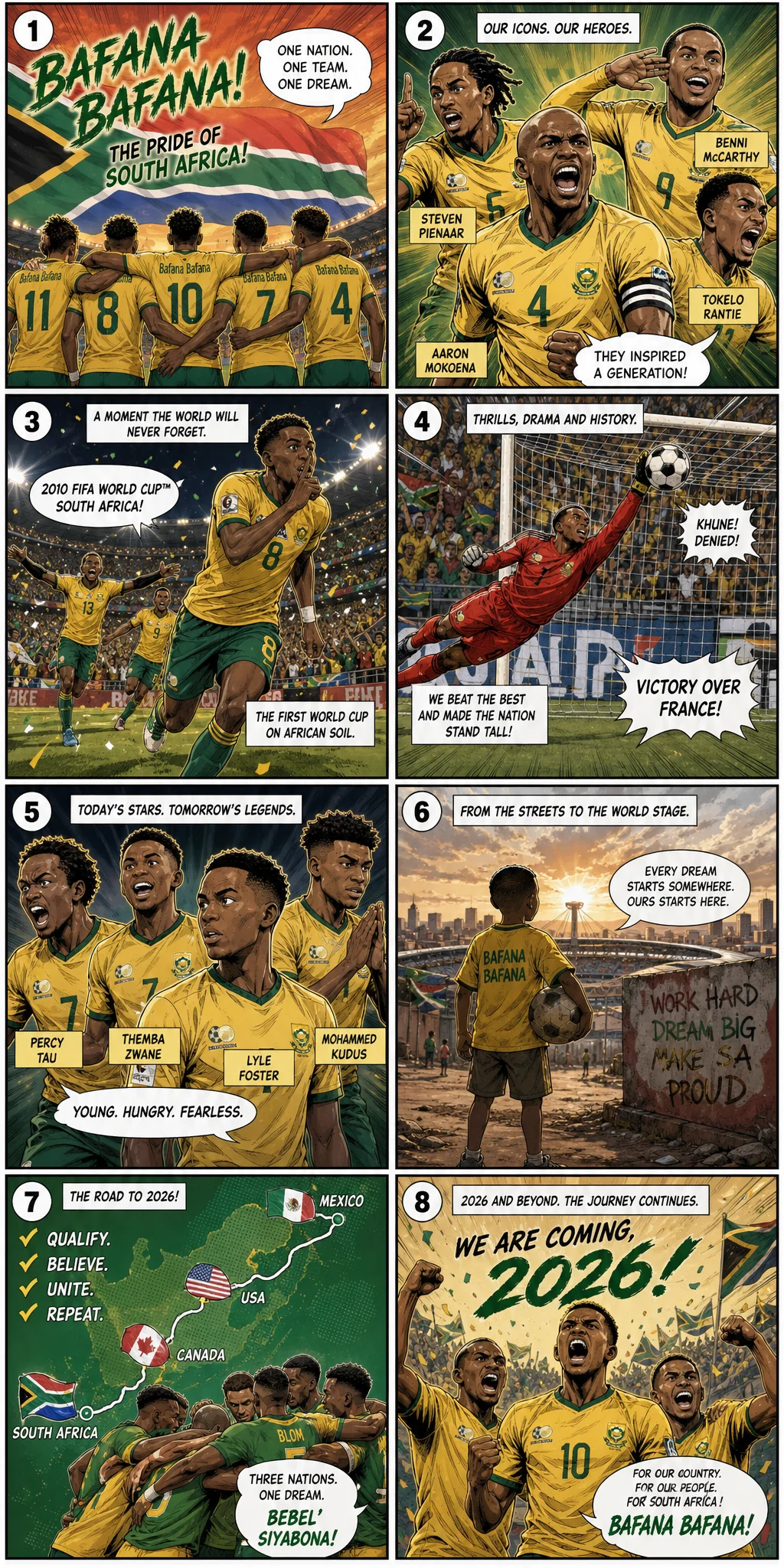
8-panel comic about South Africa national football team and their journey to the 2026 FIFA World Cup.
Published: June 5, 2026
South Africa National Football Team: The Rainbow Nation's Beautiful Game
South Africa's national football team, known as "Bafana Bafana" — meaning "The Boys" in Zulu — carries the weight of a nation's complex history onto the football pitch. From the dark days of apartheid-era isolation to the triumphant hosting of the 2010 FIFA World Cup, the team's journey mirrors the country's own path toward reconciliation and unity. As participants in the 2026 World Cup, South Africa enters Group A alongside co-hosts Mexico, South Korea, and Czechia — a moment that rekindles the spirit of 2010 and offers a new generation the chance to write its own chapter.
HISTORICAL FOUNDATIONS
Football arrived in South Africa in the late nineteenth century through British soldiers, colonial administrators, and railway workers. By the 1880s, organized matches were being played in the coastal cities of Cape Town, Durban, and Port Elizabeth. The sport spread rapidly among both white settlers and Black communities, with each group forming its own leagues and associations — a reflection of the segregated society that would soon become codified into law.
The South African Football Association was founded in 1892, but the multi-racial body that truly represented the nation's diversity only emerged in the 1950s. Under apartheid, South Africa was expelled from FIFA in 1964, a sporting exile that lasted nearly three decades. During these years, football became a powerful force in the anti-apartheid struggle. Prisoners on Robben Island, including Nelson Mandela, organized their own Makana Football Association — a league that operated under FIFA rules inside the prison walls, proving that the beautiful game could not be contained by barbed wire and concrete.
The return to international football came in 1992, just two years after Mandela's release. South Africa's readmission to FIFA was a symbol of the country's rebirth, and in 1996, Bafana Bafana delivered the most iconic moment in the nation's sporting history: victory in the Africa Cup of Nations on home soil. The team, led by coach Clive Barker and featuring stars like Neil Tovey, Mark Fish, and Doctor Khumalo, defeated Tunisia 2-0 in the final before a delirious crowd at Soccer City in Johannesburg. Mandela, wearing a number 6 Springbok jersey — a gesture of reconciliation — presented the trophy. It was a moment that transcended sport.
LEGENDS OF BAFANA BAFANA
Doctor Khumalo remains one of the most beloved figures in South African football history. A midfield maestro with extraordinary vision and technique, he became the face of the sport during the post-apartheid era. His stint with the Chicago Fire in Major League Soccer expanded his international profile, and his distinctive playing style — combining physical power with surprising grace — inspired a generation of South African footballers.
Lucas Radebe, known as "The Chief," rose from the dusty streets of Soweto to captain both the national team and Leeds United in the English Premier League. At Leeds, Radebe became a cult hero, revered for his leadership, his impeccably timed tackles, and his dignity both on and off the pitch. When Leeds offered him a testimonial match, he insisted that the proceeds go to South African charities — a gesture of generosity that captured his character. Nelson Mandela once said of Radebe: "This is my hero."
Benni McCarthy stands as Bafana Bafana's all-time leading goalscorer with 31 international goals. His career took him across Europe — Ajax, Celta Vigo, Porto, Blackburn Rovers, and West Ham United — and he won the UEFA Champions League with Porto under José Mourinho in 2004. McCarthy's powerful shot, intelligent movement, and confident personality made him one of Africa's most recognizable football exports. Steven Pienaar, the dynamic winger who shone at Ajax and Everton, provided creativity and work-rate from midfield, becoming the first South African to captain a Premier League side.
THE MODERN ERA
South African football has experienced a turbulent period since the highs of 1996 and 2010. The national team failed to qualify for the Africa Cup of Nations in 2017 and faced early exits in several continental tournaments. The domestic Premier Soccer League has grown in financial strength and professionalism, but translating that club-level success to the national team has proven challenging.
The current Bafana Bafana squad represents a renewed sense of purpose. Percy Tau, the creative forward who honed his craft at Mamelodi Sundowns before moving to Brighton & Hove Albion in the Premier League, and later to Al Ahly in Egypt, is the team's talisman. His dribbling ability, vision, and composure in front of goal make him the primary attacking threat. Ronwen Williams, the captain and goalkeeper, has provided stability and leadership during the reconstruction period. His performances for Mamelodi Sundowns in the CAF Champions League established him as one of Africa's finest shot-stoppers.
Emerging talents like Lyle Foster, who has shown his goalscoring ability at Burnley in England, and midfielders Teboho Mokoena and Sphephelo Sithole, who combine technical skill with physical presence, form the core of a team growing in confidence. The defensive unit, marshaled by the experienced Siyanda Xulu and Grant Kekana, has shown improved organization and resilience in recent international campaigns.
THE WORLD CUP RETURN
South Africa's qualification for the 2026 World Cup is a story of redemption. The tournament structure — expanded to 48 teams, with Africa receiving nine guaranteed spots — provided a realistic pathway, and the team seized the opportunity with determined performances throughout the qualifying campaign. Returning to the World Cup stage feels like a homecoming, a reminder of the magical month in 2010 when the world turned its eyes toward the southern tip of Africa.
The iconic vuvuzela, that droning plastic horn that became the unforgettable soundtrack of the 2010 World Cup, remains a symbol of South African football culture. While its constant buzz divided global opinion, for South Africans it represented collective joy, a communal expression of supporting their team and their nation. Preparations for 2026 have been thorough and methodical. The coaching staff has emphasized defensive organization, quick transitions, and maximizing set-piece opportunities. Mexico's altitude advantage at the Azteca presents a unique challenge, but South Africa's athletes — conditioned in high-altitude training centers — are well-prepared for thin-air football.
FOOTBALL AND SOUTH AFRICAN CULTURE
Football in South Africa is the sport of the majority. Unlike rugby or cricket, which were historically associated with the white minority, football has always been the game of the townships, the dusty streets, the shebeens where cold beer and heated debates about Kaizer Chiefs versus Orlando Pirates flow with equal intensity. The Soweto Derby between Chiefs and Pirates regularly draws over 80,000 fans to FNB Stadium (formerly Soccer City) and is one of the world's most passionately contested club rivalries.
The sport serves as a vehicle for social mobility, with academies across the country identifying young talent from impoverished communities. The Kaizer Chiefs and Mamelodi Sundowns youth systems have produced players who have gone on to professional careers in Europe, Asia, and across Africa. Football also provides a platform for addressing social issues — HIV/AIDS awareness, education, and youth development remain central to the sport's community engagement in South Africa.
The 2010 World Cup left a complex legacy. The stadiums built for the tournament — Soccer City, Moses Mabhida in Durban, Cape Town Stadium, and others — remain as architectural monuments, though questions persist about their post-tournament utilization. The tournament did, however, fundamentally change global perceptions of South Africa and Africa as a whole, demonstrating the continent's capacity to host events of the highest standard.
THE PATH FORWARD
South Africa enters the 2026 World Cup without the weight of unrealistic expectations, and this may prove to be an advantage. The team will face Mexico in the opening match at the Estadio Azteca — a baptism of fire before a hostile crowd and a global television audience of billions. Subsequent matches against South Korea and Czechia offer opportunities for points, and any progression beyond the group stage would be celebrated as a significant achievement for southern African football.
The tactical framework has been built on defensive solidity, with an emphasis on protecting the central areas and forcing opponents wide. Counter-attacks, driven by the pace and creativity of Tau and the emerging forward line, represent the primary goal-scoring pathway. Set pieces, with the aerial threats of central defenders and the delivery quality of midfield technicians, provide a secondary avenue for goals.
Beyond results, this tournament represents an opportunity for South African football to reassert itself on the global stage. The country's football infrastructure, its passionate supporter base, and its deep well of athletic talent suggest that sustained success is achievable. For Bafana Bafana, the 2026 World Cup is not an endpoint — it is a stepping stone toward reclaiming a position among Africa's and the world's football elite. The rainbow nation's beautiful game continues, and the boys are ready to play.