Ecuador: Journey to 2026
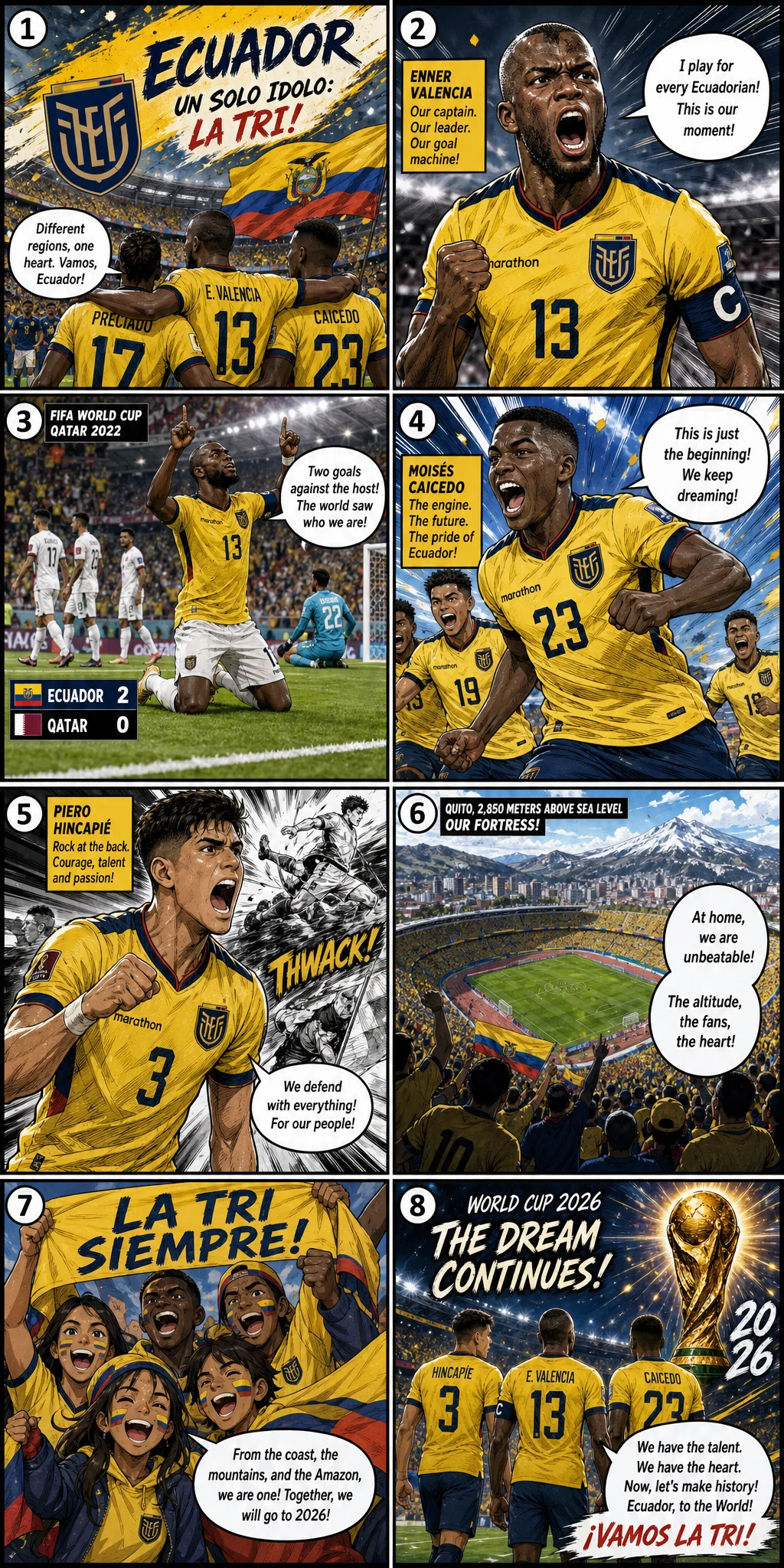
8-panel comic about Ecuador national football team and their journey to the 2026 FIFA World Cup.
Published: June 5, 2026
Ecuador National Football Team: The Tricolor's Andean Ascent
The Ecuador national football team, known as "La Tri" for its tricolor flag of yellow, blue, and red, represents one of South American football's most compelling development stories. A nation once considered a CONMEBOL afterthought — caught between the continent's traditional powers and its own geographic challenges — Ecuador has transformed into a consistent World Cup participant and a respected opponent capable of troubling any team. The 2026 FIFA World Cup represents the next stage in Ecuador's footballing ascent: the ambition to advance beyond the group stage and establish the Tricolor as a genuine knockout-round threat.
HISTORICAL FOUNDATIONS
Football arrived in Ecuador in the late nineteenth century, brought by English merchants and quickly adopted in the port city of Guayaquil and the highland capital of Quito. The Ecuadorian Football Federation was founded in 1925, but for most of the twentieth century, Ecuador operated on South American football's periphery. The continental power structure — Argentina, Brazil, and Uruguay occupying the podium, with Paraguay, Chile, Colombia, and Peru competing for the next tier — left little room for a nation that lacked the population base, economic resources, and football infrastructure of its competitors.
Ecuador's first World Cup qualification came in 2002, a breakthrough achieved under the guidance of Colombian coach Hernán Darío Gómez. The team, featuring the legendary striker Agustín Delgado and midfield creator Álex Aguinaga, navigated the brutal CONMEBOL qualifying competition to reach football's greatest stage. The debut campaign ended in the group stage with defeats to Italy and Mexico and a victory over Croatia — a creditable performance that established Ecuador as a nation capable of competing at the World Cup level.
The 2006 World Cup in Germany represented Ecuador's finest tournament performance. Under Colombian coach Luis Fernando Suárez, La Tri defeated Poland and Costa Rica to advance to the Round of 16 for the first time in the nation's history. The Round of 16 match against England was a 1-0 defeat on a David Beckham free-kick, but Ecuador had proven that it belonged among football's competitive nations. The team's tactical discipline, physical fitness, and the goalscoring of Carlos Tenorio and Agustín Delgado made them difficult opponents throughout the tournament.
The 2014 and 2022 World Cups followed, each ending in the group stage but demonstrating that Ecuador's qualification was not a historical fluke. The nation had established itself as a regular World Cup participant — an achievement that placed Ecuador in a select group of South American nations capable of consistently navigating the continent's punishing qualifying competition.
THE ALTITUDE ADVANTAGE
No discussion of Ecuadorian football is complete without addressing the nation's unique geographic weapon: altitude. The Estadio Rodrigo Paz Delgado in Quito sits at 2,850 meters (9,350 feet) above sea level, higher than any other major international football venue outside Bolivia. Opponents accustomed to sea-level oxygen struggle to breathe, to recover between sprints, to think clearly in the thin air. Ecuadorian players, raised and conditioned at altitude, possess a physiological advantage that has proven decisive in numerous CONMEBOL qualifiers.
The altitude question has generated controversy throughout South American football. Brazil and Argentina have protested the competitive fairness of playing at such elevations. FIFA briefly banned international matches above 2,500 meters in 2007 before reversing the decision following protests from Andean nations. The debate continues, but the reality is clear: Ecuador's home-field advantage at altitude is one of the most significant in international football, and the team's qualifying campaigns are built upon maximizing points from home matches in Quito.
The tactical implications extend beyond simple physical advantage. Ecuadorian teams play with an understanding of how the ball moves differently at altitude — faster, with less air resistance — and how opponents will fatigue in predictable patterns. The pressing triggers, the moments when the team increases tempo, the game management in the final 20 minutes — all are calibrated to exploit the altitude's effects on visitors who arrived in Quito only 24 to 48 hours before kickoff.
LEGENDS OF THE TRICOLOR
Agustín Delgado, "El Tin," is Ecuador's all-time leading World Cup goalscorer and the nation's most iconic footballer. His three goals at the 2006 World Cup, his powerful header against Poland, and his career at clubs including Southampton in the English Premier League established him as the standard against which Ecuadorian strikers are measured. Delgado's combination of physical presence, aerial dominance, and clinical finishing provided the attacking focal point during Ecuador's breakthrough era.
Álex Aguinaga, the elegant midfielder who spent the majority of his career at Necaxa in Mexico, earned 109 caps for Ecuador and provided the creative vision that the national team had historically lacked. His intelligent passing, set-piece delivery, and leadership across three decades made him the bridge between Ecuador's footballing past and its World Cup future.
Iván Hurtado earned a record 168 caps for Ecuador, making him one of the most capped players in international football history. His longevity, defensive reliability, and quiet leadership provided stability through multiple World Cup cycles. Antonio Valencia, the powerful winger and later right-back at Manchester United, became the first Ecuadorian to captain a Premier League club and the first to win major English trophies. His pace, strength, and crossing ability made him a Premier League fixture for over a decade.
THE MODERN ERA
Ecuador enters the 2026 World Cup with a young, talented squad that represents the country's most promising generation since the 2006 team. Moisés Caicedo, the Chelsea midfielder who became the most expensive Ecuadorian footballer in history with his transfer from Brighton, is the team's engine. His reading of the game, ball-winning ability, and progressive passing make him one of the most complete young midfielders in world football. Caicedo's partnership with Piero Hincapié, the versatile Bayer Leverkusen defender, forms the defensive-midfield spine around which the team is constructed.
Enner Valencia, despite being in the latter stages of his career, remains the team's captain and spiritual leader. His six World Cup goals across the 2014 and 2022 tournaments make him Ecuador's most prolific World Cup scorer, and his experience at clubs including West Ham United, Everton, and Fenerbahçe provides invaluable tournament knowledge. The emergence of young forwards and attacking midfielders developed in Ecuador's improving domestic league and in European academies has added depth and tactical flexibility.
The domestic Liga Pro, while not among South America's strongest leagues, has improved in professional standards and youth development. Independiente del Valle, the club from the outskirts of Quito, has become one of the continent's most admired talent factories — winning the Copa Sudamericana and reaching the Copa Libertadores final while exporting young players to European clubs. The Independiente model — identifying youth talent, providing elite training and education, and selling players to fund continued development — represents the sustainable pathway for Ecuadorian football.
FOOTBALL AND ECUADORIAN CULTURE
Football in Ecuador bridges the country's significant regional divisions. The historic rivalry between Quito and Guayaquil — the highland capital and the coastal commercial hub — extends to football, with Liga de Quito, Barcelona SC (of Guayaquil), Emelec, and El Nacional commanding passionate followings that reflect deeper cultural and economic tensions. The national team, when successful, unites the country in a way that few other institutions can.
The sport's popularity in Ecuador is comparable to that in any South American nation — a daily obsession, a central topic of conversation, a source of pride and frustration in equal measure. Street football remains the primary developmental environment for young Ecuadorians, the concrete pitches of Quito's neighborhoods and Guayaquil's barrios producing players with the close control and improvisational creativity characteristic of South American football.
The connection between football and indigenous identity — Ecuador has one of South America's largest indigenous populations — adds a distinctive dimension to the national team's cultural significance. Players with indigenous heritage, including several members of the current squad, represent communities that have historically been marginalized in Ecuadorian society. Their visibility on the national team provides representation and role models for indigenous youth.
THE PATH FORWARD
Ecuador enters the 2026 World Cup with clear ambitions: advance from the group stage and compete in the knockout rounds. The 2006 Round of 16 appearance remains the nation's best performance; matching or exceeding that result is the realistic target. The team's blend of young talent — Caicedo, Hincapié, and emerging attackers — with experienced leadership provides a balanced foundation.
The tactical approach will leverage Ecuador's traditional strengths: physical fitness, tactical discipline, and the counter-attacking threat posed by athletic forwards. Caicedo's midfield dominance will be crucial — his ability to win possession and initiate attacks determines the team's capacity to compete against technically superior opponents. Wide play, with overlapping full-backs and direct wingers, provides the primary attacking avenue.
For Ecuador, the 2026 World Cup is about consolidation — proving that the nation's consistent qualification is not a historical anomaly but the new normal. The Tricolor's ascent from South American afterthought to respected World Cup participant has been one of the continent's most encouraging football stories. The next chapter begins in North America.