Forty-Eight Teams Walk Into a World Cup
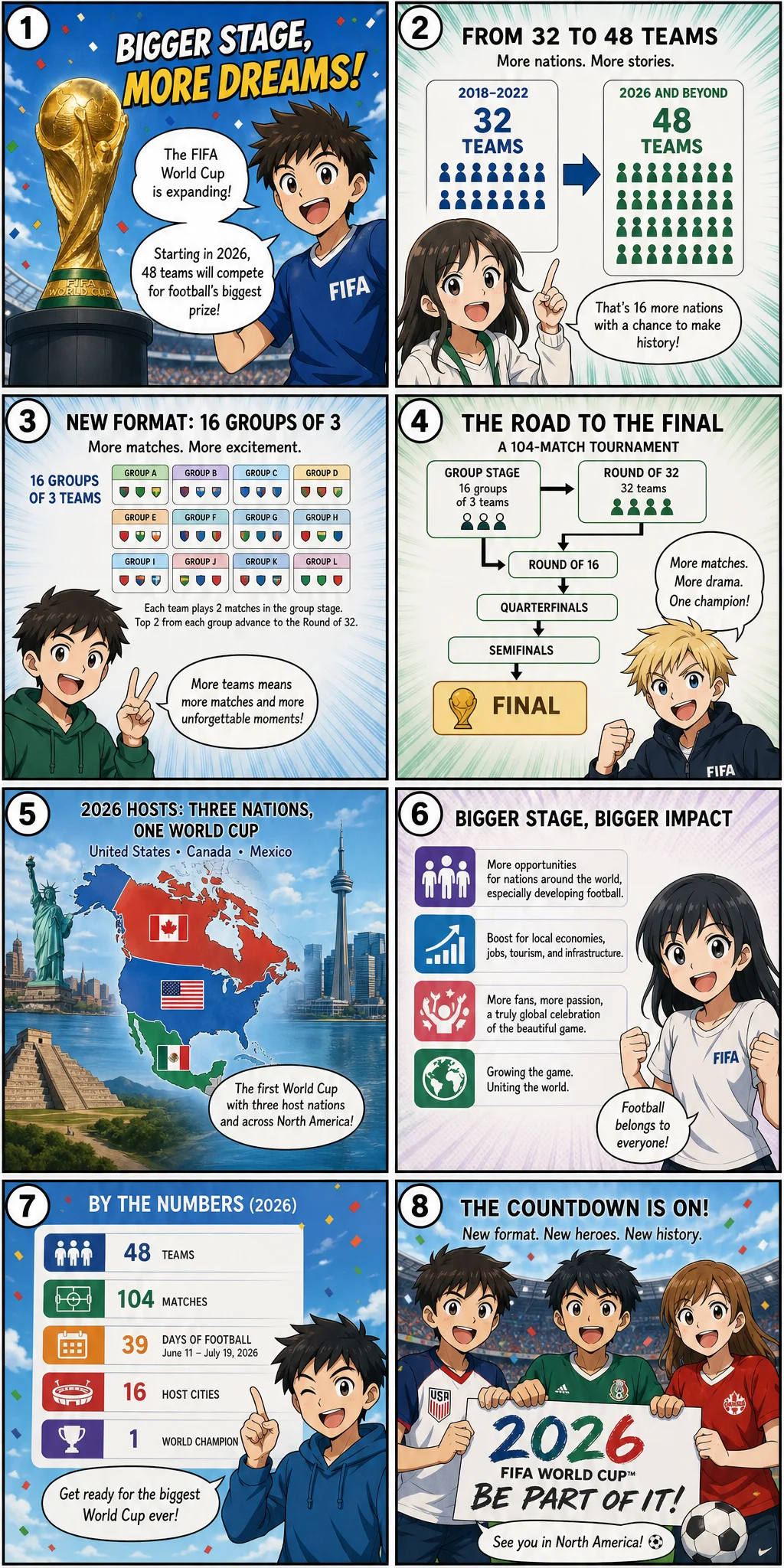
The 2026 FIFA World Cup expands from 32 to 48 teams for the first time — 16 new slots, 104 matches, 12 groups, and a third-place advancement rule so complex it broke a retired accountant.
Published: June 6, 2026
# The Day 48 Teams Walked into the World Cup, I Did the Math, Then Threw the Calculator Away
June 11, 2026. World Cup opening day. I'm sitting in a bar in Toronto, and the pre-match warm-up show is playing on the TV. Behind the host is a giant fixture chart — 12 groups, 4 teams each, flags plastered all over the wall like Post-it notes. Next to me sits an old gentleman, maybe seventy, wearing reading glasses, holding a pen and a piece of paper torn from a notebook. He's been writing on that paper for about fifteen minutes.
"What are you writing?" I ask.
"I'm trying to figure out the third-place qualification rules," he says, not looking up.
"Are you a journalist?"
"No. I'm a retired accountant. I've been crunching numbers my whole life. I can't crunch this."
He puts the pen down and slides the paper toward me. On it is a dense table — 12 groups, each group's third-place team, points comparison, goal difference comparison, goals scored comparison, fair play points comparison, and if everything's tied — a draw. In the bottom right corner of the paper, he's written one word: "FIFA." Next to it, a question mark.
"You know," he says, taking off his reading glasses and wiping them, "the first time I watched the World Cup, in 1974, there were only 16 teams. You could count all the strong teams on one hand. Brazil, Germany, Italy, Netherlands, Argentina. That's it. You put those five in your head, and the tournament was basically over. In 1982, 24 teams. I bought a book to keep track — a World Cup handbook, about two hundred pages. In 1998, 32 teams. I started using Excel. In 2026 —" he points at the paper. "— I've used my retirement degree. Still not enough."
He takes a sip of beer, looks at the flag-covered wall on the TV, and is silent for a moment.
"You know who's to blame for this?"
"FIFA?"
"No. It's Sepp Blatter. In 1998, when he was elected FIFA president, he announced the World Cup would expand from 24 to 32 teams. The whole world was cursing him then. English newspapers said '32 teams will ruin the quality of the World Cup.' German coaches said 'too many minnows, the group stage will become dead time.' Italian journalists wrote a full-page article with the headline 'The World Cup is turning into a political tool.'" He rotates his beer glass. "Twenty-four years later, no one remembers those curses. Everyone only remembers the 1998 World Cup — Zidane, Ronaldo, Šuker, Bergkamp. 32 teams became 'normal.'"
He takes another sip. "So now 48 teams are here. Everyone's saying the same old things — the level will drop, the group stage will get boring, too many unfamiliar countries. And then twenty years from now — no one will remember those complaints. Everyone will only remember those countries walking into the World Cup for the first time. Those kids seeing their own flag on TV for the first time. Those players crying for the first time when their national anthem plays." He puts the glass down on the table. "That's what football does best — turns the abnormal into normal, then makes you forget it was ever abnormal."
## From 16 to 48: A Journey You Don't Remember but Keeps Happening
The history of World Cup expansion — if you draw it as a curve, it's not a curve. It's a staircase. Every twelve years, it jumps up one step.
1930 to 1978: 16 teams. For nearly fifty years, the World Cup's size didn't change. In that era, there were so few participating teams that you could memorize every starting lineup a week before the tournament kicked off. If you grew up watching the World Cup in the 1970s, your World Cup memory was a short family list — Brazil, Germany, Italy, Argentina, Netherlands, England. Occasionally a new name squeezed in, but that was a big deal — when Cameroon first participated in 1982, sports journalists all over the world were checking maps, "Where is Cameroon?"
1982: Jumped from 16 to 24 teams. Eight more slots. That year, you saw Algeria in the World Cup for the first time. Honduras. New Zealand. A lot of people said 24 teams was too many — the second-round group stage format was complicated, requiring three teams to play a mini round-robin. But guess what? Everyone got used to it. 1986, 1990, 1994 — 24 teams became the new normal.
1998: Jumped from 24 to 32 teams. Another eight slots. That year, you saw Jamaica in the World Cup for the first time. South Africa. Japan and South Korea participating together. The group stage stretched from two weeks to three. You complained about the schedule being too long again — and then you got used to it again. 2002, 2006, 2010, 2014, 2018, 2022 — 32 teams became what you thought of as "normal." So much so that when FIFA announced 48 teams, your first reaction was: "Isn't that too many?" — the exact same words your father said in 1982, and your grandfather said in 1998.
2026: Jumping from 32 to 48 teams. Sixteen more slots. Not eight. Sixteen. This jump is bigger than any before it. The sixteen extra slots are distributed like this: Africa goes from 5 to 9 — nearly double. Asia goes from 4.5 to 8.5 — also nearly double. Europe goes from 13 to 16. North/Central America goes from 3.5 to 6 (including three automatic host spots). South America goes from 4.5 to 6. Oceania goes from 0.5 to 1 — that 0.5, for Oceania, was a curse, because it meant the Oceania champion had to play a playoff against a South American or Asian team, and usually lost. Now Oceania finally has a "real" slot. New Zealand — or Fiji — or any of those small islands surrounded by the South Pacific — can dream of walking into the World Cup without having their hopes shattered at the last moment by the cruel reality of a fifth-place South American team.
You know what this means? It means a kid growing up in Suva, Fiji — who might never have watched a World Cup live on TV because of the time zone, the tournament always happening while he's asleep — can now dream that one day, his country will appear on that flag-covered wall. Not "if a miracle happens." It's "as long as we play well enough, the slot is there." The difference between those two, for that kid, is his entire life.
## 48 Teams Isn't a Number. It's a World Map That's Been Redrawn.
The World Cup used to be a party for the few. Europe and South America took the vast majority of slots. Africa — 54 countries — had only 5 slots. Asia — 47 countries — had only 4.5. This meant that in Africa, you could be one of the best footballing nations on the entire continent and still not make the World Cup — because there weren't enough slots. Not because you weren't good enough. It was because the door of this world wasn't open wide enough for your country.
48 teams doesn't change the number. It changes the width of that door. The sixteen extra slots mostly went to Africa and Asia. The populations of these two continents combined make up the vast majority of the world — but in past World Cups, their combined slots were only about a third. The expansion makes that ratio a little more reasonable. Not completely reasonable. But at least — better than before.
## Epilogue
The retired accountant next to me — his name is George — folds his paper and puts it in his pocket. He picks up his beer and takes a big gulp.
"I give up," he says.
"Give up what?"
"Give up trying to figure out who'll qualify." He points at the TV screen. "I'll wait until the matches are over and see the results. There'll always be a few surprises anyway — those countries you've never heard of, those kids coming for the first time. They're not here to sightsee. They're here to tell you — the door's already open. We've walked in." He stands up, picks up his beer, and walks toward the bar door. Then he turns around.
"You know the best part? Now, more kids all over the world — in Accra, in Phnom Penh, in Suva, in Tashkent — are looking at the same flag-covered wall, and pointing at one of those flags — their flag — and saying: 'Look. That's us.'"
He pushes the door open and walks out into the June sunlight.
"So fuck the math. 48 teams is great. The more, the better. Let the whole world in."
The door closes behind him. The fixture chart on the TV flickers. I look at the flag-covered wall — twelve groups, forty-eight flags — and I pick up the notebook George left on the table. On his paper, below the question mark next to "FIFA," he's added another line. The handwriting is messy, but I can make out what he wrote —
"Welcome to the party."