Three Countries, One Table, and an Unprecedented Party
How the USA, Canada, and Mexico became the first three-nation host in World Cup history — three parties connected by a corridor.
Published: June 6, 2026
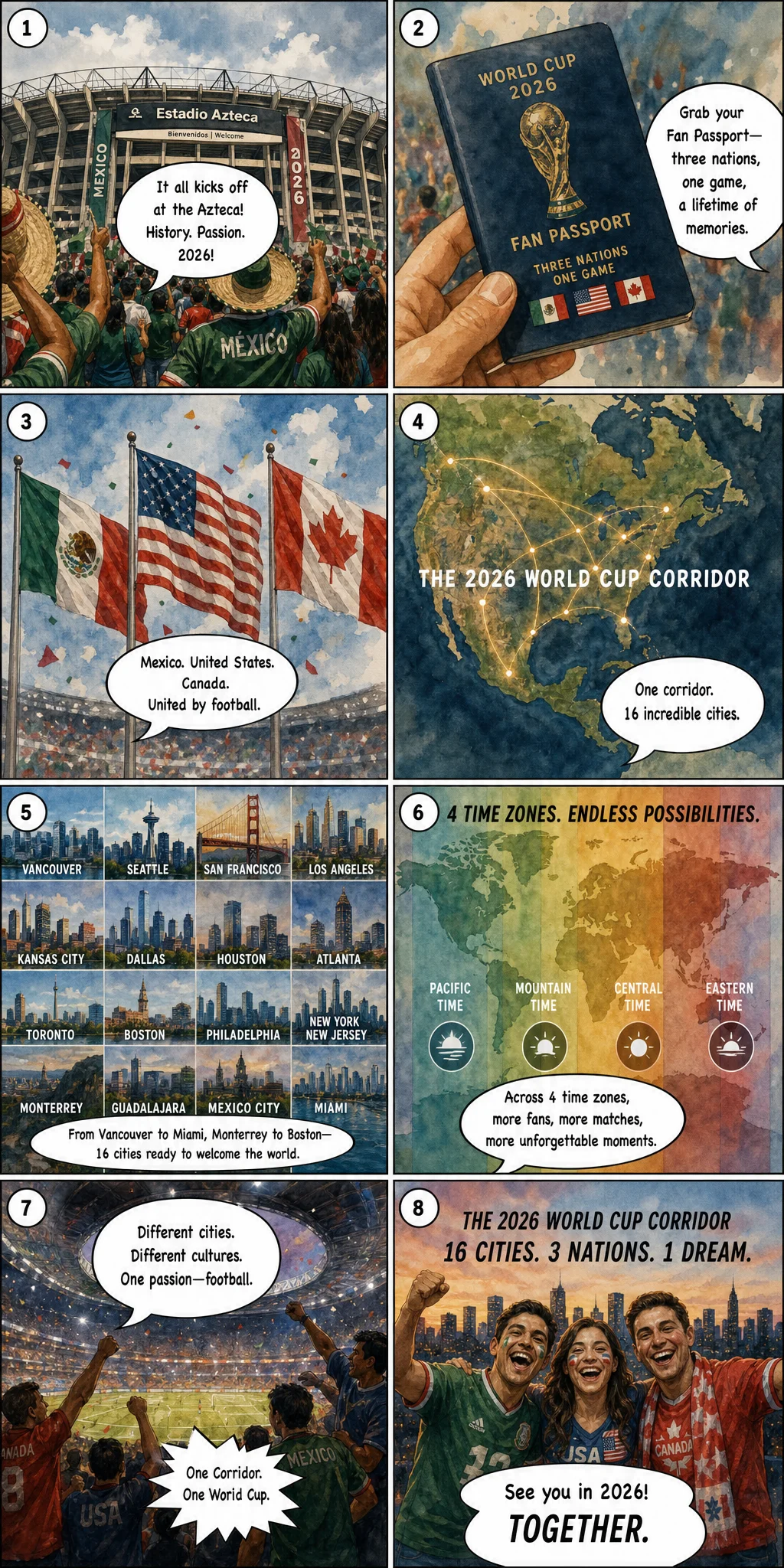
The 2026 World Cup is the first in history to be co-hosted by three countries: the United States, Canada, and Mexico. When FIFA announced this decision in 2018, the world's reactions broadly fell into three categories: Americans said, "Obviously it's us," Canadians said, "We'll help out too," and Mexicans said, "The Azteca Stadium has hosted two World Cup finals—what have your stadiums hosted?"
A tri-nation co-hosting arrangement has never happened in the World Cup's ninety-plus-year history. Not because no one ever thought of it—in fact, the 2002 Japan-South Korea World Cup already proved co-hosting is feasible—but because integrating the visa policies, customs procedures, aviation networks, and infrastructure of three different countries requires an administrative workload that no normal human being can comprehend.
I once interviewed a guy who worked on FIFA's organizing committee for fifteen years. He told me something: "Co-hosting isn't three countries throwing one party together. It's three countries each throwing their own party, and then we built a corridor in between." He was talking about that corridor—the "World Cup Corridor" stretching from Mexico City through Texas all the way to Toronto—the longest sporting event route in human history.
Imagine this: you're a fan. You watch the opening match in Mexico City, fly to Dallas for a group stage game, fly to Vancouver for the round of 16, and finally fly to New York for the final. Your passport will have entry stamps from three countries. Your phone will have visas for three countries—if Canada's fast-track works, if the US doesn't flag your application, if Mexico still offers visa-free entry for your passport. In thirty-nine days, you cross three countries, four time zones, three climates, and countless security checks. By the time you get home, you might need another thirty-nine days to recover.
But ask any fan who lived through that journey—they'll tell you the same thing: "Worth it." Not because of the matches. Because of those three countries—neighbors who never felt like family—for those thirty-nine days in the summer of 2026, they really did feel like one place.
In a bar in Vancouver, a Canadian told me: "You know, we share a border with Americans, but we never felt like we're from the same country. The World Cup made us feel for the first time—well, maybe we could be." He took a sip of his beer. "At least for those thirty-nine days."