Netherlands: Journey to 2026
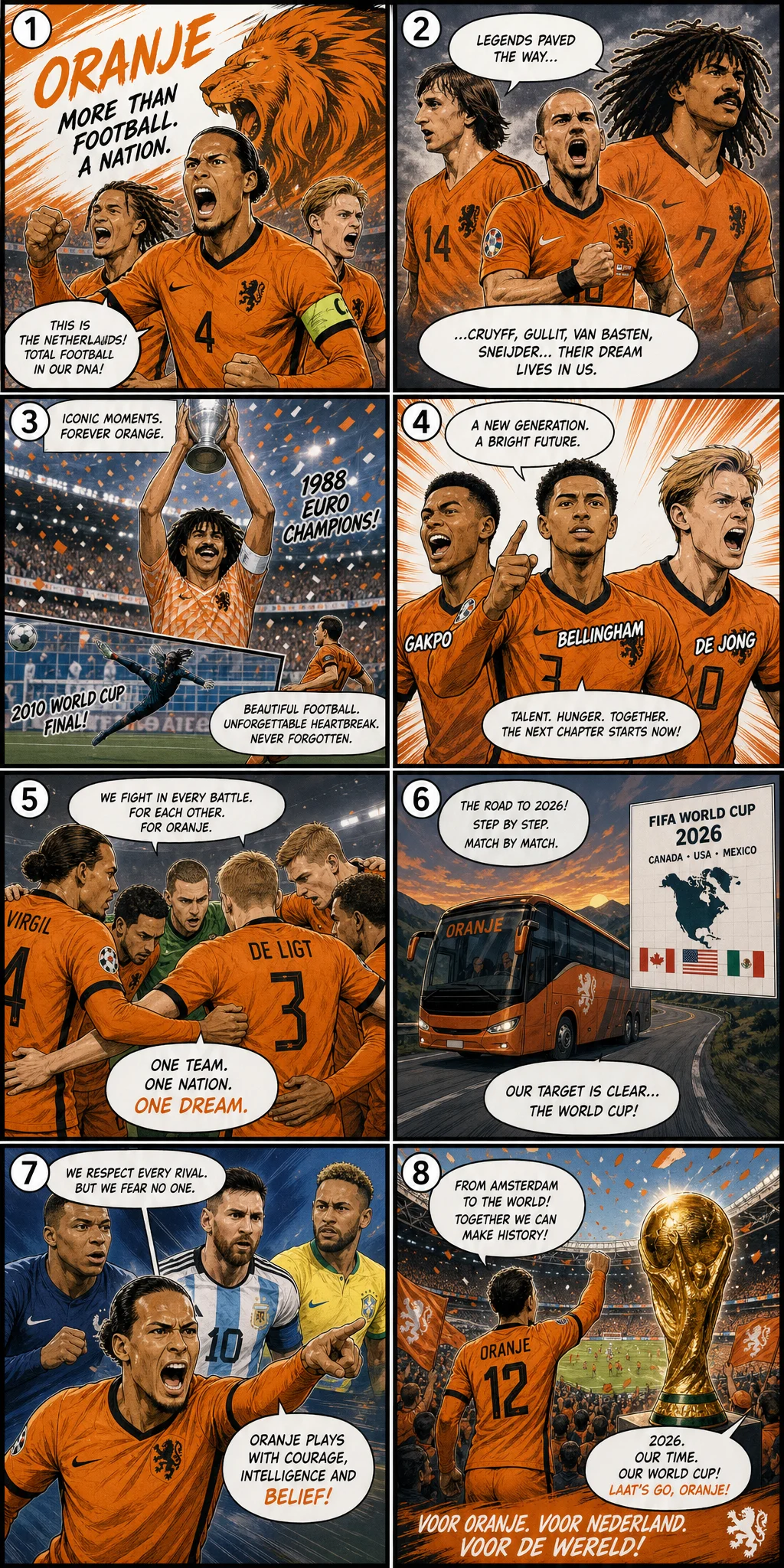
8-panel comic about Netherlands national football team and their journey to the 2026 FIFA World Cup.
Published: June 5, 2026
Netherlands National Football Team: The Oranje's Eternal Quest for Total Football
The Netherlands national football team, known as "Oranje" for the distinctive orange shirts that honor the House of Orange-Nassau, represents one of football's most influential and romanticized cultures. No nation has contributed more to the tactical and philosophical development of the game while winning fewer trophies than its genius suggests it should have. The Dutch gave the world "Total Football," produced Johan Cruyff, and have reached three World Cup finals without ever lifting the trophy. The 2026 FIFA World Cup offers Oranje another opportunity to end the beautiful game's most poignant drought.
HISTORICAL FOUNDATIONS
The Royal Dutch Football Association (KNVB) was founded in 1889, and the Netherlands was among football's early adopters in continental Europe. Dutch clubs — Ajax Amsterdam, Feyenoord Rotterdam, PSV Eindhoven — established themselves as European powers in the post-war decades, with Ajax winning three consecutive European Cups from 1971 to 1973 under the philosophical guidance of Rinus Michels and the on-field genius of Johan Cruyff.
The 1974 World Cup in West Germany introduced Total Football to a global audience. The Dutch system — in which outfield players were expected to be comfortable in any position, where center-backs could become attackers and wingers could become full-backs in fluid, mesmerizing patterns — represented a paradigm shift in football thinking. The opening goal of the final against West Germany, a penalty earned by Cruyff after a move involving 15 passes without a German touch, remains the most symbolically perfect World Cup goal. The Netherlands led 1-0 before Germany equalized and then, through Gerd Müller, won the match 2-1. The most beautiful team had lost to the most effective team, and a pattern was established.
The 1978 final in Argentina repeated the tragedy. Without Cruyff, who had retired from international football, the Netherlands again reached the final and again lost to the host nation — Argentina winning 3-1 after extra time. Rob Rensenbrink's shot against the post in the final minute of normal time, with the score 1-1, came within centimeters of changing Dutch football history — a moment of agonizing near-miss that has become part of Oranje's collective memory.
The 1988 European Championship, won under Michels with a team featuring Marco van Basten, Ruud Gullit, and Frank Rijkaard, represented the glorious exception — a tournament in which Dutch genius was rewarded with silverware. Van Basten's volley from an impossible angle in the final against the Soviet Union is perhaps the most technically perfect goal ever scored in a major final. The image of captain Gullit lifting the trophy in Munich provided Dutch football with its ultimate moment of validation.
The 1990s and 2000s brought continued World Cup relevance — the 1998 semi-final loss to Brazil on penalties in France, the 2010 final loss to Spain in extra time in South Africa, the 2014 semi-final penalty shootout loss to Argentina in Brazil. Three finals, three semi-finals, zero titles. The beauty and the grief of Dutch football are inseparable.
LEGENDS OF ORANJE
Johan Cruyff is the most influential figure in football history. More than his three Ballon d'Or awards, more than his goals and assists and trophies, Cruyff changed how the game is understood. His philosophy — that football is a matter of space, time, and geometry, that intelligence and technique matter more than physical attributes, that the game should be played beautifully as a moral imperative — became the foundation of modern football. The Cruyff Turn, executed against Sweden in the 1974 World Cup, is the most famous individual move in the sport's history. His legacy at Barcelona — both as a player and as the architect of La Masia, the academy that produced Messi, Xavi, and Iniesta — means that every modern team that prioritizes possession, pressing, and positional play is, in some sense, playing Cruyffian football.
Marco van Basten scored perhaps the most beautiful goal in football history — the volley in the 1988 European Championship final — and was the most complete striker of his generation before a malicious ankle injury ended his career at 28. His elegance, power, and technical perfection represented the physical expression of Dutch football's highest ideals.
Ruud Gullit, the "Black Tulip," was a player of such complete physical and technical gifts that he seemed genetically engineered for Total Football — a central defender, midfielder, and striker who could dominate any position on the pitch. Dennis Bergkamp brought Arsenal the Dutch aesthetic — the first touch that killed a ball dead, the goals that combined geometry and imagination in ways that seemed to originate in a different dimension. Arjen Robben's left-footed cut inside from the right wing, repeated a thousand times and defended successfully perhaps a dozen times, was football's most predictable and most unstoppable individual move.
THE MODERN ERA
The Netherlands enters the 2026 World Cup with a squad that blends the nation's traditional technical quality with a more pragmatic, defensively solid approach than the romanticism of previous generations. Virgil van Dijk, the Liverpool captain and one of the world's premier center-backs, is the team's defensive cornerstone and spiritual leader. His commanding presence, aerial dominance, and ability to organize the defensive line provide the stability that has occasionally been missing from Dutch teams.
Frenkie de Jong, the Barcelona midfielder, is the modern inheritor of the Cruyffian tradition — a player whose ability to carry the ball past pressure, to find passing angles that others cannot perceive, to control the tempo of a match from deep midfield positions makes him the team's creative engine. Matthijs de Ligt, the powerful central defender, and the emerging talents in the full-back and wide attacking positions provide a blend of experience and youth that should peak at the right time.
The forward line features Cody Gakpo, the versatile attacker whose performances for Liverpool and the national team have established him as a reliable goalscorer and creative force, and young talents who represent the next wave of Dutch attacking excellence. The goalkeeper position, traditionally a strength for the Netherlands dating back to Edwin van der Sar, continues to produce reliable performers.
The Eredivisie, while no longer among Europe's financial elite, remains one of the continent's most productive talent development environments. Ajax, PSV, and Feyenoord continue to produce technically proficient, tactically educated players who then move to Europe's wealthier leagues. The Dutch model — youth development, attacking football, tactical innovation — continues to influence the global game even as the domestic league operates with a fraction of the resources available to English, Spanish, or German clubs.
FOOTBALL AND DUTCH CULTURE
Dutch football is inseparable from Dutch culture — a reflection of a society that values intelligence, creativity, and egalitarianism, that is suspicious of hierarchy and authority, that believes in the possibility of doing things better. Total Football was not merely a tactical system; it was a cultural statement, a democratic vision of a sport in which every player could be a creator and every position could be a platform for genius.
The orange color that defines Dutch football support — the Oranjegekte (Orange Craze) that transforms cities into seas of orange during major tournaments — connects the sport to the monarchy and, more broadly, to Dutch national identity. The color is worn with a joyous, self-aware excess that reflects the Dutch approach to nationalism: enthusiastic but ironic, passionate but never self-important.
The tradition of Dutch tactical innovation — from Total Football through Louis van Gaal's systematized approach to the contemporary synthesis of pressing, possession, and positional play — reflects a broader Dutch intellectual tradition of questioning established methods and seeking more elegant solutions. Dutch coaches — Cruyff, Van Gaal, Rinus Michels, Guus Hiddink, Ronald Koeman, Erik ten Hag, Arne Slot — have exported this philosophy across Europe and the world.
THE PATH FORWARD
The Netherlands enters the 2026 World Cup as a credible contender — not among the tournament favorites, but a team capable of defeating any opponent on a given day. The squad's quality, particularly in defense and midfield, should provide the foundation for a deep tournament run. The question, as it has been for fifty years, is whether the Dutch can win the matches that decide championships.
The tactical approach under the current coaching staff reflects Dutch football's evolution — possession-based, positionally structured, with an emphasis on controlling matches through technical quality and tactical intelligence. The team possesses the defensive organization that has been strengthened in recent years, the midfield quality to dominate possession against most opponents, and the attacking talent to create chances.
For the Netherlands, the 2026 World Cup is about legacy and redemption. The nation that gave football its most beautiful ideas has never received its ultimate reward. Oranje carries the weight of three lost finals, of Cruyff's genius unrewarded, of a football culture that deserves the one trophy that has always eluded it. In the stadiums of North America, the Sea of Orange will sing, and the Dutch will try — once more, as they have tried since 1974 — to make the beautiful game victorious.