Twelve Groups, Eight Third-Placed Teams, and a Global Excel Meltdown
The 48-team format's most chaotic innovation: 8 best third-placed teams advance. A retired accountant tried to calculate it. He failed.
Published: June 6, 2026
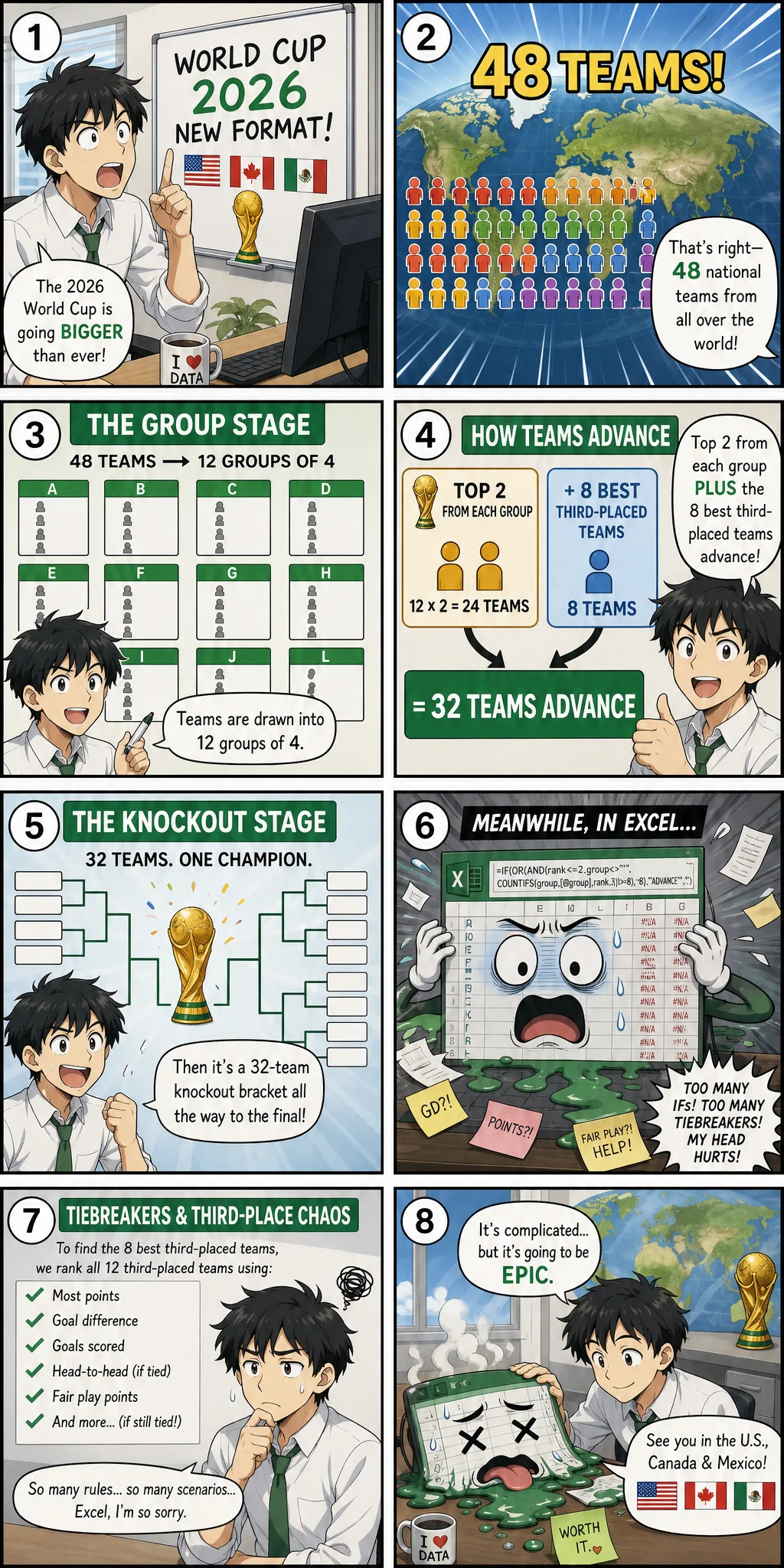
48 teams are divided into 12 groups. Four teams per group. The top two from each group advance—simple enough, that's 24 teams. Then FIFA says: "There are eight more spots, for the best third-placed teams." That sentence is where all the chaos begins.
Twelve groups, twelve third-placed teams. You need to pick eight to go through. What do you compare? First, points. If points are tied, goal difference. If goal difference is tied, goals scored. If goals scored are tied, fair play points (one yellow card minus one point, one red card minus three). If all that's still tied—draw lots.
I was sitting in the press box at Dallas's AT&T Stadium during the final round of the group stage. The journalist next to me—an Englishman who'd been writing about football for The Guardian for twenty years—opened his laptop, pulled up the live standings, and turned the screen toward me. The tables for all 12 groups were updating simultaneously. The third-placed team in Group C had the same points as the third-placed team in Group F, but Group F's third had a better goal difference by one, so Group F was ahead. But the match in Group G was still going—87th minute—and if a goal went in there, the whole ranking would reshuffle. He turned the screen back, typed three words on his keyboard: "I have no idea."
But he didn't need to know. Because FIFA designed this format not for you to calculate cleanly. It's to ensure that every match in the final round of the group stage carries stakes. In the 32-team era, the last round often had so-called "dead rubbers"—both teams already qualified or eliminated, the game meaningless. Under the 48-team system, that almost never happens. Because even the team at the bottom, if they win one match, can squeeze into one of those eight third-place slots. Every match counts. Every goal counts.
So if you're in a bar during the final round of the group stage and you see a crowd huddled around a phone, pulling up Excel, arguing about goal difference over beers—don't laugh at them. They're going through the most unique ritual of the 2026 World Cup: searching for order in the chaos, then giving up, then ordering another beer, then waiting for the referee to blow the whistle.