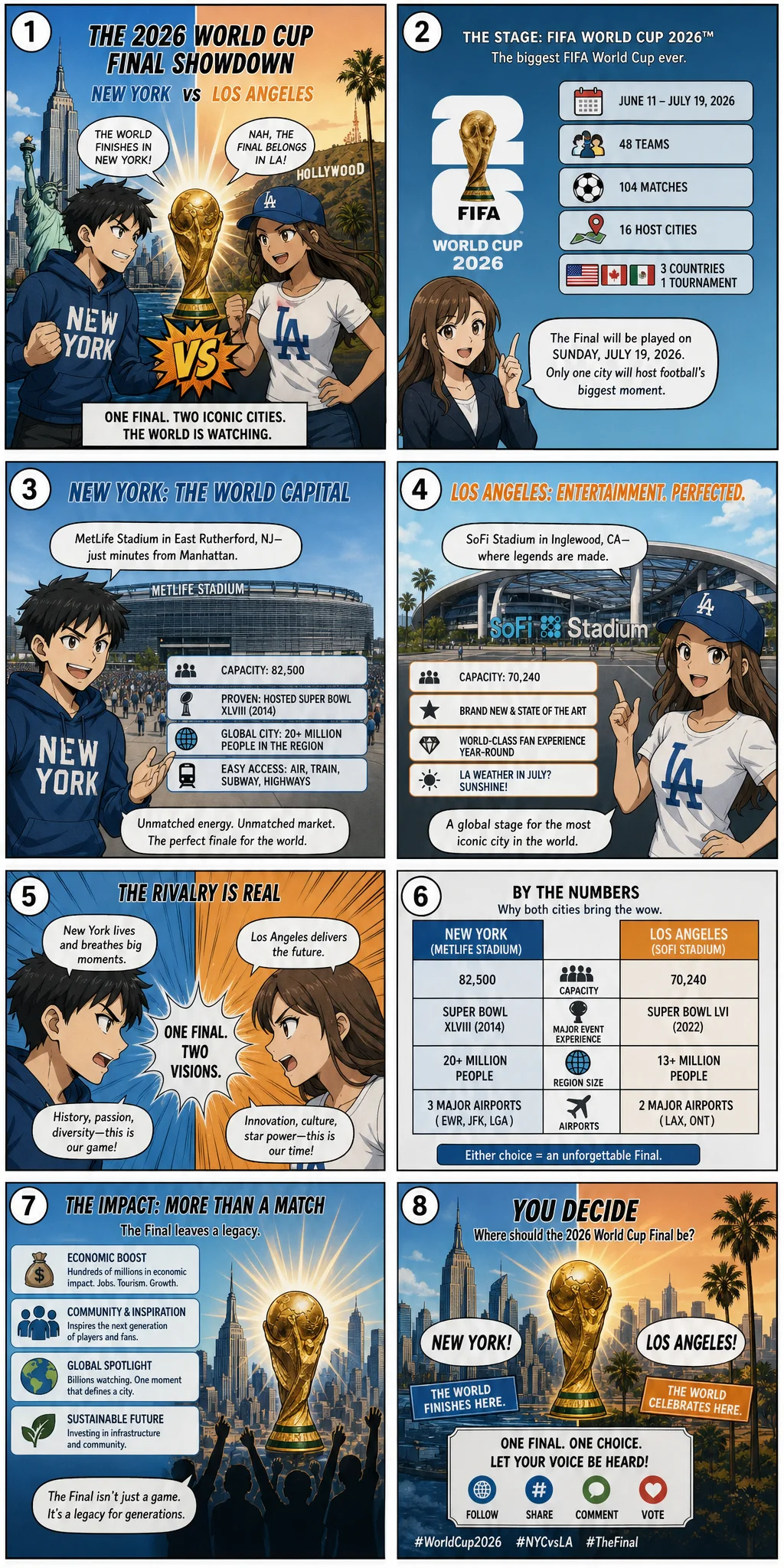
The Parking Lot That Stole the Final: New York vs Los Angeles
Behind closed doors in Zurich, New York beat LA for the 2026 final. Not because the stadium was better. Because the city was.
Published: June 6, 2026
February 2024. FIFA headquarters, Zurich. A closed-door meeting. Two groups sat on opposite sides of the conference table. On one side, the New York/New Jersey bid team—their stadium was MetLife, wedged between the New Jersey Turnpike and a marsh, no ring screen, no Hollywood. On the other side, Los Angeles—SoFi Stadium, $5.5 billion, the most expensive stadium in the world, a thousand-ton dual-sided 4K ring screen, Hollywood stars' backyard.
Doesn't sound like a fair fight. But FIFA's decision wasn't just about the stadium. FIFA looked at: the transport routes from airport to stadium, the number of hotels (not rooms, but hotels where sponsors and TV network bosses could stay without bumping into each other), the satellite uplink infrastructure. And on those two counts—satellites and global direct flights—New York was the safest bet in the world.
FIFA didn't pick the best stadium. FIFA picked the stadium least likely to screw up.
After the result was announced, SoFi Stadium's official account posted just one tweet: "Congratulations to New York/New Jersey. See you in 2026. We'll be ready." Thirty thousand likes. Eight thousand angry replies. A friend of mine who works at SoFi Stadium texted me a single word. Can't write that word here. Then he added: "We spent five and a half billion. They picked a parking lot."
But he was wrong. MetLife isn't a parking lot. On final day, the parking lots around MetLife—yeah, parking lots—were jammed with cars from all over the world. People were grilling. Brazilians, Argentinians, English, French. Flags tied to rearview mirrors. NYPD helicopters circling overhead. Inside the stadium, 82,500 people were creating something no price tag can measure—the atmosphere of a World Cup final. Nobody cared where that five and a half billion went. Nobody cared where that ring screen was. They cared about one thing only: that ball, those ninety minutes, that moment.