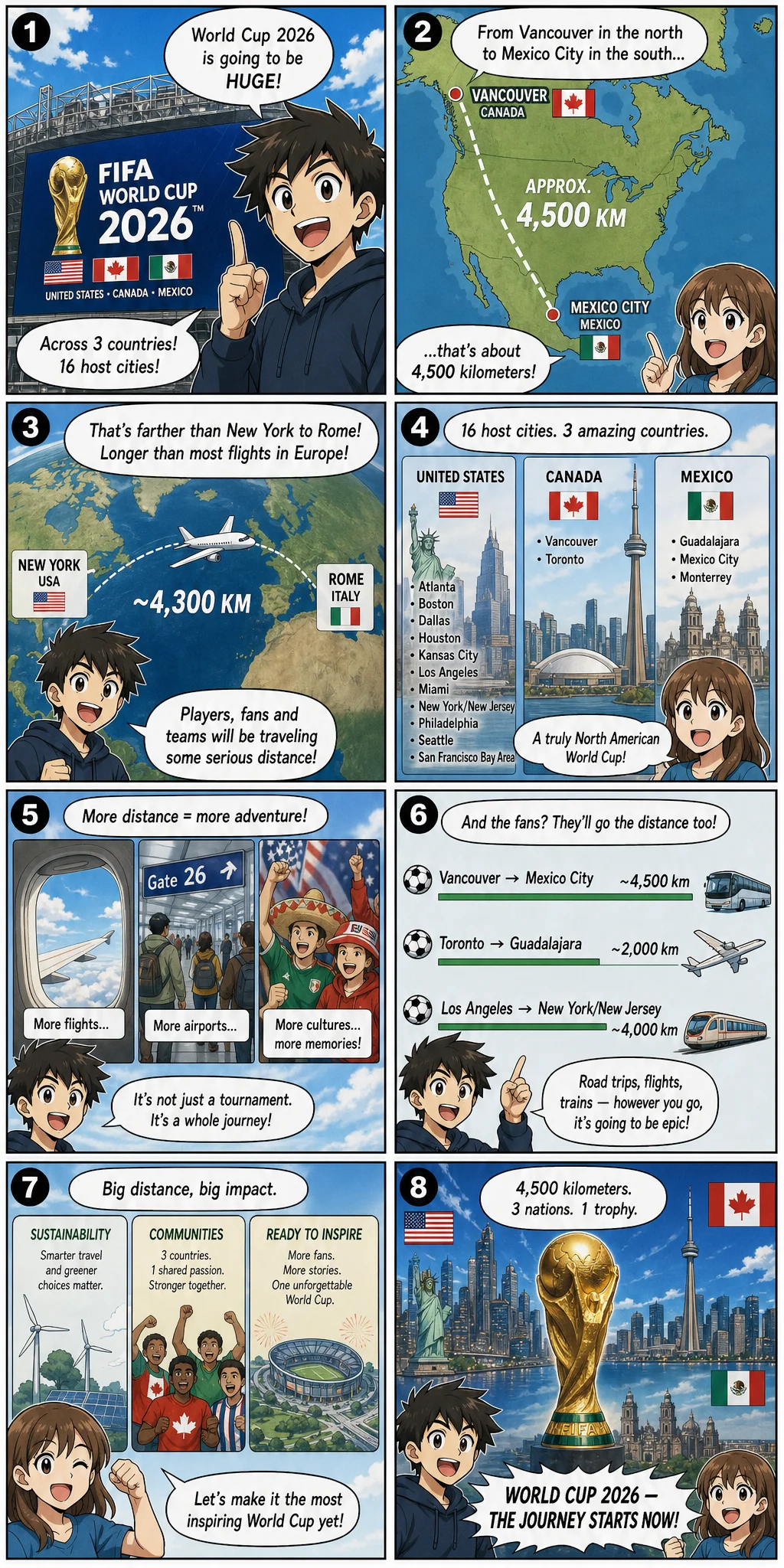
Four Thousand Five Hundred Kilometres of Madness
Some 2026 teams will fly over 8,000km in the group stage alone — crossing climate zones, time zones, and the limits of human physiology.
Published: June 6, 2026
At the 2026 World Cup, there will be teams flying over 8,000 kilometers during the group stage. Not the knockout stage. The group stage. Three matches. Three cities. Three climate zones. Picture this: you fly from Vancouver (14°C, rain) to Miami (38°C, 90% humidity), then to Boston (22°C, possible rain). Your body goes from winter to summer and back to spring in nine days. Your internal clock gets lost across three different time zones. Your knees swell on the plane—remember what we talked about in the Story series? The cabin pressure puts your muscle recovery on pause. When you land, you're not ready to play the next match. You're ready to collapse on the hotel bed, praying your team doctor has a recovery technique we haven't invented yet.
A sports physiologist once told me: "The World Cup champion won't be the team that plays the best. It'll be the team that flies the least." He wasn't joking. FIFA's scheduling computer, in theory, considers geographic proximity when generating the fixtures—but "in theory" is a whole different beast from reality in the complex math of 48 teams. Some teams get a relatively compact schedule. Others—like that unlucky Argentina team we tracked in the Story series—get thrown into a flight path that spans the entire North American continent. In the end, what decides the champion might not be your skill on the ball. It's your mileage in the air.