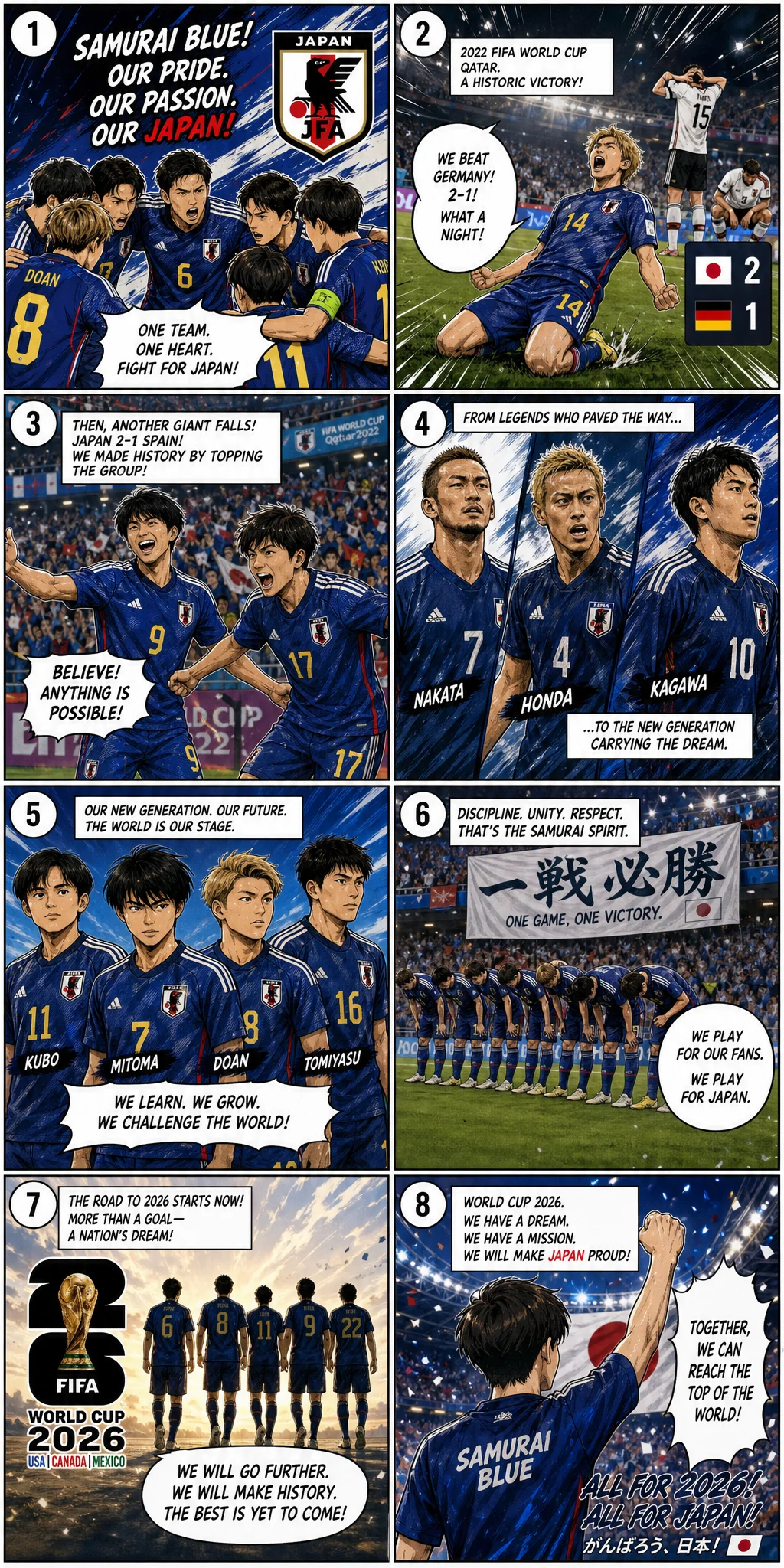
Japan: Journey to 2026
8-panel comic about Japan national football team and their journey to the 2026 FIFA World Cup.
Published: June 5, 2026
Japan National Football Team: The Samurai Blue's Technical Revolution
The Japan national football team, known as the "Samurai Blue" for their distinctive blue kits that have become synonymous with Asian football excellence, represents one of the sport's most remarkable transformation stories. From a nation that had never qualified for a World Cup before 1998, Japan has become a consistent presence at football's highest level and, increasingly, a team capable of competing with — and defeating — the world's traditional powers. Their qualification for the 2026 FIFA World Cup marks Japan's eighth consecutive appearance, a record of sustained success unmatched in Asian football.
HISTORICAL FOUNDATIONS
Football arrived in Japan in the 1870s, introduced by British naval officers and teachers who brought the game to the rapidly modernizing Meiji-era nation. The Japan Football Association was founded in 1921, and the country made its Olympic football debut at the 1936 Berlin Games, famously defeating Sweden 3-2 in what became known as the "Miracle of Berlin" — an early international result that captured the Japanese imagination.
For most of the twentieth century, football existed in the shadow of baseball and sumo wrestling in the Japanese sporting landscape. The national team competed regionally but could not break through to World Cup qualification, falling short in successive campaigns against stronger Asian opponents. The 1968 Olympic bronze medal in Mexico City — featuring legendary striker Kunishige Kamamoto, who scored seven goals in the tournament — represented a high point, but sustained international competitiveness remained elusive.
The transformative moment arrived in 1993 with the launch of the J.League, Japan's first fully professional football competition. The league attracted international stars in the latter stages of their careers — Zico, Gary Lineker, Pierre Littbarski, Dragan Stojković — who brought professionalism, tactical knowledge, and global credibility to Japanese football. The J.League's success, combined with a systematic approach to youth development, created the foundation for sustained international competitiveness.
Japan's first World Cup appearance came in 1998 in France, a tournament that ended with three group-stage defeats but marked the nation's arrival on football's biggest stage. Co-hosting the 2002 World Cup with South Korea accelerated Japan's football development, with the team reaching the Round of 16 under French coach Philippe Troussier. Victories over Russia and Tunisia, followed by a narrow 1-0 defeat to eventual semi-finalists Turkey, demonstrated Japan's capacity to compete at the World Cup level.
LEGENDS OF THE SAMURAI BLUE
Hidetoshi Nakata stands as Japan's first truly global football superstar. His elegance, intelligence, and technical quality — combined with a fashion-forward personal brand that transcended sport — made him one of the most recognizable Asian athletes of his generation. Nakata's career at Perugia, Roma, Parma, Bologna, and Fiorentina in Serie A — Italian football's most tactically demanding environment — proved that Japanese players could thrive at the highest levels of European football. His performances at the 2002 World Cup, particularly against Tunisia, were the defining moments of his international career.
Kazuyoshi Miura, "King Kazu," is Japanese football's most enduring icon. His career, which extended into his fifties and made him the oldest professional footballer in history, represents the longevity, discipline, and passion that Japanese football values. While Miura's peak preceded Japan's World Cup era — controversially excluded from the 1998 squad despite scoring 55 international goals — his role in popularizing football during the J.League's launch was indispensable.
Keisuke Honda delivered Japan's most memorable World Cup moments. His free-kick against Denmark in 2010, his goal and assist against Cameroon, and his dramatic strike against Senegal in 2018 established him as Japan's most reliable tournament performer. Honda's intellectual approach to football — he read management books, studied tactics obsessively, and spoke openly about his ambitions to coach at the highest level — reflected the analytical dimension of Japanese football culture.
Shinji Kagawa brought Japanese technical excellence to Borussia Dortmund and Manchester United, winning two Bundesliga titles under Jürgen Klopp and demonstrating the close control and spatial intelligence characteristic of Japanese attacking players. Shunsuke Nakamura's left foot — producing free-kicks of physics-defying precision for Celtic and the national team — made him a cult hero in Scotland and a symbol of Japanese creative quality.
THE MODERN ERA
Japan enters the 2026 World Cup with its most talented and deep squad in history. The transformation from a team that occasionally troubled superior opponents to one that expects to compete with and defeat them has been gradual but unmistakable. The 2022 World Cup in Qatar provided the definitive evidence: victories over Germany and Spain, two of football's most historically dominant nations, in matches where Japan deserved to win based on performance, not luck.
The current squad features a remarkable concentration of players competing in Europe's top five leagues. Kaoru Mitoma, the Brighton winger with a university degree in physical education and a dribbling style that seems to operate at a different frame rate than defenders, has become one of the Premier League's most exciting attacking talents. His journey — from Kawasaki Frontale to a loan at Union Saint-Gilloise to Premier League stardom — reflects the patient, systematic development that characterizes Japanese football's modern approach.
Takefusa Kubo, once hailed as the "Japanese Messi" during his time in Barcelona's youth academy, has matured at Real Sociedad into a creative attacker of genuine La Liga quality. His close control, vision, and ability to operate in tight spaces make him the creative hub of Japan's attack. Wataru Endo, the Liverpool midfielder, provides the defensive intelligence and positional discipline that allows Japan's more creative players to express themselves. His reading of the game, tackling, and simple but effective distribution make him arguably the team's most important player — the balance that makes the attacking quality possible.
The defensive unit features Takehiro Tomiyasu, the versatile Arsenal defender capable of playing across the back line, and emerging full-backs and center-backs developed in European and J.League environments. The goalkeeper position, traditionally an area where Japanese football lagged behind its outfield quality, has improved with players gaining experience in European leagues.
FOOTBALL AND JAPANESE CULTURE
Japanese football culture reflects broader national characteristics: discipline, collective organization, continuous improvement (kaizen), and respect for tactical education. The J.League's development model — professional clubs integrated with youth academies, school football programs, and university competitions — creates multiple pathways for talent to emerge and develop.
The manga and anime Captain Tsubasa, launched in 1981, has been one of football's most influential cultural products — a comic series that inspired an entire generation of Japanese children to play football and, remarkably, influenced footballers across Asia, the Middle East, and Latin America. Players including Andrés Iniesta, Fernando Torres, and Alessandro Del Piero have cited Captain Tsubasa as an influence on their choice of football as a career.
The Japanese supporters have earned a unique global reputation for their post-match stadium cleaning — an expression of cultural values of tidiness and collective responsibility that has moved international observers. The "Nippon Blue" faithful bring organization, creativity, and relentless positivity to their support, contributing to match-day atmospheres that reflect the best of Japanese football culture.
THE PATH FORWARD
Japan enters the 2026 World Cup with ambitions that extend beyond mere participation. The victories over Germany and Spain at the 2022 World Cup — matches in which Japan demonstrated tactical sophistication, physical competitiveness, and mental resilience — have raised expectations. The Round of 16, Japan's ceiling in four previous tournaments, no longer represents the limit of ambition. The quarter-finals, a stage no Asian team has reached since South Korea in 2002, is the target.
The tactical approach under the current coaching staff emphasizes collective defensive organization, rapid transitions exploiting Japan's technical and athletic advantages, and the individual creativity of players like Mitoma, Kubo, and other attacking talents. Japan can compete with any opponent in terms of tactical preparation and physical fitness; the question is whether the finishing quality in crucial moments — the difference between noble defeat and historic victory — has improved enough to carry the team past its traditional ceiling.
For Japanese football, the 2026 World Cup represents the opportunity to announce that Asia's most consistent World Cup nation has become Asia's most dangerous. The Samurai Blue's technical revolution has transformed them from participants to contenders. The world will be watching to see how far the revolution has progressed.