Four Time Zones, One Watch, and a Fan Who Has No Idea What Time It Is
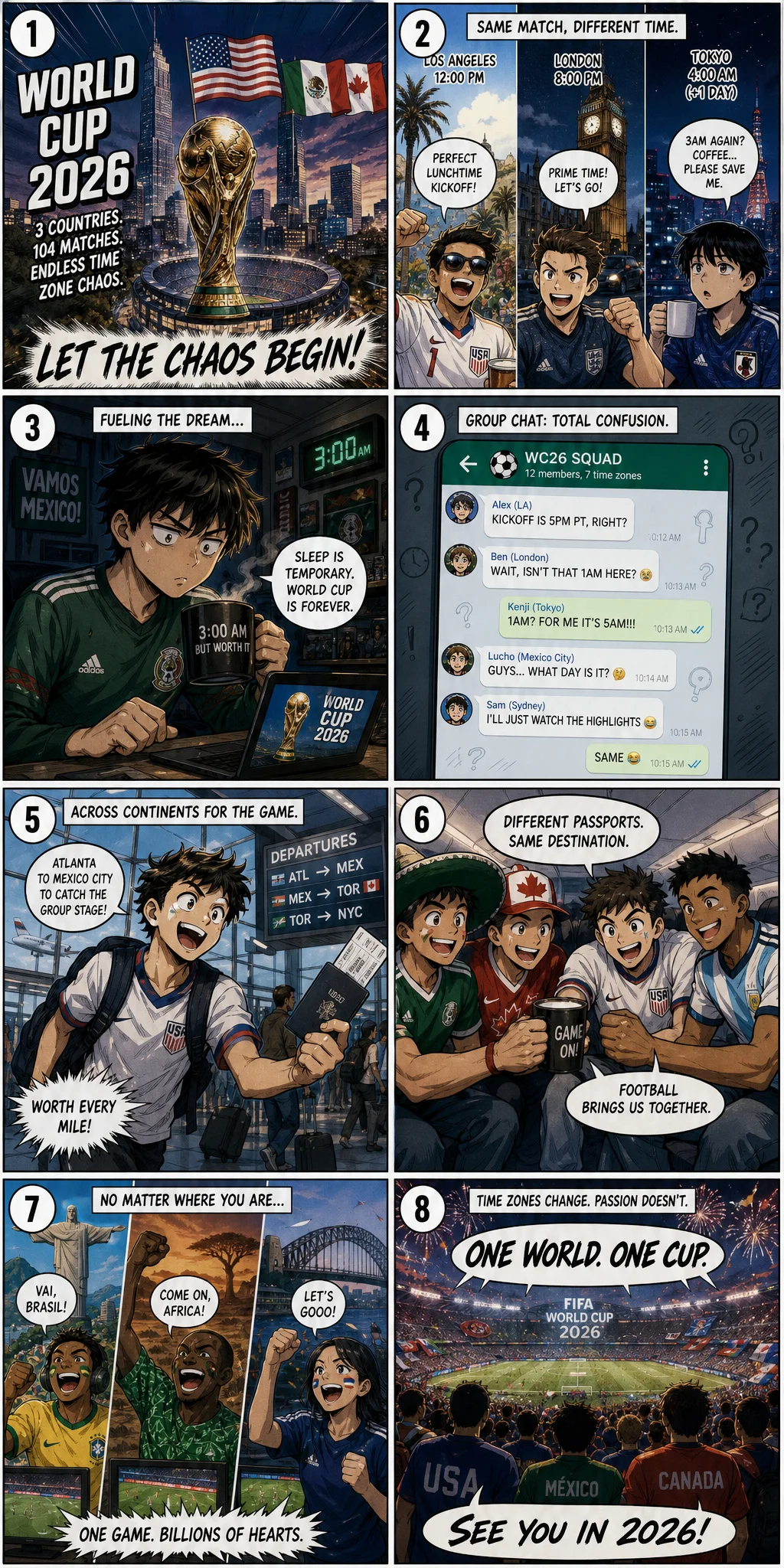
The 2026 World Cup spans four time zones. Fans are waking up at 3am, arguing about kickoff times, and forming a strange timezone-confused global solidarity.
Published: June 6, 2026
The 2026 World Cup spans four time zones: Pacific (UTC-7), Mountain (UTC-6), Central (UTC-5), and Eastern (UTC-4). If you watch a 1 PM match in Vancouver, then fly to Atlanta, your phone automatically updates the time when you land—but your body doesn’t. Your body is still in Vancouver. It’ll tell you it’s time for bed at 7 PM in Atlanta, just as the game is kicking off.
For fans, jet lag is a low-grade form of torture. You drag yourself out of bed at 3 AM to watch the opening match—because it’s 2 PM in Mexico City, already 8 AM in the UK, and evening in Australia. You’re living in multiple time zones at once throughout the same World Cup. Your coffee consumption hits an all-time high. And your answer to “What time is it?” becomes “Which country?”
You know what the hardest part is? It’s not you. It’s arranging to watch a match with your friends. “We’re kicking off at nine, right?” “Which nine?” “Our nine or their nine?” “Wait, that game’s in Dallas—is Dallas Central Time? Or Eastern?” “I don’t know, I thought Dallas was in California.” That’s the most authentic everyday conversation of the 2026 World Cup—a bunch of grown adults in a group chat, trying to figure out time zones like kids lost in a department store. But honestly—there’s a charm to it too. A kind of global, synchronized chaos that only the World Cup can deliver. When the whole world spends the same month not knowing what time it is—that’s a weird kind of unity.