The Foxborough Traffic Nightmare: When the World Cup Meets American Suburbia
Gillette Stadium is 30 miles from Boston in a small town with one road and no transit. For the 2026 World Cup, fans are packing tents.
Published: June 6, 2026
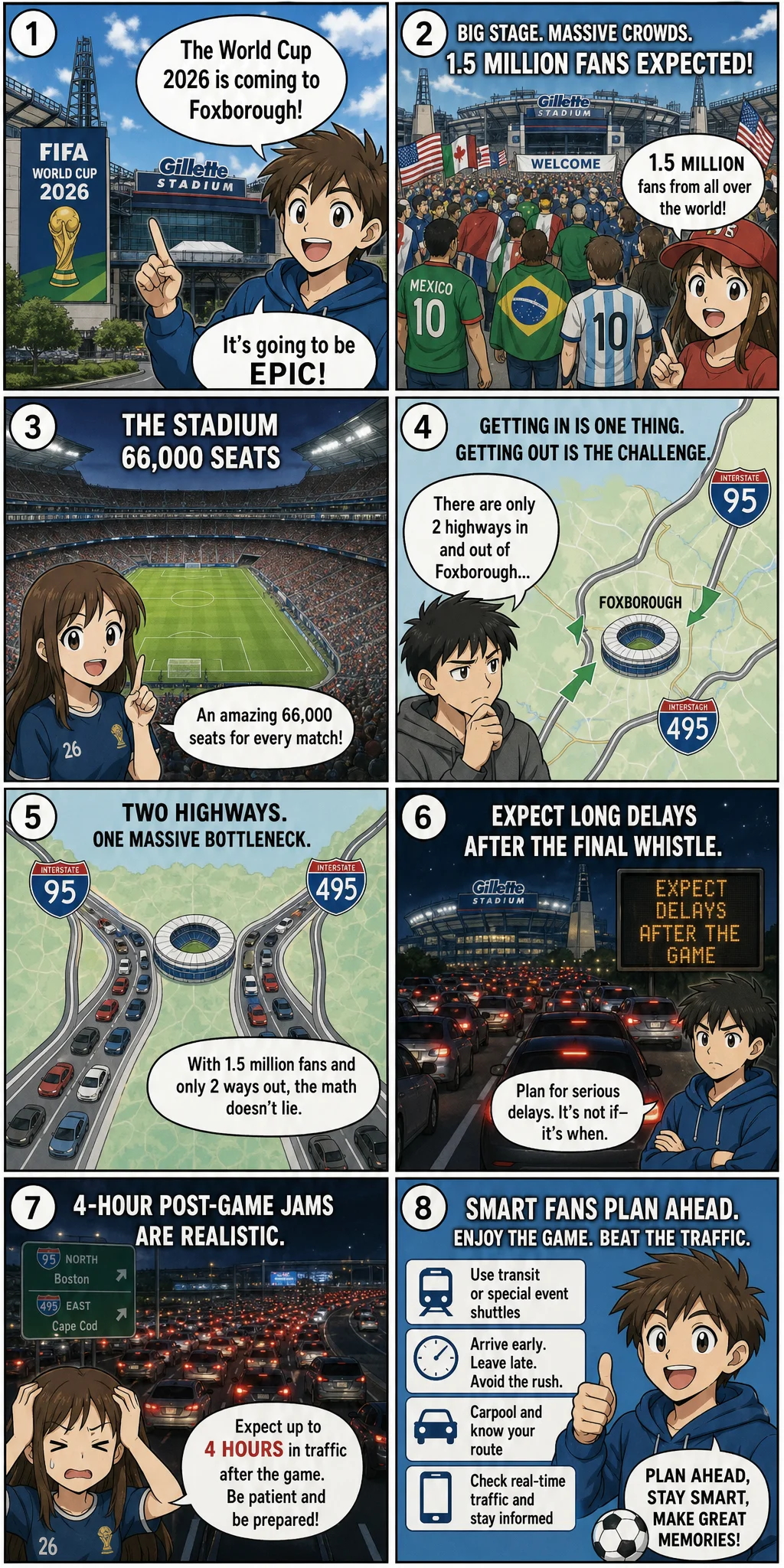
The Gillette Stadium in Boston isn't actually in Boston. It's in Foxborough—a small town 30 miles from downtown Boston. Thirty miles. Roughly 48 kilometers. About a 40-minute drive—if there's no traffic. But on a World Cup match day, that road from downtown Boston to Gillette Stadium—basically a single-lane suburban highway—turns into a moving parking lot.
Foreign media have already started sounding the alarm. The Guardian's travel section ranked Gillette Stadium as the number one "most difficult stadium to reach" for the 2026 World Cup. But the town manager of Foxborough said something in a local newspaper interview that really stuck with me: "We're a small town. We don't have a subway. We don't have light rail. What do we have? We have a parking lot—a big parking lot. The World Cup is coming. We'll figure it out."
I admire that attitude. American suburban infrastructure wasn't designed for the World Cup—it was designed to get one car from point A to point B. When you drop 40,000 international fans without cars into a town with just one road—what happens? The answer is: Uber surge pricing goes astronomical, locals start renting out their driveways to fans for parking (a hundred bucks a spot), and the smartest fans show up a day early to pitch tents in the parking lot and sleep overnight. The magic of the World Cup isn't about perfect infrastructure. It's about fans finding a way, no matter how imperfect the infrastructure is.