The Countries You Have Never Heard Of
The newcomers to the World Cup—Uzbekistan, Cape Verde, Jordan, and Curaçao—have qualified for the World Cup finals for the first time in their history.
Published: June 6, 2026
# Countries You've Never Heard Of: The Newcomers to the World Cup
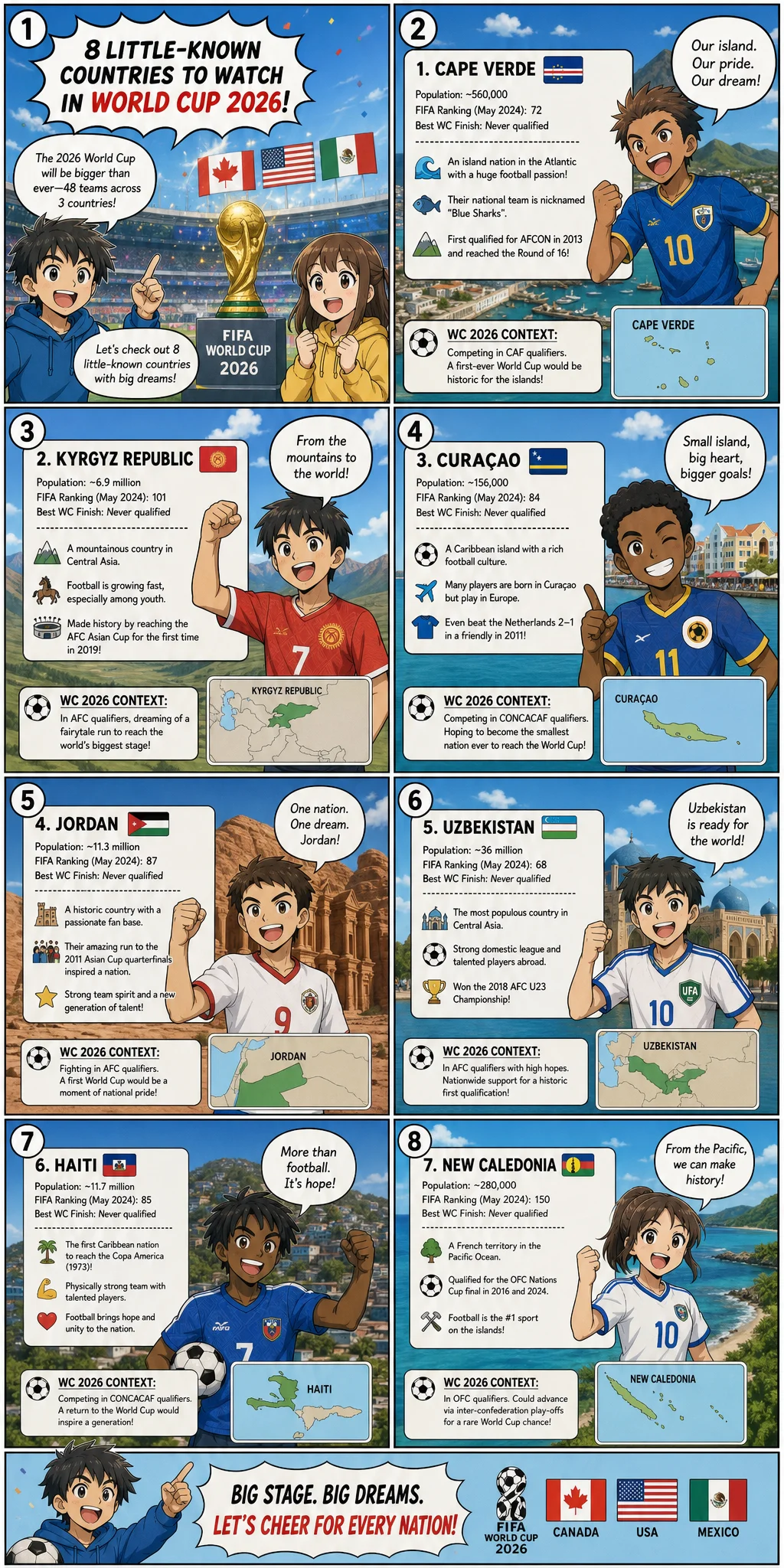
The 2026 World Cup welcomes several historic new faces. Uzbekistan. Jordan. Cape Verde. Curaçao. These four names—if you're not a geographer, you may need to Google a few of them—are all making their debut in the World Cup finals.
Uzbekistan is a Central Asian former Soviet republic, famous for the ancient Silk Road city of Samarkand and its cotton. Football has never been their national calling card. But their youth development system has quietly toiled over the past decade, with the U20 and U23 national teams consistently reaching the knockout stages of Asian competitions. Their star player, Eldor Shomurodov, has played for Cagliari and Roma in Serie A—he is the face of Uzbek football, a player who has made scouts around the world start looking for "Tashkent" on the map. Uzbekistan's path to qualification was long and arduous—in the final round of the Asian qualifiers, they defeated a more experienced West Asian team away from home, and the streets of Tashkent turned into a makeshift celebration square that night.
Cape Verde—a West African island nation with a population of less than 600,000, consisting of ten islands. If they were a city, they probably couldn't even fill the stands of a World Cup stadium. But their national team—nicknamed the "Blue Sharks"—fought their way through the African qualifiers. Cape Verde's football story is one of migration—most of their players are Cape Verdean descendants born in Portugal, France, or the Netherlands, playing in lower-tier European leagues, and some aren't even full-time athletes. A Cape Verdean defender might play a World Cup qualifier on the weekend and then return to his job stocking shelves at a supermarket on Monday morning. It's this group of people who eliminated Nigeria—one of the most successful nations in African football history—in the African qualifiers. That match took place in Cape Verde's capital, Praia, with televisions flickering on across the entire country. After the final whistle, people danced in the streets of every village on the islands. A nation of 600,000 had made it to the World Cup. This story needs no statistics to prove its weight.
Jordan—a Middle Eastern kingdom sandwiched between Saudi Arabia, Iraq, Syria, and Israel—has never been a traditional powerhouse in Asian football. Their national team's best achievement over the past two decades was reaching the Asian Cup quarterfinals. But in the 2026 World Cup qualifiers, Jordan did something even their own fans couldn't have imagined: they eliminated several traditional strong teams in the group stage and advanced directly as group runners-up. Jordan's football style is counter-attacking—they know they're not the strongest, but they have an underrated defense and a striker who transforms into a different kind of player at crucial moments. After securing qualification, the King of Jordan declared a national holiday. For a country that had never appeared in the World Cup, this day wasn't just about celebration—it was about identity. From now on, Jordan is no longer "that country you're not quite sure about on the map." Jordan is a "2026 World Cup participant."
Curaçao—a Dutch island in the Caribbean with a population of 150,000, likely one of the smallest participating nations in the 2026 World Cup. Curaçao only became an independent football association in 2010 (previously part of the Netherlands Antilles). Almost all of their players compete in various Dutch leagues. Their head coach is Dutch, and their assistant coach is a local from Curaçao. Their qualification journey went through the Caribbean qualifiers and the final round of CONCACAF. The miracle of Curaçao football didn't happen overnight—it's the result of an entire generation of Curaçaoan players raised in the Netherlands, who decided to wear the jersey of their grandparents' homeland and etched the name of this 150,000-person island into World Cup history.
These four teams probably won't win the World Cup. They may be eliminated in the group stage. But the World Cup has never been just about winning. It's about those who were never invited finally receiving an invitation. When the children of Uzbekistan see their national flag for the first time in the team parade at the World Cup opening ceremony—when Cape Verdean fishermen hear their country's name spoken by broadcasters around the world on the radio—when Jordanian fans in the squares of Amman watch their team step onto the World Cup pitch—when Curaçao's 150,000 people realize that the world finally knows their name. These moments—not the scores, not the points, not the knockout results—are the entire meaning of the World Cup's existence.