The Ball With Canada's Maple Leaf, Mexico's Eagle, and America's Stars
The official ball for 2026 features a design combining symbols of the Three Kingdoms with fluid geometric lines—an eight-year-old child in a store hugged the display ball and refused to let go.
Published: June 6, 2026
# That Ball Bears Canada’s Maple Leaf, Mexico’s Eagle, and America’s Stars
The official match ball for the 2026 World Cup—Adidas hasn’t given it a name like “Al Rihla” or “Telstar” yet, at least not as of this writing. But its design has been unveiled, and it may well be the most ambitious—and most successful—attempt in World Cup history to embed host-nation culture into a football.
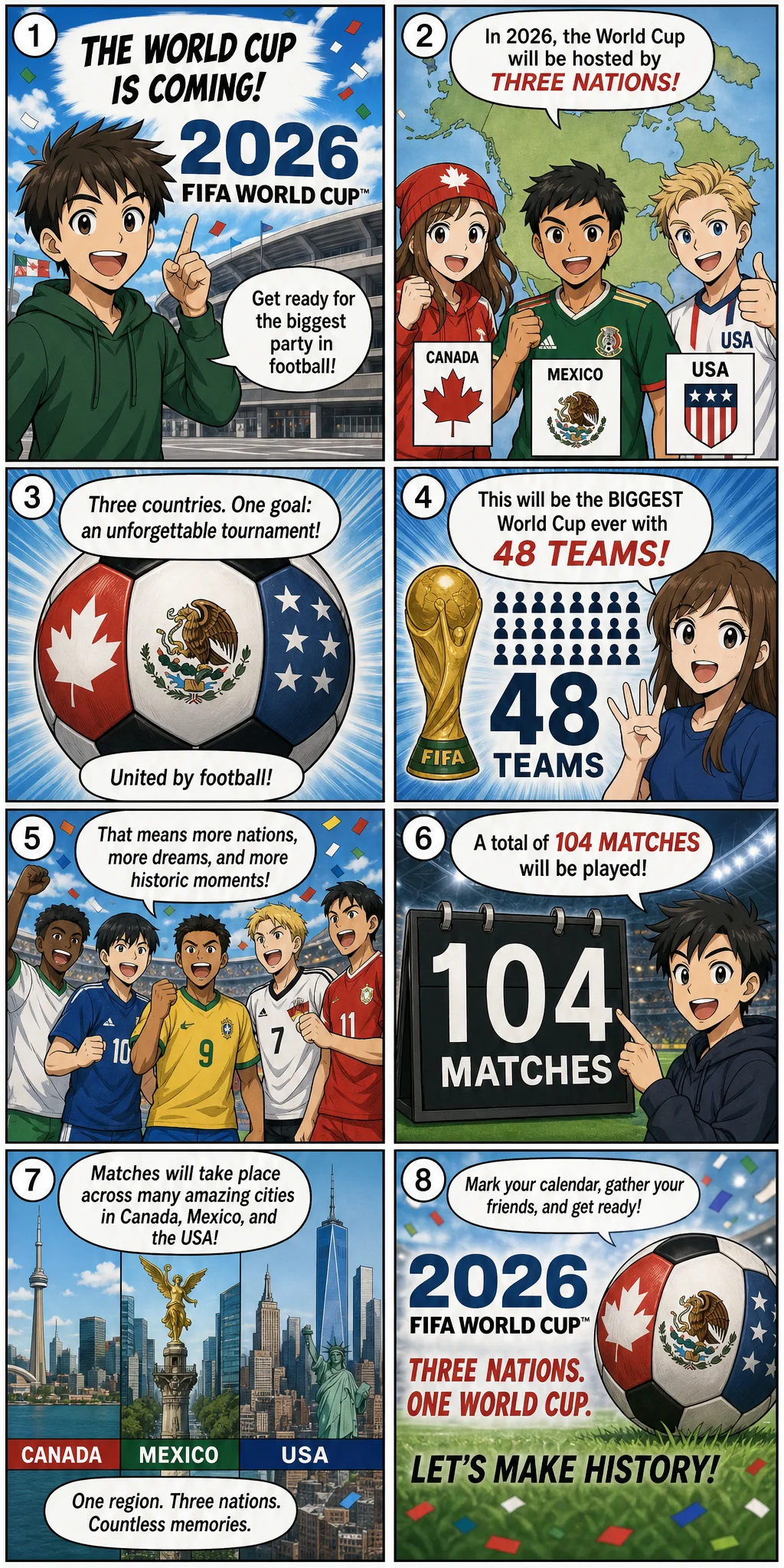
Three symbols appear on the ball’s surface: Canada’s maple leaf, Mexico’s eagle, and America’s stars. They aren’t isolated in separate zones—instead, fluid geometric lines weave them together, as if three cultures are intertwining in the same gust of wind. Adidas’s design team says the inspiration came from the three oceans surrounding North America—the Atlantic, the Pacific, and the Gulf of Mexico—the currents that naturally bind these three nations. The maple leaf isn’t a lone leaf on the ball; it’s carried by wave-like lines, flipping and crossing paths with the eagle’s wings and the stars’ radiance. From certain angles, you can’t even tell which line belongs to which country—and that’s exactly the effect the design team wanted.
Football design isn’t just about aesthetics. It has to meet the rigorous demands of sports physics. The margin of error in modern match balls has been compressed to the micron level—an imperfect seam can shift a ball’s flight path by a few centimeters, and at the elite level, that’s the difference between a goal and the post. Adidas made a decision with this 2026 ball that I didn’t see coming: they hid the technology. The ball’s appearance isn’t “tech-forward”—none of that futuristic texture you can instantly tell was generated by a computer algorithm. Instead, it has a warm, handcrafted feel. From a distance, it looks like an embroidered work of art, with lines that seem stitched on by hand, one needle at a time. Up close, you realize those seemingly random curves are actually mathematically precise fluid-dynamic textures—they’re not there to look good; they’re there to keep the ball stable during high-speed rotation.
I first touched this ball at a sporting goods store. It’s light—440 grams, same as all modern match balls. But its surface texture—that feel somewhere between smooth and micro-friction—makes you want to kick it. A kid, maybe eight years old, walked over, picked up another display ball, looked at his mom, then hugged it tight against his chest, like he was holding a puppy. Not asking to buy it. Just holding it. His mom crouched down and said, “You need to put it back.” He shook his head. He pressed his cheek against the ball’s surface—right next to that maple leaf, that eagle, those stars. That’s probably exactly what Adidas was going for. Not a football. A reason to want to run out onto the grass in the summer of 2026.