Sweden: Journey to 2026
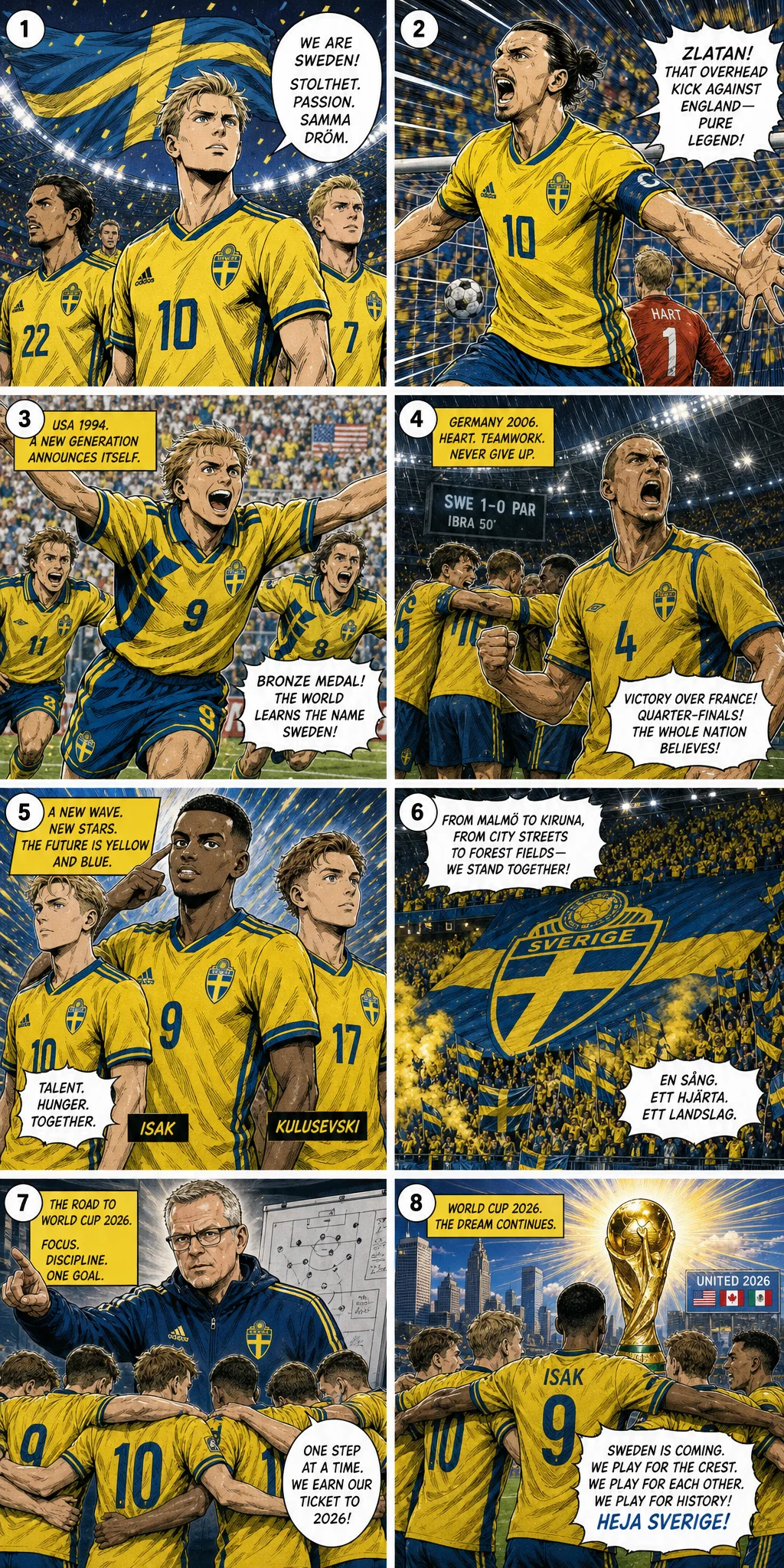
8-panel comic about Sweden national football team and their journey to the 2026 FIFA World Cup.
Published: June 5, 2026
Sweden National Football Team: The Blue and Yellow's Nordic Steel
The Sweden national football team, known as "Blågult" — The Blue and Yellow — for the colors of the national flag they wear with understated pride, represents a football nation that has consistently exceeded the expectations suggested by its modest population of just over ten million. Swedish football is defined by collective organization, physical robustness, and a tactical intelligence that has produced some of the game's most respected coaches. Sweden's qualification for the 2026 FIFA World Cup continues a tradition of punching above weight that has made the Nordic nation one of European football's most respected competitors.
HISTORICAL FOUNDATIONS
Football arrived in Sweden in the late nineteenth century, introduced by English workers and students who brought the game to the industrializing cities of Gothenburg, Stockholm, and Malmö. The Swedish Football Association was founded in 1904, and the sport quickly established itself as one of the country's most popular pastimes, competing with ice hockey and bandy for the affections of the Swedish sporting public.
Sweden's early international football was defined by the 1948 Olympic gold medal in London, a tournament in which the legendary forward trio of Gunnar Gren, Gunnar Nordahl, and Nils Liedholm — known as "Gre-No-Li" — announced Swedish football's arrival on the global stage. Nordahl's 43 goals in 33 international matches before his move to AC Milan, where he became the club's all-time leading goalscorer until being surpassed decades later, established a standard of Swedish goalscoring excellence.
The 1950 World Cup in Brazil saw Sweden reach the final group stage, finishing third behind Uruguay and Brazil. The 1958 World Cup, hosted by Sweden, represents the nation's greatest football achievement. The team, featuring young talents like Kurt Hamrin and the veteran leadership of Liedholm, reached the final in Stockholm before losing 5-2 to a transcendent Brazil team featuring a 17-year-old Pelé. Sweden had hosted the world and performed at a level that the nation's football infrastructure and population size made remarkable.
The 1994 World Cup in the United States produced Sweden's modern golden memory: a third-place finish under coach Tommy Svensson, the team defeating Bulgaria 4-0 in the third-place playoff. Thomas Brolin's goal — a sweeping team move finished with a delicate chip — is among the most aesthetically pleasing goals in World Cup history. Tomas Ravelli's penalty saves against Romania in the quarter-final shootout secured Sweden's place in the semi-finals, where a 1-0 defeat to eventual champions Brazil ended the dream but could not diminish the achievement.
LEGENDS OF BLÅGULT
Zlatan Ibrahimović is Sweden's greatest ever footballer by every statistical measure and by the sheer force of his personality. His 62 goals in 122 international appearances, his career at the world's elite clubs — Ajax, Juventus, Inter Milan, Barcelona, AC Milan, Paris Saint-Germain, Manchester United — and his unique combination of technical genius and self-mythologizing swagger made him one of the defining figures of twenty-first century football. Ibrahimović's goal against England in 2012 — a 35-yard bicycle kick that defied physics and probability — is one of football's most spectacular goals. His autobiography, titled "I Am Zlatan Ibrahimović," perfectly captured the persona that made him globally iconic.
Gunnar Nordahl, the original Swedish goal machine, scored 210 goals in 257 matches for AC Milan — a strike rate of devastating efficiency. His departure to Italy, along with Gren and Liedholm, prompted the Swedish Football Association to ban professional players from the national team — a policy that kept the Gre-No-Li trio from representing Sweden at the 1950 World Cup and deprived the nation of its greatest generation at its peak. Liedholm, who played into his forties (including in the 1958 World Cup final at age 35), represented Swedish football's technical sophistication — a player of such composure and passing quality that AC Milan fans still speak his name with reverence.
Henrik Larsson, the dreadlocked striker whose partnership with the national team extended across two distinct eras, scored 37 international goals and provided the bridge between the 1994 bronze medal team and the 2006 World Cup campaign. His selfless team play, aerial ability despite modest height, and clinical finishing made him beloved at Celtic, Barcelona (where he came off the bench to create both goals in the 2006 Champions League final victory), and Manchester United. Freddie Ljungberg, the red-haired Arsenal winger whose late-arriving runs into the penalty area became a trademark, was the attacking spark of the early 2000s Swedish teams.
THE MODERN ERA
Sweden enters the 2026 World Cup in a post-Zlatan era — liberated, in some respects, from the gravitational pull of a superstar whose presence both elevated and complicated the team's tactical identity. The current squad represents a return to Swedish football's traditional strengths: collective organization, physical competitiveness, and tactical discipline executed with a unity of purpose.
Alexander Isak, the Newcastle United striker, is the attacking focal point — a tall, technically gifted forward whose combination of physical presence and silky close control makes him difficult for any defender to handle. His emergence as one of the Premier League's most effective strikers has given Sweden the goal-scoring threat that every successful national team requires. Dejan Kulusevski, the versatile Tottenham Hotspur attacker, provides creativity, work-rate, and the ability to operate in multiple attacking positions.
The midfield features Emil Forsberg, the experienced playmaker who has been Sweden's creative hub for multiple tournament cycles, alongside emerging talents who provide energy and progressive passing. The defensive unit, built around the commanding presence of Victor Lindelöf (Manchester United) and supported by full-backs and central defenders operating in Europe's top leagues, provides the organizational foundation that has characterized Swedish defensive excellence.
The domestic Allsvenskan, while not among Europe's financially elite leagues, continues to produce tactically educated, physically competitive players. Malmö FF's European campaigns, including regular Champions League group stage appearances, have provided valuable exposure for Swedish talent. The Swedish model — combining professional domestic football with strategic player exports to stronger European leagues — has proven sustainable and productive.
FOOTBALL AND SWEDISH CULTURE
Swedish football culture reflects the nation's broader social values: egalitarianism, collective responsibility, and a preference for substance over style. The Swedish model of football club ownership — in which members control clubs through democratic structures, with no private ownership permitted under the 51% rule — represents a unique commitment to community-based sport in an era of globalized capital.
The supporters' culture is passionate but generally free of the hooliganism and violence that have plagued football in other European nations. The "Gula Väggen" (Yellow Wall) and other organized supporter groups create colorful, vocal atmospheres without the social problems that have accompanied ultra culture in some countries. Swedish football's family-friendly reputation is both a point of pride and, occasionally, a subject of debate about whether the domestic game possesses sufficient intensity.
The national team provides a unifying force in Swedish society at a time when debates about immigration, identity, and social cohesion dominate public discourse. The diversity of the current squad — featuring players with roots in the Balkans, the Middle East, Africa, and across Europe as well as native-born Swedes — reflects the modern Swedish reality. The team's success depends on this diversity functioning cohesively, a metaphor that does not go unremarked in Swedish public conversation.
THE PATH FORWARD
Sweden enters the 2026 World Cup as a team that opponents respect and would prefer to avoid. The Swedish style — organized, physical, difficult to break down, dangerous on set pieces and counter-attacks — is not glamorous but it is effective. The Round of 16 is the realistic target; a quarter-final appearance, depending on the draw, is within the team's capability.
The tactical approach emphasizes defensive organization in a compact shape, quick transitions exploiting the pace and technical quality of Isak and Kulusevski, and set-piece proficiency — a traditional Swedish weapon that remains among the team's most reliable goal-scoring avenues. Sweden will not dominate possession against elite opponents, but the team is comfortable without the ball, content to absorb pressure and strike with efficiency.
For Swedish football, the 2026 World Cup is an opportunity to demonstrate that the nation's consistent competitiveness is not dependent on a single transcendent talent. The post-Zlatan era has been navigated successfully; the blue and yellow remain a respected force in international football. The Nordic steel — cool, durable, and sharp — travels well to North America.