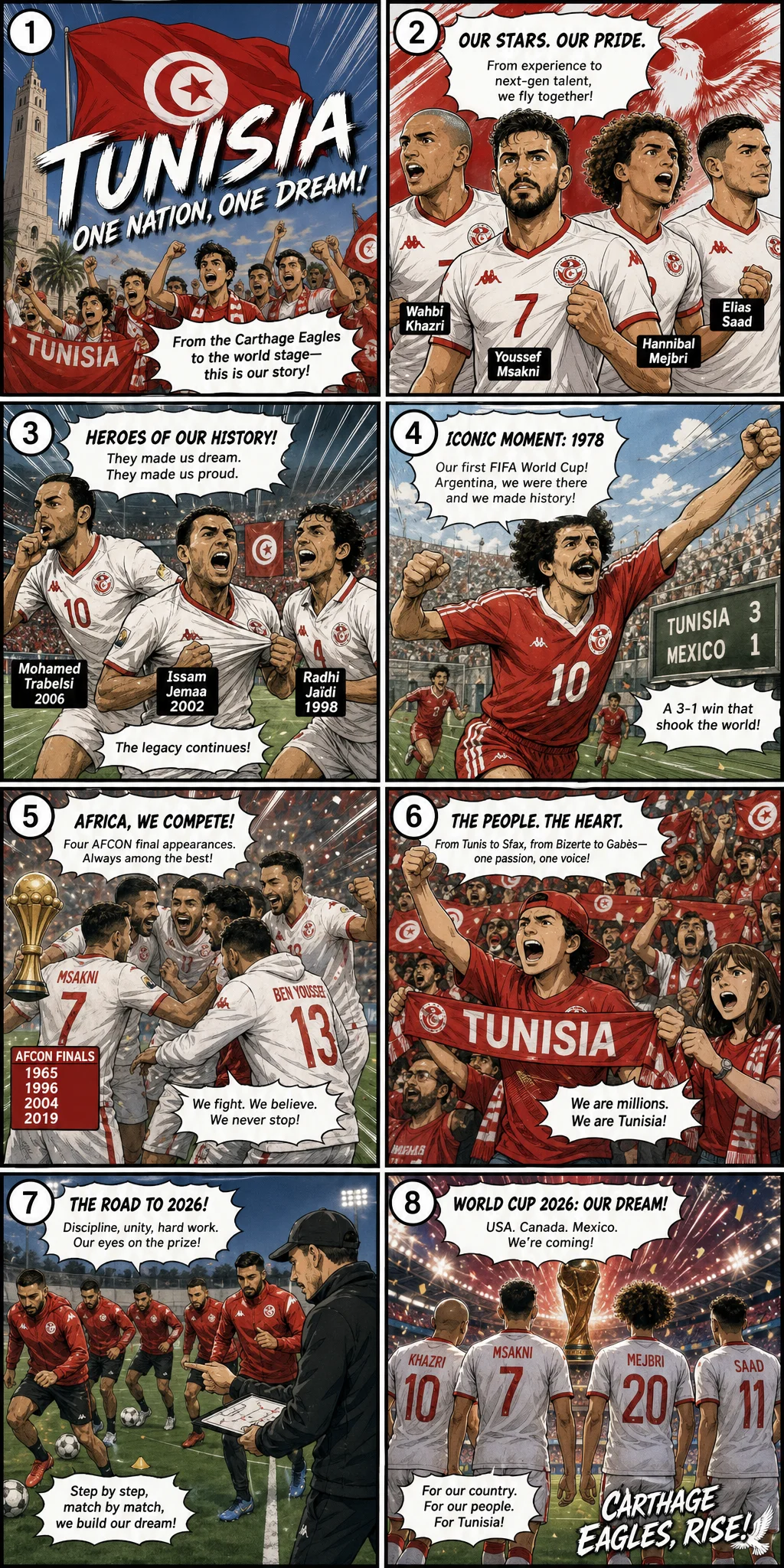
Tunisia: Journey to 2026
8-panel comic about Tunisia national football team and their journey to the 2026 FIFA World Cup.
Published: June 5, 2026
Tunisia National Football Team: The Eagles of Carthage Soaring Again
The Tunisia national football team, known as "Les Aigles de Carthage" — The Eagles of Carthage — carries the name and symbolic power of the ancient civilization that once dominated the Mediterranean from its capital near modern-day Tunis. Tunisia's football history, while not as decorated as some of Africa's traditional powers, reflects a nation that has consistently produced technically proficient, tactically intelligent footballers and competed with dignity at the sport's highest levels. Their qualification for the 2026 FIFA World Cup represents another opportunity for the Eagles to demonstrate North African football's quality on the global stage.
HISTORICAL FOUNDATIONS
Football arrived in Tunisia during the French protectorate period in the early twentieth century, spreading through the coastal cities and towns of a country whose history stretches back over three millennia. The Tunisian Football Federation was founded in 1957, just one year after independence, establishing the sport as an integral part of the new nation's identity. The national team's first international matches in the late 1950s began a journey that would eventually lead to consistent African competitiveness.
Tunisia's breakthrough moment came in 1978 when the team qualified for the World Cup in Argentina — becoming the first North African nation and only the second African nation overall (after Zaire in 1974, and Egypt in 1934) to reach football's greatest tournament. The campaign included a historic 3-1 victory over Mexico — Africa's first ever World Cup win — with goals from Ali Kaabi, Néjib Ghommidh, and Mokhtar Dhouieb. Though Tunisia failed to advance from the group stage, losing to Poland and drawing with defending champions West Germany, the victory over Mexico established a benchmark for African World Cup performance.
The 1998 World Cup in France marked Tunisia's return to the tournament after a 20-year absence, followed by appearances in 2002 and 2006. Each campaign ended in the group stage, but the consistency of qualification — three consecutive tournaments — demonstrated Tunisia's position among Africa's football elite. The 2018 World Cup in Russia saw Tunisia return after missing the 2010 and 2014 tournaments, with competitive performances against England (a 2-1 defeat decided by a late Harry Kane winner) and Belgium suggesting that the gap between North African football and the world's best was narrowing.
The 2022 World Cup in Qatar produced Tunisia's most famous tournament victory: a 1-0 win over defending champions France on the final day of the group stage. Wahbi Khazri's goal — a driving run and clinical finish — secured a result that, while not sufficient for knockout qualification, was celebrated across the Arab world as a moment of North African football pride.
LEGENDS OF THE EAGLES
Tarak Dhiab is widely considered Tunisia's greatest ever footballer. The elegant midfielder, named African Footballer of the Year in 1977, represented the technical sophistication that characterizes North African football at its best — intelligent passing, close control, and the ability to dictate a match's tempo from midfield. His career at Espérance de Tunis, where he won multiple domestic and continental titles, made him a club icon, and his international career spanning the 1970s established Tunisia's football credibility on the African stage.
Radhi Jaïdi, the towering central defender who played for Bolton Wanderers and Birmingham City in the English Premier League, earned 105 caps for Tunisia and provided the defensive stability and aerial threat that characterized the national team's most successful era. His goal against Saudi Arabia at the 2006 World Cup — a powerful header from a set piece — remains one of the Eagles' iconic tournament moments.
Wahbi Khazri, the creative forward whose career at Bordeaux, Sunderland, Saint-Étienne, and Montpellier demonstrated sustained quality in France's Ligue 1 and England's Premier League, has been the team's attacking talisman for over a decade. His goal against France in 2022, combined with his set-piece delivery and creative contributions, made him the face of Tunisian football in the modern era. Youssef Msakni, the dribbling wizard who has spent most of his career in Qatar's Stars League after emerging at Espérance, has scored crucial international goals and provided moments of individual brilliance.
THE MODERN ERA
Tunisia enters the 2026 World Cup with a squad that blends experienced campaigners with emerging talents developed in the domestic league and European academies. The Tunisian Ligue Professionnelle 1, anchored by the dominant forces of Espérance de Tunis, Club Africain, Étoile du Sahel, and CS Sfaxien, continues to produce technically proficient players who feed the national team and export markets.
The current tactical identity emphasizes defensive organization, midfield control, and the counter-attacking threat that has become the signature of North African football at the international level. Tunisia does not possess the individual attacking talent of teams like Morocco or Senegal, but the collective organization and tactical discipline make the Eagles difficult opponents for any team.
The squad features professional players based primarily in France, other European leagues, and the Gulf region, with the domestic league providing a pipeline of emerging talent. The goalkeeper position has been a traditional strength, with agile, technically proficient shot-stoppers representing Tunisia's contribution to the global goalkeeping tradition. The midfield combines defense-first solidity with the ability to progress the ball through technical passing sequences.
FOOTBALL AND TUNISIAN CULTURE
Football in Tunisia is a national obsession that bridges the country's regional, class, and generational divisions. The Tunis derby between Espérance and Club Africain divides the capital with an intensity that ranks among African football's most passionate rivalries — the Stade Olympique de Radès transformed into a cauldron of noise, color, and emotion when the two giants meet.
The national team serves as a source of collective pride and occasional national unity in a country whose post-Arab Spring political journey has been complex and contested. Tunisia's 2011 revolution — the spark that ignited the broader Arab Spring — elevated football supporters' groups to political actors, and the subsequent relationship between football, civil society, and the state remains dynamic.
Match days transform Tunisian cities. Cafes fill with spectators, streets empty of traffic, and the national colors — red and white — appear on flags, scarves, and painted faces. When the Eagles score, the celebrations echo through neighborhoods and are amplified by social media, connecting the domestic audience with the large Tunisian diaspora in France, Italy, and across Europe.
THE PATH FORWARD
Tunisia's goal at the 2026 World Cup is to advance beyond the group stage for the first time in the nation's history — a barrier that six previous tournament appearances have failed to breach. The expanded tournament format, with its more forgiving group stage structure and expanded knockout pathways, provides an opportunity for teams from Africa and Asia to advance further than in previous tournaments.
The tactical approach will emphasize the defensive organization and collective discipline that have become Tunisian football's hallmarks. The team will likely cede possession to higher-ranked opponents, defend in compact blocks, and seek scoring opportunities through counter-attacks and set pieces — the latter a traditional strength, with the aerial threats of central defenders and the delivery quality of midfield technicians.
For Tunisia, the 2026 World Cup is about validation — proof that North African football's quality extends beyond Morocco's historic 2022 run, that the Eagles of Carthage can soar at the same altitude as their regional rivals. The red and white travels to North America carrying a nation's hopes and a football tradition that stretches back to the ancient city whose name it bears. Carthage rises again.