The Story of Jerseys: How Colours and Numbers Became Legends
Exploring the cultural origins of Brazil's yellow, Netherlands orange, Argentina stripes, Croatia checkered, iconic shirt numbers, and 2026 technology.
Published: June 8, 2026
The Story of Jerseys
I first understood the weight of a football shirt in a small bar in Milan.
Bar Sport, tucked into the western shadow of San Siro — the kind of place where the espresso is always bitter, the photographs on the wall are always black and white, and the old man in the corner can tell you what happened in the eleventh minute of a match from forty years ago. That evening, a Coppa Italia game flickered on the television, the players moving in crisp new blue shirts. The old man nodded toward the screen. "You know where that blue comes from? Not the sea, not the sky — the coat of arms of the House of Savoy. 1560."
A jersey can hold a hundred stories. We wear them to scream at televisions, to weep in stadiums, to boast at weddings, to mourn at funerals. But they are more than fabric — they are vessels of memory, flags of identity, the shape of things that language cannot reach.
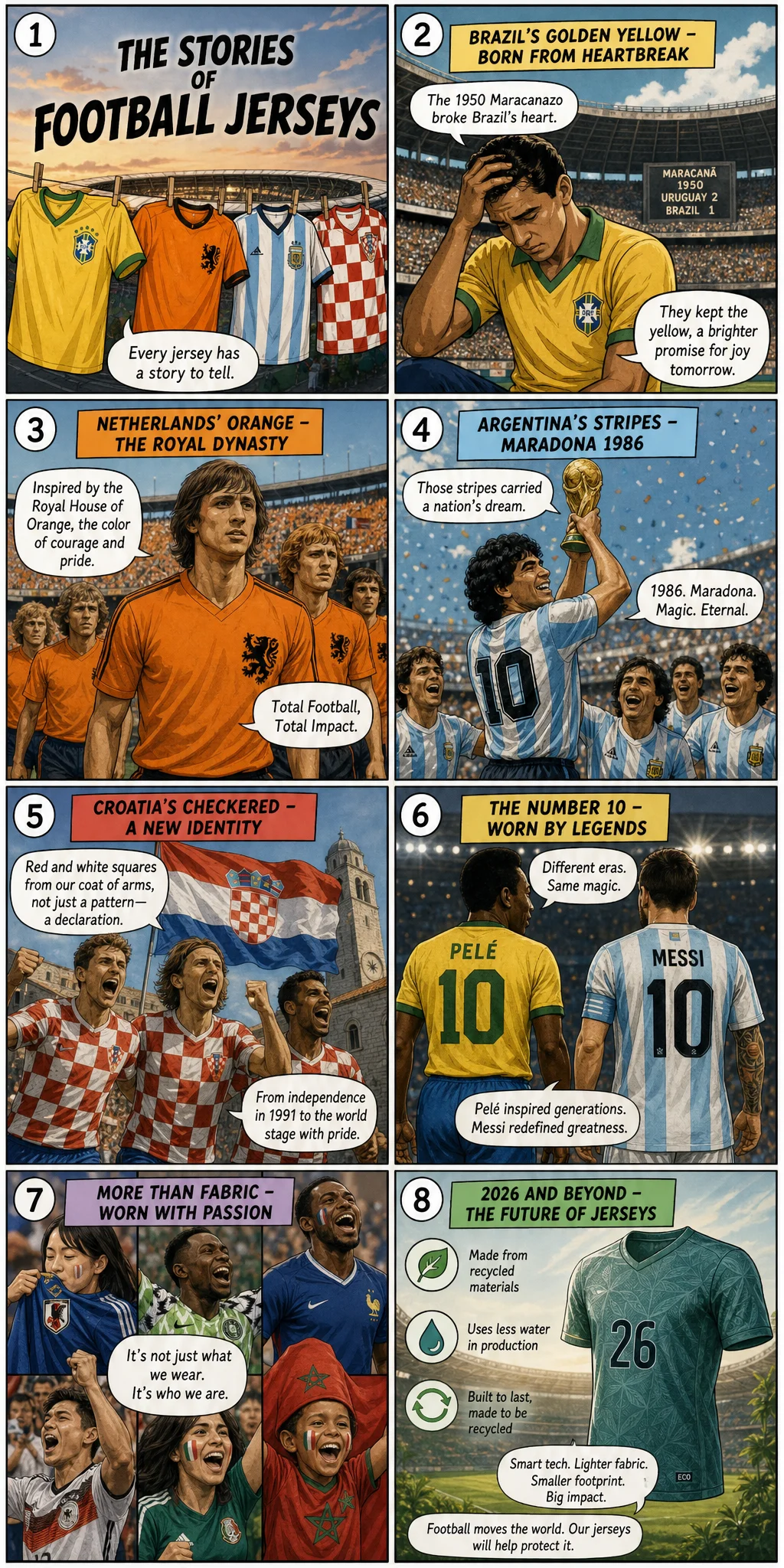
Start with Brazil's yellow. The most famous football colour on earth began as a national trauma. 1950, the Maracanazo — the moment two hundred thousand people stopped breathing at once — left the entire country disgusted with the white shirt. White was cursed, insufficiently Brazilian. So in 1953, a newspaper launched a design competition. A nineteen-year-old named Aldyr Schlee, living in a small town near the Uruguayan border, drew a canary-yellow jersey with green collar and cuffs, blue shorts. He won. That shirt has carried Brazil to five World Cups. Pelé wore it. Zico wore it. Ronaldo wore it. Neymar wore it. The 2026 version still has Schlee's name stitched inside the collar.
The Dutch orange is something else entirely. Not a design choice — a dynastic colour. The House of Orange-Nassau, the Dutch royal family, literally gave their name to the colour. The Netherlands play in orange not because their flag contains it (it doesn't — red, white, blue), but because they are running for a monarchy. In 1974, Total Football — Cruyff, Neeskens, Rensenbrink — transformed orange into an aesthetic. You see that orange shirt and you know what's coming: rapid triangles, positional rotation, a certain almost arrogant technical certainty. A colour became shorthand for a philosophy.
Argentina's blue-and-white stripes carry a different kind of weight. When Maradona wore that darker-shadowed Le Coq Sportif shirt on June 22, 1986, at the Azteca, he did two things — one England would never forgive, the other humanity would never forget. That jersey later sold for nearly nine million dollars. Not in a museum — in a Norwegian bank vault. The most expensive piece of fabric in football history.
Croatia's checkered pattern — the šahovnica — is medieval heraldry, the coat of arms of the Croatian kingdom, existing centuries before football did. When Šuker, Boban, and Prosinečki ran through France in 1998, they weren't just playing football. They were telling the world: this country exists. The checkered shirt remains the most instantly recognisable pattern in World Cup history.
Ask about the number ten shirt. It began as an administrative label — Pelé was randomly assigned number ten in 1958, a seventeen-year-old nobody knew. Then that number, worn by Pelé, Maradona, Zidane, Messi, Neymar, became a symbol of sovereignty. Number nine is the hunter — Ronaldo, Batistuta, Lewandowski — they end matches. Number ten is the creator — they define them. Number seven is the rebel — Best, Cantona, Cristiano — they defy them. Numbers transformed from practical labels into archetypes, from wardrobe into myth.
The 2026 jerseys belong to another technological dimension. Adidas makes shirts from recycled ocean plastic — you're wearing fishing nets that once floated off the Maldives. Nike resurrected its legendary Total 90 series — Australia's home kit directly references the 2006 design. Puma weaves temperature-regulating fibres into the fabric — the shirt cools you before you sweat. All of this promises faster, cooler, longer. But none of it is what a jersey truly means.
The real meaning came in the old man's next sentence. He set down his coffee cup, gestured at his own faded red-and-black Milan polo — collar stretched, cuffs frayed — and said something I will never forget: "It's not just a colour. It's our colour."
A jersey can be the healing of a trauma, the declaration of a dynasty, the birth of a nation, the canonisation of a number, the end of an era. It can be the shape of a city, a family, a faith. When you put it on, you are not just wearing a shirt. You are wearing every story of everyone who ever wore it before you.
Including the old man in the shadow of San Siro.
Including you.