World Cup Title Rankings: The System Behind the Stars
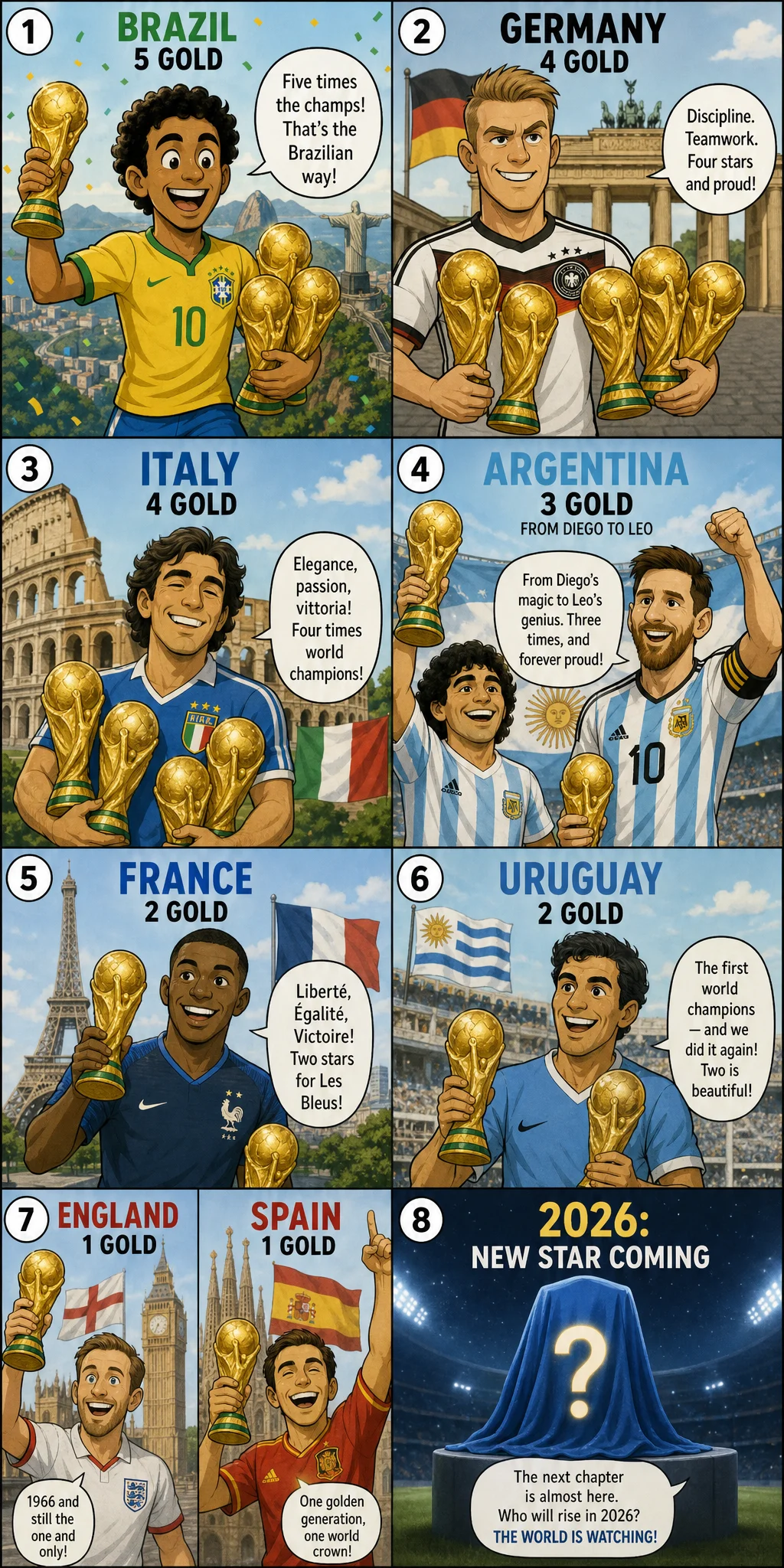
Eight nations have won the World Cup. Brazil leads with 5 titles, followed by Germany and Italy with 4, Argentina with 3. This is not just a list—it's a century of systems producing champions.
Published: June 8, 2026
Championship Tally: A Century of Systemic Evolution
The World Cup is not won. It is produced by systems.
Let's start with a counterintuitive number: twenty-two World Cups have produced eight champion nations. Eight. And four of them—Brazil, Germany, Italy, Argentina—have accounted for sixteen of those twenty-two trophies. Championships are not evenly distributed. They cluster.
If you view the championship tally as the output of a system, rather than the sum of heroic stories, you begin to ask a more interesting question: why do some nations win repeatedly, while others only appear during specific windows?
Brazil: The Industrial Production Line of Five Titles
In 1958, Brazil won its first World Cup in Sweden. A seventeen-year-old named Pelé burst onto the scene that year—but the point is not Pelé. The point is that the tactical preparation for that 1958 Brazilian team was led by a psychologist named João Carvalhaes. He was the first officially hired team psychologist in World Cup history. The Brazilian Football Confederation administered personality tests to the entire squad before the tournament, concluding that Pelé had the mental fortitude to handle knockout matches, while another forward, Garrincha—arguably more talented—showed results indicating he was "unsuited for high-pressure environments." Both played. Both devastated their opponents.
Brazil's system did not emerge from nowhere. It is the product of continuity. The 1970 World Cup title—widely considered the greatest single tournament performance in football history—was built on the same 4-2-4 structure, but with Zagallo moved from winger to midfield, forming an early prototype of the 4-3-3. The 1994 title was built on counter-attacking defense and Romário's efficiency in the box. The 2002 title was built on an asymmetrical pressing system in a 3-4-2-1. Five titles, five different tactical solutions. A system learned how to evolve.
Germany: The Only Nation to Rebuild from Ruins Four Times
Germany's championship history is a chronicle of organizational resilience. 1954—the "Miracle of Bern"—West Germany defeated the unbeaten-in-four-years Hungarian team in the final, relying not on talent, but on Adidas's screw-in studs (true—they were the first interchangeable stud boots, providing superior traction in the rain over the Hungarians' flat-soled shoes) and coach Herberger's tactical deception of deliberately losing 8-3 to the same Hungarian side in the group stage. 1974—Beckenbauer's sweeper system formally defined German football for the next two decades. 1990—defeating Italian-style defensive counter-attacking in Italy. 2014—winning the title in Brazil after annihilating the hosts 7-1.
This is no coincidence. After being eliminated in the group stage of Euro 2000—yes, Germany once failed to advance from the group—the German Football Association launched a plan to build fifty-two youth development centers nationwide. Twelve years later, the generation produced by those centers won the World Cup. The system's return on investment is approximately a decade.
Italy's Four Titles: The Self-Replication of a Defensive Philosophy
An underappreciated fact about Italy's four titles: they span seventy-two years, from 1934 to 2006. No other nation has maintained championship competitiveness over such a long period. Spain could not—they failed to break through before or after their 2010 peak. England could not—one title in sixty years.
Italy's secret is not a single generation of genius. It is the self-replicating ability of catenaccio as a cultural gene. Vittorio Pozzo in 1934 did not use catenaccio—he used the Metodo, an asymmetrical 2-3-2-3 formation—but he established the organizing principle of Italian football: defense is not passive. Defense is the starting point of attack. This principle passed through Pozzo (1930s), Bearzot (1980s), and Lippi (2000s), each time donning a new tactical garment, but the core logic never changed.
Argentina's Three Titles: Genius Density in Chaos
Argentina's championship pattern is entirely different from other champion nations. It is not system-driven—at least not in the way Germany or Italy are. Argentina's output is closer to a question of genius density: when your country produces a player capable of rewriting football's rules roughly once every decade, you do not need a perfect system. You need to get out of their way when they appear.
1978: Home soil, a military junta backdrop, the individual explosion of Mario Kempes. 1986: Maradona—not a system, but a single man. 2022: Messi completed his World Cup narrative at age thirty-five, but what truly allowed Argentina to win was the midfield pressing system built by Scaloni—the coverage range of De Paul, Mac Allister, and Enzo Fernández meant Messi did not need to defend. Argentina finally learned to build a structure around genius.
France, Uruguay, England, Spain: Window Champions
These four nations hold a combined six titles. Their commonality is not systemic legacy—it is having the right generation at the right time.
France's two titles (1998, 2018) are twenty years apart, but strikingly similar in structure: both relied on a powerful defensive midfield core (Deschamps won as both player and coach), and both featured a generation produced by the Clairefontaine academy. France's model is cyclical, but Clairefontaine's existence makes that cycle predictable.
Uruguay's two titles (1930, 1950) belong to the prehistoric era—when World Cup participation was fewer than sixteen teams and tactics were still in their infancy. The 1950 Maracanã Miracle—when 200,000 Brazilians simultaneously stopped breathing—is the greatest away victory in football history. But it cannot be replicated.
England's one title (1966) and Spain's one title (2010) are mirror images: both endured decades of failed "golden generation" narratives until a specific tactical configuration unlocked the championship. England relied on 4-4-2 with wide pressure and a hat-trick from a man named Geoff Hurst. Spain relied on tiki-taka's extreme ball possession—passing until the opponent fell asleep.
2026: Who Will Move the Needle?
The championship tally is not static—but it changes very slowly. With forty-eight teams participating, the champion will still most likely come from one of the eight nations that have already won. Expansion has not made the title more democratic—it has made the group stage more chaotic, but the knockout structure still rewards systemic depth.
One data point worth watching: in the last seven World Cups, European teams have won five. South America's advantage is being eroded by Europe's systematized youth development and tactical industrialization. If Brazil cannot break this trend in 2026, it will face its longest title drought—twenty-four years.
The championship tally does not tell you who is "best." It tells you who has built a system capable of functioning repeatedly over the high-pressure crucible of seven knockout matches. The title is not won. It is produced. And those eight nations—they possess the world's most sophisticated football factories.