Belgium: Journey to 2026
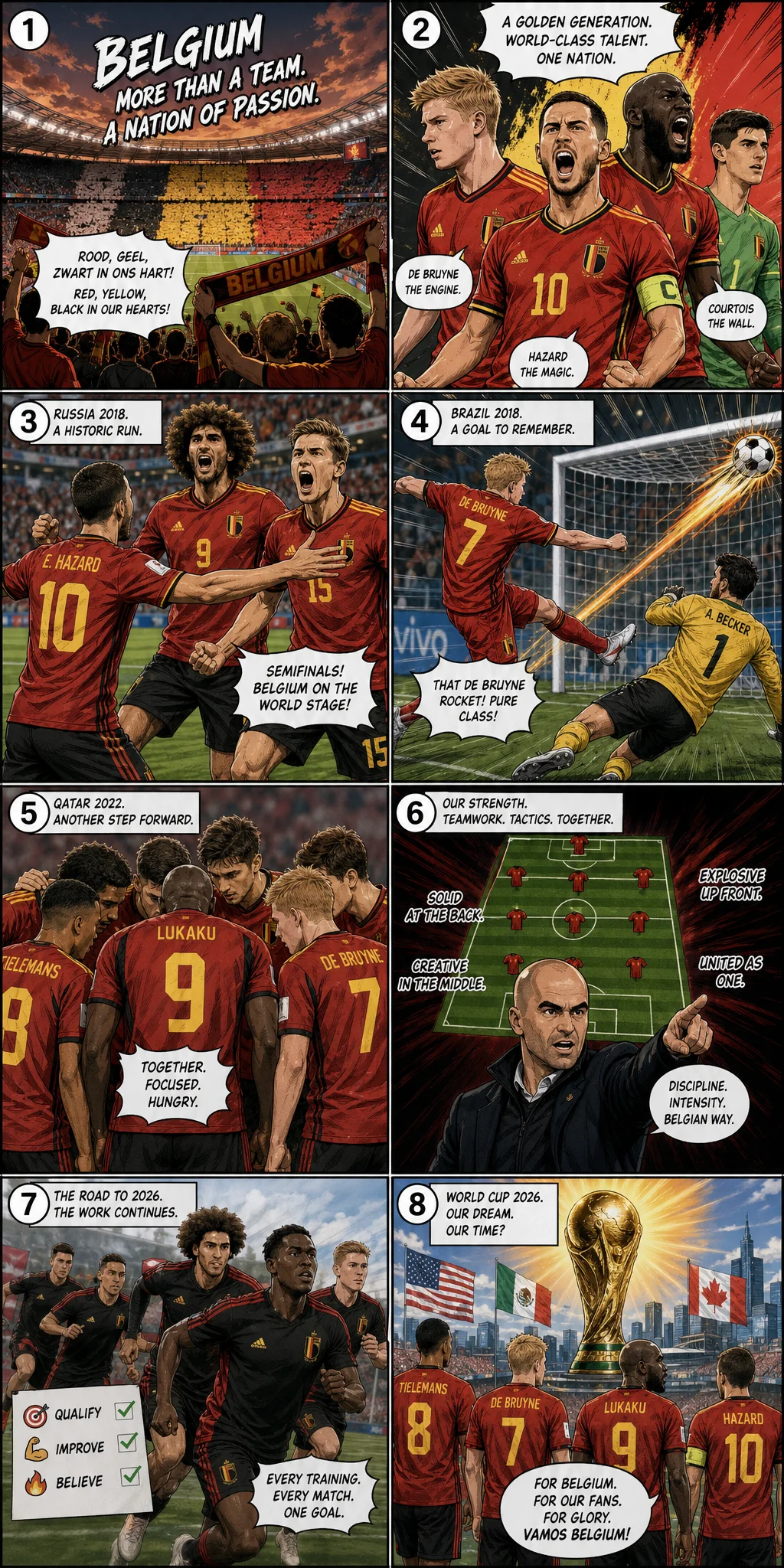
8-panel comic about Belgium national football team and their journey to the 2026 FIFA World Cup.
Published: June 5, 2026
Belgium National Football Team: The Red Devils' Golden Sunset
The Belgium national football team, known as the "Red Devils" for the fearsome crimson of their jerseys, has lived through a golden generation that transformed a nation of 11 million people into a global football power. For nearly a decade, Belgium occupied the top position in the FIFA World Rankings — a remarkable achievement for a country that had not reached a major tournament semi-final in three decades before the current era. The 2026 FIFA World Cup likely represents the last tournament for the core of Belgium's golden generation, a final opportunity to secure the major trophy that has eluded the most talented squad in the nation's history.
HISTORICAL FOUNDATIONS
Football in Belgium dates to the nineteenth century, with the Royal Belgian Football Association founded in 1895 — one of the oldest in the world. Belgium was among the earliest adopters of organized football outside the British Isles, and its national team competed in several pre-World Cup Olympic tournaments and the early World Cups, reaching the Round of 16 in 1934 and 1938.
For most of the twentieth century, Belgium operated as a respectable but unthreatening European football nation — capable of reaching major tournaments, occasionally producing outstanding individual players, but never seriously contending for titles. The 1980s provided a golden moment: the 1980 European Championship final, lost 2-1 to West Germany on a Horst Hrubesch goal, and the 1986 World Cup semi-final in Mexico, a run led by the brilliant midfielder Enzo Scifo. Belgium lost the semi-final to Diego Maradona's Argentina and the third-place match to France, finishing fourth — the nation's best World Cup performance before the current generation.
The decades between 1986 and the recent golden era were characterized by respectable performances without tournament breakthroughs. Belgium qualified for World Cups in 1990, 1994, 1998, 2002, and 2014 — consistent but unspectacular, never advancing beyond the Round of 16 until the current generation changed the nation's football expectations.
LEGENDS OF THE RED DEVILS
Enzo Scifo remains the benchmark of Belgian midfield elegance. His vision, passing, and goalscoring from central positions defined Belgium's 1986 World Cup run, and his career at Anderlecht, Inter Milan, Bordeaux, Auxerre, and Torino demonstrated technical quality of the highest order. Scifo's Italian heritage — he was born to Sicilian parents in the Belgian mining town of La Louvière — reflected the immigrant communities that have historically enriched Belgian football's talent pool.
Paul Van Himst, the elegant forward of the 1960s and 1970s who scored 30 goals in 81 international appearances, was Belgium's first football icon — a player of such quality that he finished fifth in the 1965 Ballon d'Or voting and led Anderlecht to multiple domestic titles. Jan Ceulemans, the indomitable captain of the 1980s, earned 96 caps and provided the physical presence and leadership that characterized Belgium's emergence as a competitive football nation.
Jean-Marie Pfaff, the charismatic goalkeeper whose career at Bayern Munich made him one of Europe's most recognizable football figures in the 1980s, established the Belgian goalkeeping tradition that Thibaut Courtois would later elevate to its highest expression. Eric Gerets, Franky Van der Elst, and Luc Nilis were the solid professionals who provided depth and reliability during Belgium's decades of consistency.
THE GOLDEN GENERATION
The Belgian golden generation — a cohort of players born primarily between 1987 and 1993 — emerged through a deliberate national strategy. The Belgian FA's youth development program, centered on the concept of "formation" rather than "competition" at young ages, emphasized technical development, small-sided games, and long-term player growth over short-term results. The program, developed with input from Dutch and French methodology, transformed Belgium's talent pipeline.
Eden Hazard was the most gifted individual talent of the golden generation — a player whose close control, dribbling, and creative vision at Chelsea and Real Madrid made him, at his peak, one of the world's most effective attackers. Kevin De Bruyne has been the most complete and consistent — a midfielder whose passing range, shooting, and tactical intelligence at Manchester City have made him arguably the Premier League's best ever midfielder, a player who sees passing lanes invisible to others and executes them with geometric precision.
Romelu Lukaku, Belgium's all-time leading goalscorer with over 80 international goals, has been the attacking focal point — a striker of immense physical power and increasingly clinical finishing. His goal-scoring record for the national team, among the best in European football history, reflects the service provided by De Bruyne and Hazard alongside his own development as a complete forward.
Thibaut Courtois, when at his best, has been arguably the world's best goalkeeper — a 6'7" giant with the reflexes of a much smaller man, capable of making saves that should be physically impossible. His performances for Atlético Madrid, Chelsea, and Real Madrid, including a man-of-the-match display in the 2022 Champions League final, have earned him a place among his generation's elite. Vincent Kompany, the captain and defensive leader whose career at Manchester City established the standard for modern center-back play — comfortable on the ball, dominant in the air, intelligent in positioning — was the golden generation's spiritual leader.
Toby Alderweireld and Jan Vertonghen, the center-back partnership that anchored the national team and Tottenham Hotspur for nearly a decade, provided the defensive stability upon which Belgium's attacking talents could flourish. Their complementary skills — Alderweireld's long passing, Vertonghen's ball-carrying from defense — represented the modern center-back archetype.
THE LAST DANCE
Belgium enters the 2026 World Cup aware that this tournament likely represents the end of an era. De Bruyne, Lukaku, Courtois, and the remaining members of the golden generation are in the latter stages of their careers. The next generation — emerging talents like Jérémy Doku, the explosive Manchester City winger, and young players being developed in the Belgian Pro League and European academies — represents the future, but this tournament belongs to the veterans.
The 2018 World Cup provided Belgium's best performance, a third-place finish that included a historic 2-1 victory over Brazil in the quarter-finals — a match in which De Bruyne scored a stunning counter-attacking goal and Belgium's tactical plan, shifting De Bruyne into a more advanced role, was executed to perfection. The semi-final against France was a 1-0 defeat, the narrowest of margins separating Belgium from a World Cup final appearance.
The 2022 World Cup in Qatar was a disappointment — a group-stage exit marked by internal tensions, aging legs, and the sense that the golden generation's window had closed. The response has been a generational transition that retains the core of experienced leaders while integrating younger talents. The question is whether the blend can produce performances worthy of the talent available.
FOOTBALL AND BELGIAN CULTURE
Belgian football operates within — and, to some extent, across — the linguistic and cultural divide that defines the nation. The country is divided between the Dutch-speaking Flemish community in the north and the French-speaking Walloon community in the south, with a small German-speaking community in the east. Football clubs and the national federation navigate this complexity, with the national team historically serving as one of the few institutions capable of uniting the country.
The Belgian Pro League, while not among Europe's financial powerhouses, has been one of the continent's most productive talent development environments. Clubs like Anderlecht, Club Brugge, Genk, and Standard Liège have developed players who have gone on to elite European careers, and the league's role as a stepping-stone for young talent — particularly from Francophone Africa and the Belgian immigrant communities — has contributed to both club success and national team depth.
The diversity of the Belgian squad — featuring players of Congolese, Moroccan, Turkish, Kosovar, and numerous other backgrounds alongside those of Flemish and Walloon heritage — reflects the country's multicultural reality. The national team's success has been celebrated as a symbol of Belgium's capacity to integrate diversity into a functioning whole, even as political debates about immigration and identity continue to divide the country's communities.
THE PATH FORWARD
Belgium enters the 2026 World Cup as a tournament wildcard — a team with the talent to defeat anyone, the experience of having competed at the highest levels, and the uncertainty of a squad in generational transition. The draw will be crucial; a favorable group and knockout pathway could see Belgium make a deep run, while a difficult draw could expose the limitations of an aging core.
The tactical approach under the current coaching staff emphasizes the possession-based, attacking football that maximizes De Bruyne's creative genius and Lukaku's finishing ability. Doku's pace and directness provide a different dimension to an attack that, at times, has been overly dependent on the Hazard-De Bruyne-Lukaku axis. The defensive organization, anchored by Courtois in goal and the remaining experienced defenders, must be more resilient than the 2022 version.
For Belgium, the 2026 World Cup is about legacy. The golden generation has one final opportunity to exchange its bronze medal from 2018 for a trophy of a different color — to prove that the most talented team in Belgian history was also the most successful. The Red Devils' golden sunset approaches. They intend to make the final light as brilliant as possible.