World Cup Official Match Balls: From Pig Bladder to Microchip
Every World Cup official match ball from 1970 Telstar to 2026 Trionda. Design evolution, technology, controversies, and the 32-panel icon that defined football's visual identity.
Published: June 8, 2026
Official Match Balls Through the Ages: From Pig Bladders to Microchips – The 32-Ball Evolution
HERE WE GO – This is the story of a football.
Not the one at Messi's feet. All of them. Twenty-two World Cups, thirty-two official match balls. A technical evolution line from 1930 Montevideo to 2026 North America.
⚪ 1930–1966: The Era Without an "Official Ball"
Understand this – the first nine World Cups had no unified official ball.
In the 1930 final, Argentina and Uruguay each brought their own ball. Argentina's was lighter, Uruguay's heavier. First half with the Argentine ball – Argentina led. Second half with the Uruguayan ball – Uruguay came back to win. Not a conspiracy theory. Just a fact from football's prehistoric age.
From the 1940s to the 1960s, World Cup balls were provided by the host nation's federation. Brown leather, 18 hand-stitched panels, weight could double when waterlogged. The 1954 Miracle of Bern in the rain – you've heard the Adidas screw-in stud story many times. But the ball that day? Heavy as a stone.
🔵⚪ 1970: Telstar – The Birth of the Television Era
1970 World Cup in Mexico. Adidas made the first-ever World Cup official match ball.
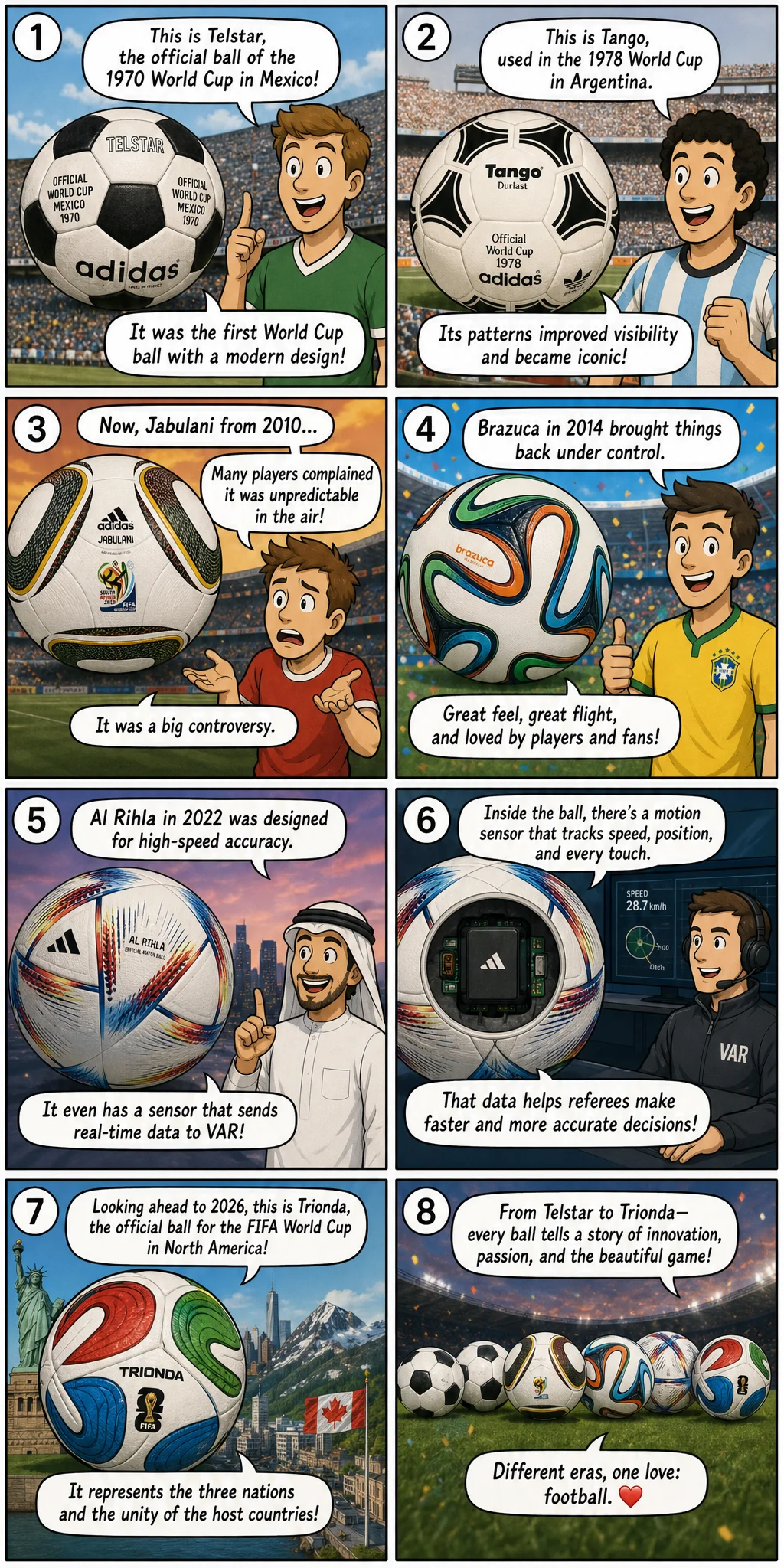
Telstar, 32 black-and-white panels. Not for looks – for TV. 1970 was the first World Cup broadcast globally in color. Black-and-white blocks were 100 times more visible on screen than plain brown leather. Adidas designers weren't making a ball – they were making a signal. That ball's design, 54 years later, remains the global visual icon of football.
⚪ 1974: Telstar Durlast – Water, Football's Only Enemy
Same Telstar, but with a Durlast coating. Waterproof. A leather football could gain nearly 500 grams in the rain. Durlast cut that number in half. You might not know the name – but it was arguably the most important technical invention in 1970s football.
🔴 1978: Tango – The Birth of an Icon
Argentina. Adidas Tango. 20 panels, 12 triadic luminous circle visuals. That ball was so beautiful that the next five World Cup balls copied its design. Tango España. Azteca. Etrusco Unico. Questra. Tricolore. Fevernova – the 2002 ball with Asian red-gold flames, at its core, was still the 1978 Tango structure. A 24-year design dynasty.
⚪ 1986: Azteca – Goodbye, Leather
The first fully synthetic World Cup ball. No animal hide. No water absorption issues. At Mexico City's 2,200-meter altitude – thin air, balls fly faster and farther – Azteca's synthetic structure ensured no deformation under extreme conditions. That was the ball for Maradona's Hand of God. Also for his five-man run. One ball carried the greatest ten minutes in football history.
🟡 1998: Tricolore – The First Colored Ball
France World Cup. Tricolore. Blue, white, red – French national colors. From Telstar's pure black-and-white to Tricolore's three colors, it took humanity 28 years to decide footballs could have color.
🟢 2002: Fevernova – Asia's First Ball
Korea-Japan World Cup. Fevernova. Golden energy lines. Asian aesthetics entered World Cup ball design for the first time. But players didn't like it – too light, unstable trajectory. This was the first "too much tech" controversy. Not the last.
🔴 2006: Teamgeist – Less Is More
Germany. Teamgeist – "team spirit." 14 panels, 18 fewer than Telstar. Fewer seams, rounder sphere, more controllable flight path. German engineers turned a football from a handicraft into a precision instrument.
🟡 2010: Jabulani – The Ball Everyone Hated
South Africa. Jabulani. 8 thermally bonded panels. The name means "celebration" in Zulu – but global player consensus was closer to "disaster."
Julio Cesar said it felt like a cheap plastic ball from a supermarket. Buffon said it shouldn't be at a World Cup. Scientists later found: Jabulani's critical speed – the point where aerodynamics shift from stable to turbulent – was just 55 miles per hour. A professional footballer's shot is usually 60 to 70. In other words: every shot crossed through turbulence. Every goalkeeper caught an object they didn't know where it would go. This is football's most famous "tech overreach" case.
🔵⚪ 2014: Brazuca – The People's Redemption
Brazil. Brazuca – Brazilian slang for "the Brazilian way of life." 6 polyurethane panels. Adidas heard every Jabulani complaint and made the complete opposite ball. Stable. Predictable. Beautiful. That World Cup saw 171 goals – tied for the highest ever. Brazuca is hailed as the best modern World Cup ball.
🟡 2018: Telstar 18 – A Tribute to History
Russia. Telstar 18. Fifty years later, the 32 black-and-white panels returned – but with an NFC chip inside. Tap your phone to the ball, and an interactive page opens. Football started connecting to the internet.
🔴 2022: Al Rihla – The Connected Ball
Qatar. Al Rihla – Arabic for "journey." 20 panels. Inside: an inertial measurement unit – IMU, the same tech as the gyroscope in your phone – sending 500 position data points per second to the VAR room. Offside calls, flight paths, touch times – this ball tells you everything in two milliseconds. Football is no longer just leather and air. It's a data platform.
🟢🔵🔴 2026: Trionda – Three Nations, Four Panels, A New Era
Confirmed – HERE WE GO.
2026 World Cup official ball: Adidas Trionda. Four panels – yes, only four. Red (Canada), Green (Mexico), Blue (USA) tricolor design. Sensor system upgraded – data return speed and accuracy surpass Al Rihla. The code running inside this ball is nearly as complex as an autonomous driving system.
This is not the end. From the pig bladder in 1930 Montevideo – really, the earliest footballs were literally made from pig bladders – to the 2026 Trionda, the evolution of a football is a microcosm of human tech history. Every World Cup, humanity asks the same ball one question: Can you be a little better?
Its answer is always: Yes.