World Cup Favorite Team Crests: Five Badges, Five National Identities
The political and historical DNA encoded in five favorite team crests: Brazil's five stars, Argentina's sun, France's rooster, England's three lions, and Germany's eagle.
Published: June 8, 2026
Crests of the Title Contenders: Five Icons, Five National Identities
In Spain, there is a football aphorism that has circulated for decades. It is not about scores or formations. It is about a flag, a badge, and a person's decision on how to wear them on their chest. I am not referring to Barça vs. Madrid — I am referring to a more fundamental question: when a nation compresses its history into an embroidered crest less than ten centimeters in diameter, what does it choose to preserve? What does it choose to forget?
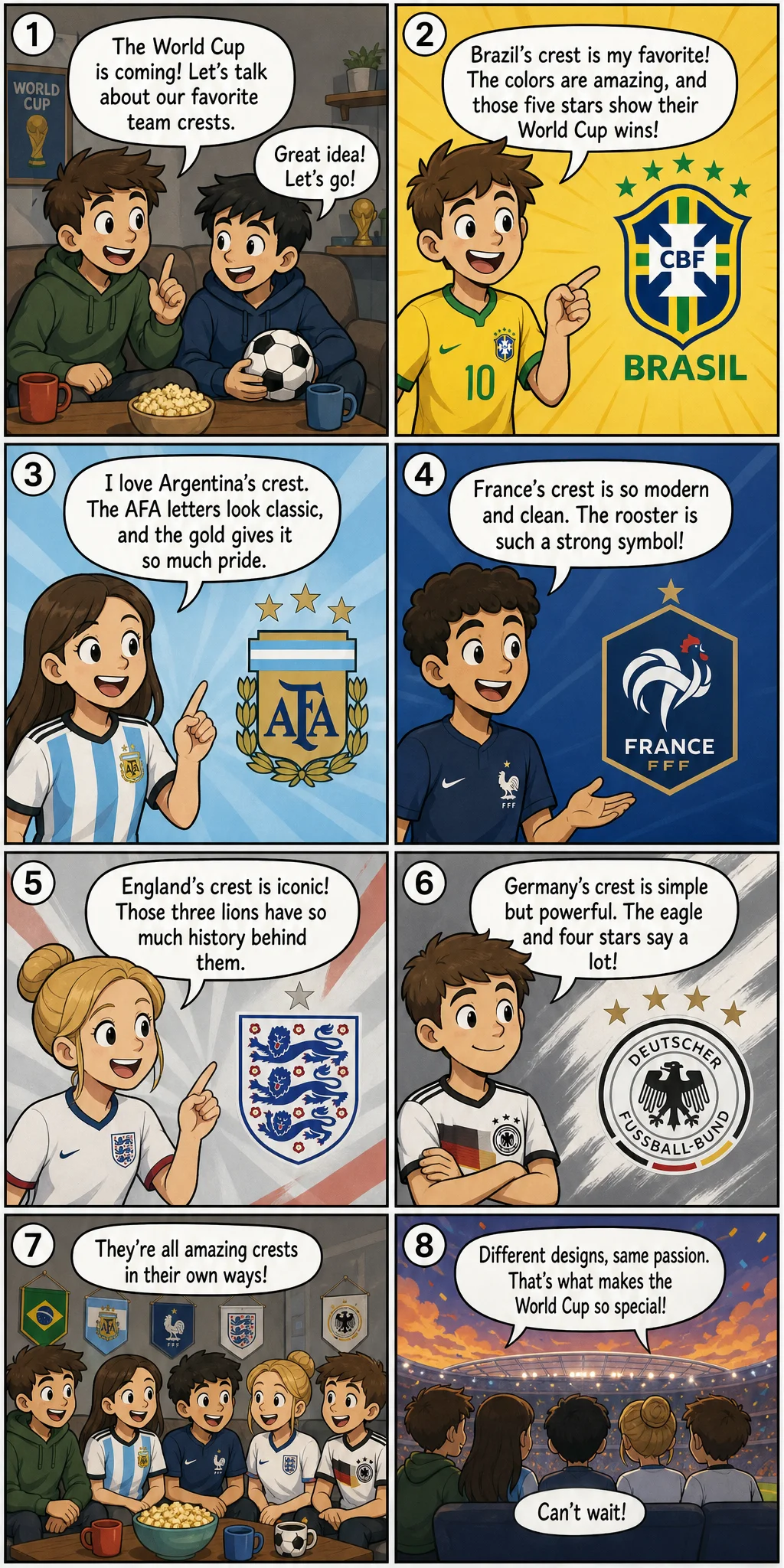
The 2026 World Cup has five title contenders — Brazil, Argentina, France, England, Germany. Their crests are not products of the same design department. They are five different strategies of national identity.
Brazil: Five Stars and a Crossed Spear
The CBF crest is a minimalist marvel. A banner — "CBF," Confederação Brasileira de Futebol. A spear crossed with a flagpole. Five stars — not decoration, but a military decoration for five World Cup titles.
In 1970, after Brazil won its third World Cup in Mexico — with Pelé, Jairzinho, Rivellino, that greatest team in history — the CBF added three stars above their crest. It was the first time in world football history that a national team placed stars on its badge. Not a FIFA regulation. Not a tradition. It was a suggestion from the fitness coach of the 1958 Brazilian team — a former military man named Paulo Amaral: why not wear our titles like military medals on our chest?
A former colony — the Portuguese monarchy expelled in 1822, slavery abolished only in 1888 — uses a military visual language to tell the world: we are the strongest. The five stars are the only political language universally accepted by Brazilians. Supporters of Bolsonaro and supporters of Lula can despise each other on everything — but when they see those five stars, they see the same thing.
Argentina: Three Blues, a Sun, and an Unapologetic Federation
The AFA crest — a shield of blue and white stripes, a yellow sun inscribed with "AFA" — looks like a military medal. That is intentional. The Argentine Football Association was founded in 1893, before Argentina was even shaped as a modern state. That sun — the Sol de Mayo, the May Sun — is the same sun used in the May Revolution of 1810 to mobilize the citizens of Buenos Aires against the Spanish colonizers. Argentina's national identity was built on a revolution. Its football association chose the same symbol: we were not given. We seized.
But look closely at the AFA crest. It only has two stars — the third star from 2022 has not yet been added, due to a lengthy bureaucratic struggle between the federation and FIFA's official regulations. A country that has won three World Cups displays only two on its badge. Stars are not won — they are approved by bureaucrats. Even stars require political maneuvering.
France: A Rooster, Blue, and the Embodiment of a Republic's Values
The FFF crest is a rooster — le coq gaulois. This symbol is about 1,400 years older than the French national team. The Roman Empire called the region of present-day France "Gallia" — the Latin word gallus means both "Gaul" and "rooster." A rooster became a pun for a people. 1,400 years later, the French Revolution turned the rooster into a symbol of the Republic: it crows at dawn, awakening the sleeping people. Wake up. The revolution begins. Those 18th-century French peasants would never have imagined that their dawn call would eventually appear on an embroidered crest on the chests of Zinédine Zidane and Kylian Mbappé.
In 1998, France won the title at home — that golden rooster stood on the chests of Zidane, Deschamps, Thuram — and the FFF added a star to the crest. A second star came in 2018. France is one of the few national teams to place its crest directly within the color field of the tricolor (blue, white, red). Rooster, flag, stars — all three merge seamlessly in the same visual space. A symbol of the Republic, transformed into the battle flag of a football dynasty.
England: Three Lions and an Inheritance That Never Arrived
England's crest is the oldest and most uneasy among the five favorites. Three lions — three lions passant guardant — are the personal emblem of Richard I of the Norman dynasty. 1198. One star — the only one, 1966. The lions have walked for eight hundred years, but that star is achingly solitary.
The three lions were not originally a symbol of England — they were a symbol of the Norman aristocracy, a group of conquerors. England borrowed the badge from its conquerors and then, using an even older national identity — the lions of Richard the Lionheart — packaged it as "English tradition." But the three lions as a symbol of English football only formally appeared in 1872, in the first-ever international match, England vs. Scotland. Those three lions are no longer lions — they are a visual container for sixty years of hope, thirty years of self-mockery, and an entire nation's endless debate over "why do we only have one title?"
Germany: A Federal Eagle and a Nation Torn Apart and Stitched Together
The DFB crest is an eagle — the Bundesadler, the Federal Eagle — not the Nazi eagle, not the Prussian eagle, but the eagle of the Federal Republic of Germany from 1949. That year, the constitutional convention at Frankfurt's Paulskirche chose this eagle — a century earlier, it had stood on the flag of the 1848 revolution, representing Germany's first democratic dream. The Nazis hijacked it. The Federal Republic reclaimed it.
The edge of the DFB crest is in black-red-gold — the same tricolor that once flew over 1848, the Weimar Republic, and the Berlin Wall in 1989. A football badge records the answers to some of Germany's most painful questions over two centuries: Who is German? Which Germany? Black-red-gold — not black-white-red, not the Nazi red swastika — is the answer. And those four stars — 1954, 1974, 1990, 2014 — correspond not to four separate victories. They correspond to four versions of Germany: the Germany of the postwar miracle, the Germany of Beckenbauer's libero era, the Germany of reunification, the Germany of the world champion. One crest. A continuous line from the 19th-century revolution to 21st-century football.
—
When you see these five crests lined up on the 2026 tournament schedule, you are not seeing five "brand logos." You are seeing five different ways five nations answer the same question: Who are we?
Brazil's spear says: We conquer. Argentina's sun says: We revolt. France's rooster says: We awaken. England's three lions say: We wait. Germany's eagle says: We remember.
On the pitch in June, twenty-two men chase a ball. But on their chests — each bearing a spear, a sun, a rooster, lions, and an eagle — they carry a history longer than any scoreline. Whoever wins, that symbol will be pinned to the next page of history. And the other four — will continue to wait.