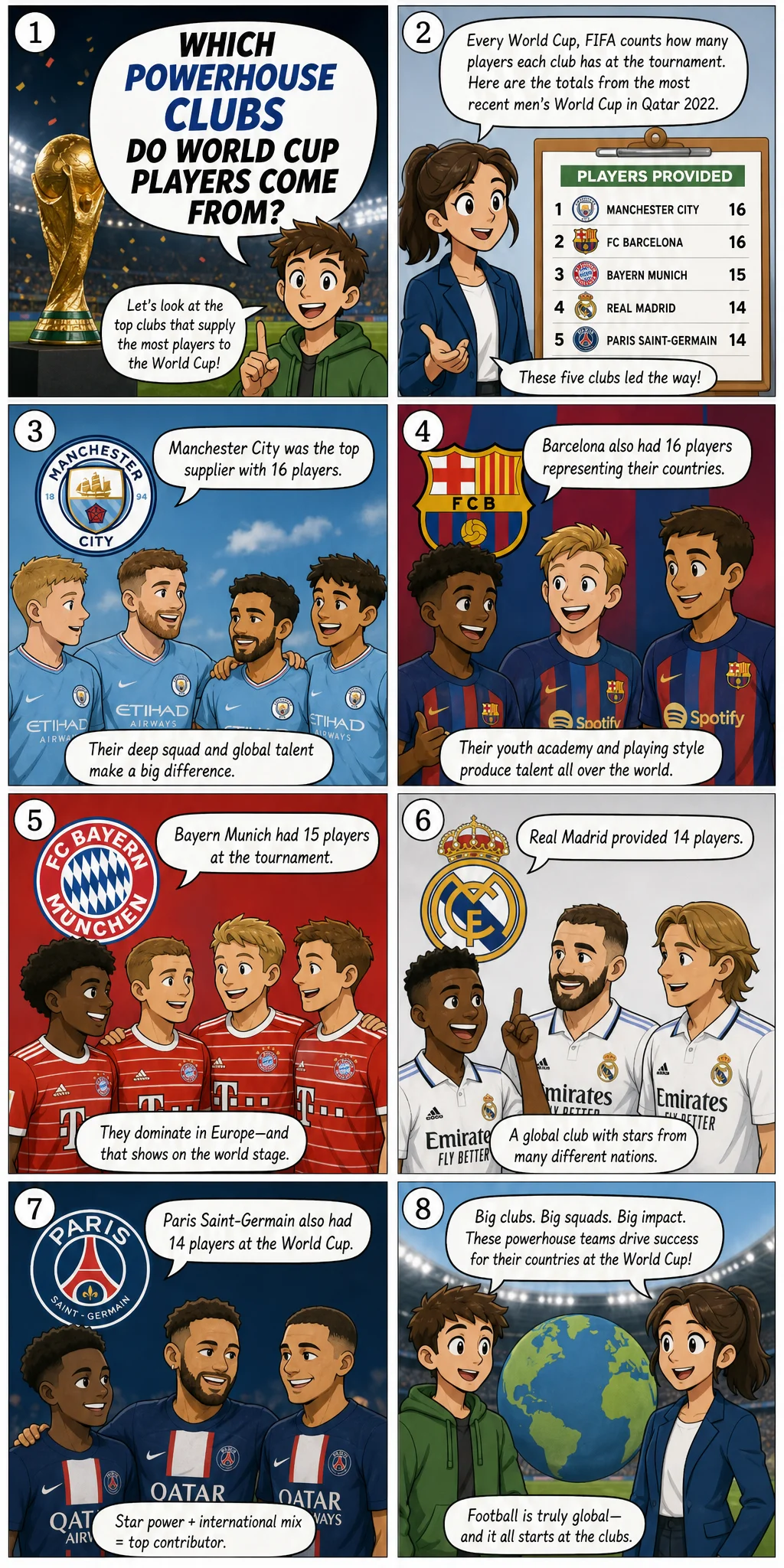
Which Powerhouse Clubs Do World Cup Players Come From
The global supply chain of World Cup talent: Man City leads with 19 players from 12 countries, followed by Bayern Munich (18), Arsenal/PSG (16), Barcelona (15), and Al-Hilal (12) as the first non-European challenger.
Published: June 8, 2026
Which Top Clubs Do the Players Come From: The World Cup's Supply Chain Map
In the order of the first World Cup in 1930, the relationship between football clubs and national teams was simple, even pure. A player played weekend league matches for his club and then—if lucky, if he was among the best twenty-two in his country—he was called up for the World Cup. There was no conflict between these two identities, no competition, no financial interests to coordinate. The world then was not globalized. Neither was football.
By 2026, this relationship has transformed into a vast global supply chain map. 1,048 players from 48 national teams, representing hundreds of clubs across six continents. The World Cup is no longer "nation vs. nation"—it is simultaneously an invisible war among clubs.
Manchester City: The Tactical Unity of a Nineteen-Man Empire
The biggest club supplier for the 2026 World Cup is not Barcelona. Not Real Madrid. It is Manchester City.
Nineteen players—from twelve different countries—share the same tactical system at the club level in sky-blue shirts, then enter their national teams to execute different instructions. This is not a statistic; it is a structural advantage. Pep Guardiola's positional play philosophy—Juego de Posición—has cultivated over the past eight years an entire generation of players who understand how to read space, how to press, how to be in the right place at the right time. When these players are called up by their national team coaches, they bring not just their skills—they bring a tactical language already etched into their neurons.
Rodri (Spain)—Balón de Oro winner, the world's best defensive midfielder. Tijjani Reijnders (Netherlands)—midfield engine. Erling Haaland (Norway)—a twenty-eight-year wait ends. Manchester City's influence is not about quantity; it is about the breadth of positional coverage—from center-backs to forwards, from Europe to South America, one club's squad equals the backbone of sixteen national teams.
Bayern Munich: Germany's Factory, Europe's Training Camp
Eighteen players. Bayern's model is not Guardiola's singular philosophy—it is a continuation of German football's organizational tradition. From the German Football Association's fifty-two youth training center plan in 2000 to the ten-hour daily technical refinement at Säbener Strasse, this club does not produce "stars"—it produces modular, plug-and-play football components adaptable to different systems.
Joshua Kimmich can play right-back, defensive midfielder, or wherever needed—not because he is special, but because Bayern's training system is designed for this versatility. Harry Kane (England) broke the Bundesliga scoring record in his first full season at Bayern—not because Kane suddenly became stronger, but because Bayern's supply system (wide crosses, midfield transitions, forward pressure release) is built to maximize a number nine's goal output.
Arsenal and Paris Saint-Germain: The Logic of Sixteen New Money Clubs
Both with sixteen players. Arsenal, under Mikel Arteta, has rebuilt a squad centered on a young midfield core—Bukayo Saka (England), Declan Rice (England), William Saliba (France)—whose national team status has risen due to the club's tactical progress. PSG's model is the opposite: not cultivation, but acquisition. Sixteen World Cup players do not come from the same youth system—they are independent commodities from the global market, assembled in Paris, then scattered in June 2026, each donning different colors again.
Barcelona and Real Madrid: Fifteen La Masia vs. Fifteen Galácticos
Among Barcelona's fifteen, a key number is overlooked: how many come from La Masia? On the other side of the world—in a training facility in Catalonia—children learn to position themselves before learning to pass. Barcelona's World Cup contribution is not a one-time recruitment success. It is the compound interest of three decades of youth philosophy. Gavi, Pedri, Lamine Yamal—none yet twenty-five, already national team mainstays. Not because they are exceptionally talented (they are), but because they have played in the same system since age eight.
Real Madrid's fifteen come from the opposite direction. They are products of the market—Jude Bellingham, Vinícius Júnior, Kylian Mbappé—a global brand collecting global talent. No "philosophy" of Real Madrid's youth system—only Real Madrid's definition of excellence: if the best player in the world exists, he should wear white.
Crystal Palace and Manchester United: Two English Stories of Twelve
This is the most intriguing parallel. Crystal Palace—twelve World Cup players. Manchester United—also twelve. One is a grassroots factory in South London, the other one of the wealthiest football brands on Earth. They converge at the same number. Crystal Palace's twelve lean toward African and Caribbean nations—Eberechi Eze (England) and Michael Olise (France) are exceptions; the rest are internationals from Ghana, Senegal, Jamaica. Manchester United's twelve are more evenly distributed across Europe and South America. Two stories, one number—the World Cup's labor market is both globalized and stratified.
Al-Hilal: The Non-European Challenger with Twelve
Saudi Arabia's Al-Hilal—twelve players, seven of whom are members of the Saudi Arabian national team. This is the first time in World Cup history that a non-European club has entered the top ten suppliers. The flood of money into the Saudi league—the PIF investment starting in 2023—is rewriting the club map of the World Cup. By the next edition—2030—this map may look entirely different.
The Historical Evolution of the Club Supply Chain
Back in 1998, the largest club supplier for the World Cup was Juventus, with about twelve players—most of them Italian. The relationship between club and national team was direct: Italian club → Italian national team → Italians. By 2018, Manchester City had taken this position—sixteen players from seven different countries. The arrow from club to national team was no longer singular. It split into a dozen directions. A Manchester City training ground might on Tuesday develop a Spaniard, a Brazilian, a Nigerian—they wear the same shirt on weekends and opposing shirts at the World Cup.
In 2026, the dominance of Manchester City (nineteen), Bayern Munich (eighteen), Arsenal and PSG (sixteen each) reflects not the "nationality" of these clubs—Manchester City is an English club owned by Abu Dhabi, coached by a Catalan, with players from twelve countries. This description alone says everything. The World Cup's club supply chain has become entirely post-national.
But look closely, and the supply chain still has a fissure. African players still come more from Europe's mid-tier clubs—Crystal Palace, Brighton, Rennes—rather than Real Madrid or Barcelona. South America's top talents are still absorbed earlier by European giants, leaving less room for national team mainstays from domestic leagues. The supply chain is stratified. It has classes.
In June 2026, when those players step out of their club training grounds and board national team buses, they take with them more than luggage. They take an entire club football world of knowledge, systems, tactical habits—and contradictions. Whoever ultimately wins, the invisible fingerprints of clubs will be on the trophy. No one will cheer for the clubs. But behind every goal—you might hear the distant echo of Manchester City, Bayern Munich, or La Masia.