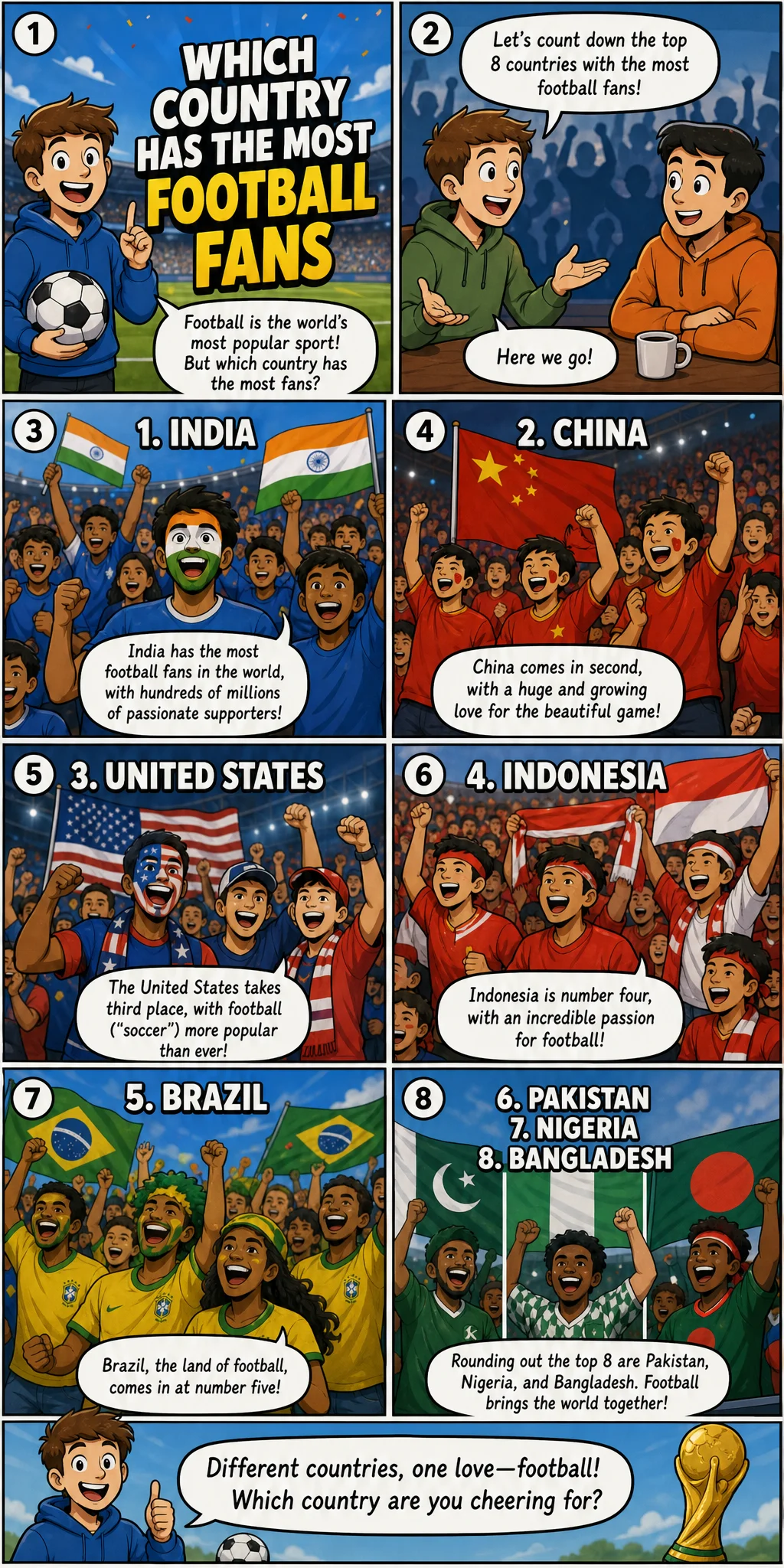
Which Country Has the Most Football Fans
China 200M fans, Brazil 171M (90% of population), Indonesia 165M, India 136M, Mexico 95M. Two kinds of fandom: population giants and cultural saturation. Social media reshapes the meaning of being a fan.
Published: June 8, 2026
The Countries with the Most Football Fans: Two Kinds of Fervour Behind the Numbers
The 3.1 million tickets for the 2026 World Cup crashed FIFA's ticketing system within hours of going on sale. That wasn't a technical glitch—it was demand. A kind of demand that server capacity cannot solve.
When we ask, "Which country has the most football fans?" we habitually answer with two numbers: total count and population penetration. These two numbers almost never overlap—and that precisely reveals the deepest truth about football as a cultural force.
The First Kind of Fervour: The Apex of the Population Pyramid
China: 200 million fans. 14% of the population.
This number is an argument in itself. A country of 1.4 billion people—14% means football is merely a minority sport—but "minority" multiplied by 1.4 billion equals 200 million. It's a country containing an entire Brazil's worth of population.
But China's 200 million fans are not raised on the streets. They are raised on television screens. The broadcasting rights for the Premier League in China are among the most expensive overseas markets in the world—on weekend afternoons or late at night, Manchester United vs Liverpool draws more viewers in China than in the UK itself. Chinese fan culture is not based on community clubs, not rooted in father-son inheritance. It is screen-based, rooted in a globalised media product. Is that a problem? For "purists," yes. But for the kid wearing a Salah Liverpool shirt on the streets of Chengdu—they never cared about the purists' opinion.
India: 136 million fans. 9.5% of the population.
India's football fans grow in the vast shadow of cricket. The Indian Super League has only existed for eleven years. A cricket nation, turning less than 10% of its population into football fans—the result is 136 million people, 9.5% of the population, more than the total population of most countries in the world. India has never played in the World Cup. But India's fans watch the World Cup—and they determine which stars' Instagram follower counts break records.
Indonesia: 165 million fans. 60% of the population.
Indonesia's numbers—third in the world by total, 60% penetration—are the least discussed but most worth discussing. How does a country with no World Cup appearance, no European top-league stars, and club football far from the world's gaze, make 60% of its population football fans? The answer is community—not digital community, but real, dense, community-based football culture. Indonesia's village leagues—tarkam—take place every weekend across the country, with no television broadcast, no sponsor logos, only local prestige. Indonesians love football not because they see it on a screen—but because they play it on dirt.
The Second Kind of Fervour: The Limits of Cultural Saturation
Brazil: 171 million fans. 90% of the population.
Brazil is not a country with football fans. Brazil is a football nation with a nationality. 90%—this number means football is not an entertainment choice. It is public space. It is on television, on the streets, in church prayers, in political campaign speeches. Pelé's funeral—December 2022—was not just national mourning. It was a secular mass, a declaration: this man—this footballer—defined who we are.
Mexico: 95 million fans. 73% of the population.
73%—anywhere in North America except Mexico, this number is fantasy. The share of football fans in the United States is around 20%. Canada is lower. Mexico's 73% does not come from the commercial success of its league—Liga MX, though the best league in North America, has global broadcast revenues nowhere near the Premier League's scale. Mexico's number comes from something older: football as family heritage. From grandfather to father to son—a cassette tape of Hugo Sánchez's bicycle kick, Cuauhtémoc Blanco's frog leap dribble, Rafa Márquez's free kick—each generation passes its idol to the next. That is not marketing. That is blood.
Spain: 40 million fans. 82% of the population.
82% of Spaniards care about football—but a more precise version of this number is: 82% of Spaniards care about football, and a highly politicised portion of them care about Real Madrid or Barcelona. Spain's fan count is not a unified "40 million." It is 25 million Real Madrid or Barcelona supporters—and the remaining 15 million supporters of other clubs, living in a cultural ecosystem defined by two giants. This is not like Brazil's全民狂热—Brazil's 90% does not distinguish between clubs—but rather like a country containing two nation-states, each with its own king, its own narrative, its own belief system.
England: 35 million fans. 62% of the population.
England's 62% is an interesting paradox. This is the country that invented modern football—1863, at the Freemasons' Tavern in London, the Football Association was founded—yet its penetration rate is lower than Spain's, lower than Mexico's, lower than Brazil's. Why? Because England's fan culture is highly concentrated on matchday itself—not a daily, pervasive presence, but a weekly cyclical religious activity. If you walk the streets of Britain at 3 PM on a Saturday—you'll find half the country has disappeared. They are in the stadium, or in front of the television, or by the radio.
The Third Kind of Fervour: The Phantom Army on Social Media
Social media has added an entirely new, completely unreliable dimension to "fan numbers." Cristiano Ronaldo's Instagram—600 million followers. Lionel Messi—500 million. Real Madrid—144 million Instagram followers, 125 million on Facebook. These numbers make demographic statistics look tiny—but they measure something entirely different. A 14-year-old boy in Mumbai following Cristiano Ronaldo is one person. But is he just a "fan"? Or is he just someone scrolling on his phone?
Social media turns fans into a phantom army—existing in numbers, in follower counts, in likes, but unable to be converted into actual bodies in the stadium. The 2026 World Cup ticketing system crashed not because 2 billion phantoms were clicking. It was because living, breathing humans wanted to walk through those turnstiles.
Epilogue: When you ask, "Which country has the most football fans?" you are actually asking two completely different questions.
The first question is: Which country has the most football fervour? Answer: Brazil. 90% of the population—171 million people—do not just "like" football. Football defines them.
The second question is: Which country is most important for the future of football? Answer: India. Indonesia. China. These countries have penetration rates far lower than Brazil's—9.5%, 60%, 14%—but every percentage point means tens of millions of people. If India goes from 9.5% to 20%, the new fans added would outnumber the entire population of Germany.
In June 2026, when the television cameras sweep across the faces in the stands—Mexico's green wigs, Brazil's golden jerseys, England's St George's Cross, Indonesia's red-and-white Garuda flag—you are not seeing statistics. You are seeing how, over half a century, a sport has sewn itself into the identity of all humanity. Some countries love with population totals. Some countries love with their souls. A few—only one—does both.
That is Brazil. Always Brazil. Until the day India decides to wake up.