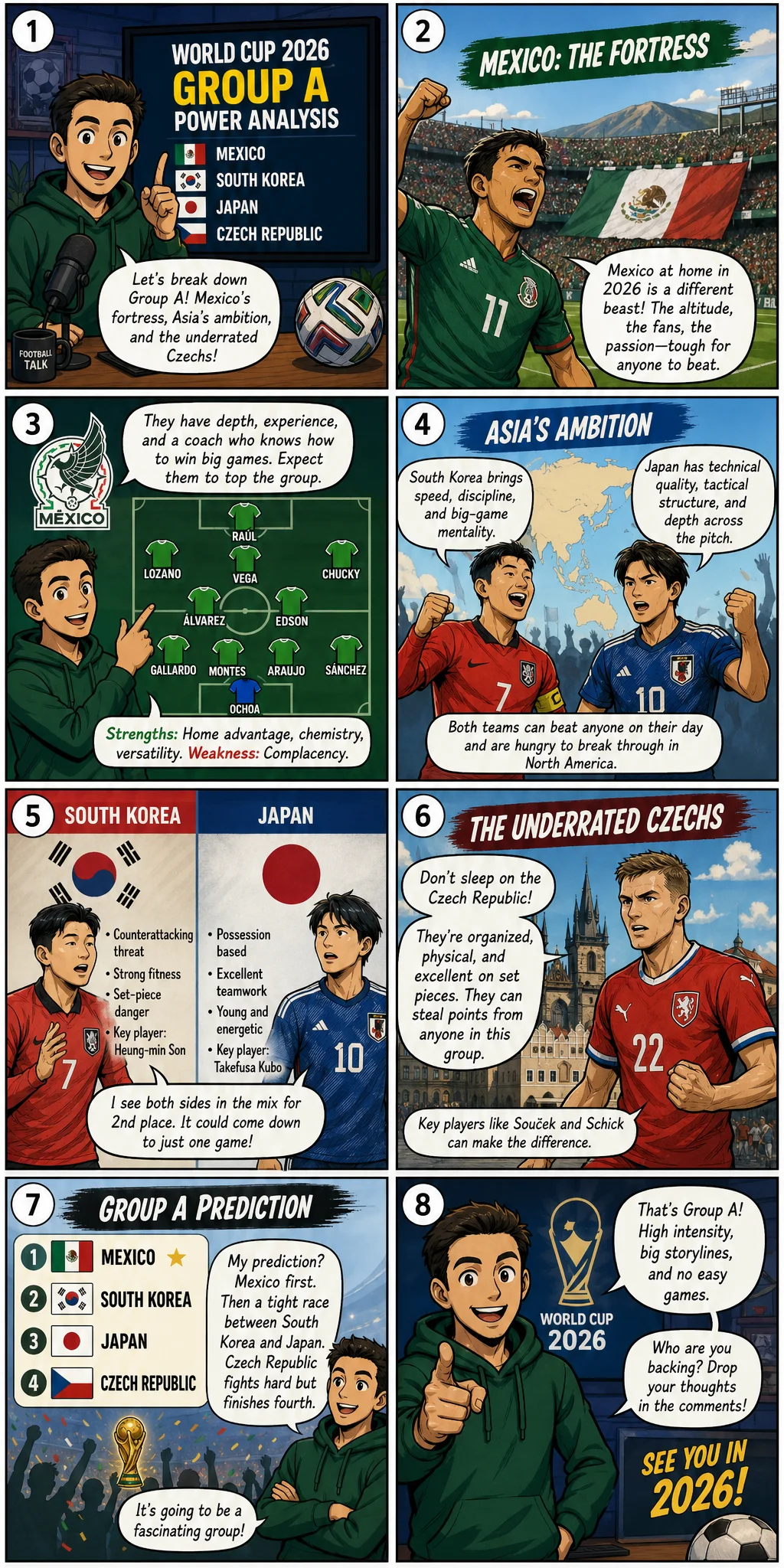
Group A Power Analysis: Mexico's Fortress, Asia's Ambition, and the Underrated Czechs
Group A: Mexico (host), South Africa, South Korea, Czechia. Altitude at Azteca, Son Heung-min's Korea, Broos' Bafana Bafana defense, Schick-Soucek Czech spine.
Published: June 8, 2026
Group A Power Analysis: Host Pressure, Asian Ambition, and an Underrated Czech Republic
In World Cup history, Group A has never been just four teams. Group A carries the weight of an opening ceremony—a nation's eyes, a tournament's opening move, and that lingering question: how long can the host survive?
The 2026 Group A answers this question with four entirely distinct football philosophies.
Mexico: Home Is a Fortress at 2,200 Meters
Mexico didn't qualify for Group A—they placed themselves there. As co-hosts, El Tri were seeded into the A1 slot, meaning their most critical matches will be played at Estadio Azteca—2,200 meters above sea level. That's not metaphorical. It's physical. Opponents feel their lungs burning after twenty minutes, while Mexican wingers keep accelerating.
Javier Aguirre's third stint with the Mexican national team—returning after 2002 and 2010—is built on defensive stability and quick counterattacks. Raúl Jiménez remains the focal point in the box, but the real attacking threat comes from the flanks. Hirving Lozano has slowed with age, but his explosive burst is still enough to turn any fullback's weekend into a nightmare. In midfield, Edson Álvarez, after a quiet but solid season at West Ham, serves as the pivot connecting defense and counterattacks.
Mexico's advantage in the group stage isn't just tactical. It's the altitude. It's the noise. It's that, in the shadow of the Azteca, the visiting goalkeeper has already lost before kickoff.
South Africa: Heirs to the 1996 Spirit
South Africa's World Cup story typically begins and ends with 2010—their year as hosts. But this Bafana Bafana side is different: their performance at the Africa Cup of Nations—reaching the semifinals in 2024—reveals a system maturing.
Belgian coach Hugo Broos has built a team centered on defensive discipline and midfield pressing. Percy Tau—playing for Egyptian giants Al Ahly—is the creative core, but the real evolution lies in defense: the Mamelodi Sundowns center-back pairing of Mothobi Mvala and Grant Kekana is the most stable club-level partnership across Africa. If you can avoid being torn apart for two consecutive years in the CAF Champions League, you can at least hold your ground at the Azteca.
South Africa's problem isn't defense. It's scoring. There's no reliable number nine. If Tau gets shut down, South Africa may need set pieces to break through.
South Korea: The Taegeuk Warriors' Generational Shift
South Korea enters 2026 with one of Asian football's rarest commodities: continuity. Hong Myung-bo—captain of the 2002 semifinal team—is now head coach. He took over from Jürgen Klinsmann after a disappointing campaign in Qatar and spent two years rebuilding.
Son Heung-min remains Asia's best attacking player. But the supporting cast has finally caught up to his level. Lee Kang-in's creative output on PSG's wing, Kim Min-jae's defensive dominance at Bayern Munich—this is the first time in South Korean history that three players simultaneously hold key roles at Europe's elite clubs.
Hong Myung-bo's tactical system is a 3-4-3—wing-backs pushing high, two midfielders maintaining width, and Son cutting in from the left. This system may lack refinement against European sides, but for a group reliant on quick transitions and wide overloads, it's lethal enough.
Czech Republic: European Football's Hidden Champion
The Czech Republic is the fourth seed in this group—yet their FIFA ranking is the second highest in the group. This paradox explains everything about Czech football. A nation of under ten million people, yet one that has produced some of European football's most sophisticated tactical minds (remember the Nedvěd-Poborský-Rosický generation of 2004?), has long been underestimated by the seeding system.
Coach Ivan Hašek's Czech team rests on two pillars: Patrik Schick's goal-scoring ability—his stunning midfield lob at Euro 2020 remains one of the most replayed goals in YouTube football history—and Tomáš Souček's midfield coverage at West Ham. Souček is the kind of player whose full contribution doesn't show on a stat sheet: he appears at every aerial duel, every second ball, every recovery position.
The Czech Republic's weakness is fullback depth. If Vladimir Coufal gets overwhelmed by Lozano's pace, the Czechs will be forced into a very narrow defensive block—and then Schick up front will become an isolated island.
Advancement Prediction: Mexico's Fortress and an Open Second Place
The advancement dynamics of Group A feature a fortress at the top and an open scramble for second. Mexico—hosts, the physical advantage of the Azteca, Aguirre's experience—is the clear choice for first. But second place is one of the hardest positions to predict in the 2026 group stage: South Africa's defensive organization could leave South Korea or the Czech Republic unable to find a route to goal. South Korea's attacking firepower—if Son and Lee Kang-in both ignite—can break any deadlock. The Czech Republic's tactical intelligence is the group's most underappreciated asset.
One hunch: this group will have a defining match—not involving Mexico. It's South Africa vs. South Korea, Monterrey, late June. Both teams know it's their de facto final for advancement. The pressure of that match—and the altitude—will bring out the best version of both sides.