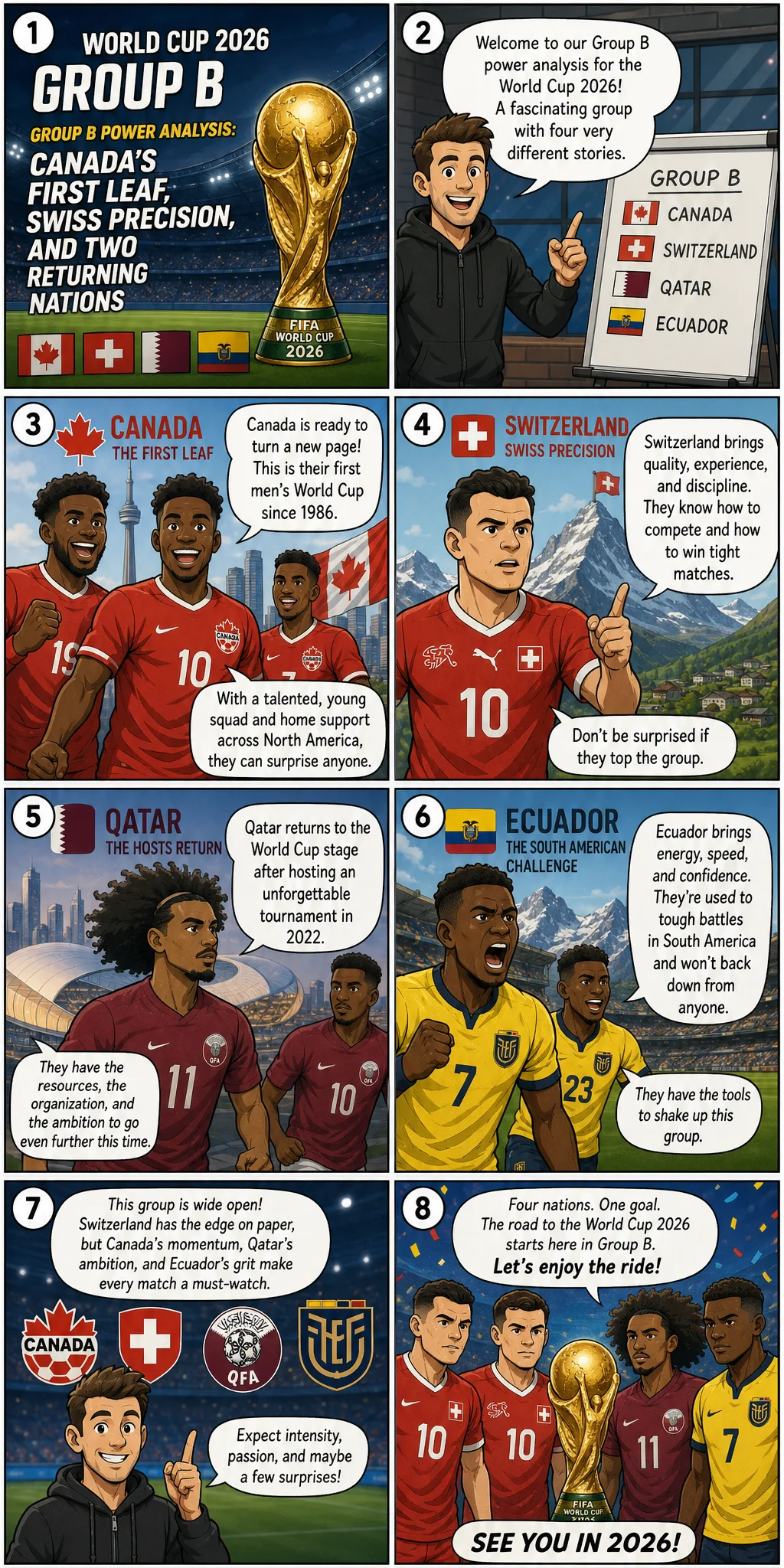
Group B Power Analysis: Canada's First Leaf, Swiss Precision, and Two Returning Nations
Group B: Canada (host), Bosnia & Herzegovina, Qatar, Switzerland. Alphonso Davies, Granit Xhaka, Jonathan David, Edin Dzeko.
Published: June 8, 2026
Group B Strength Analysis: Canada's Second Chance, Switzerland's Precision, and Two Returnees
In World Cup history, only a few nations have hosted the tournament without ever winning a match. Canada is one of them—in 2022, John Herdman's side played three games in Qatar, lost all three, and scored one goal. Four years later, they have a second opportunity on home soil. Alongside them, Switzerland awaits with a squad capable of dismantling any underestimator.
Canada: The Maple Leafs' Second Chance
Jesse Marsch—an American missionary of the Red Bull system—has taken over this team. He is not here to teach Canadians how to play football. He is here to instill a belief: you are no longer that "first-time participant" nation.
Alphonso Davies remains the sun of this team—the Bayern Munich left-back, when sprinting at full speed, has an acceleration curve approaching physical boundaries—but his role has changed. He is no longer the sole star. Jonathan David's consistent scoring rate at Lille (a career average of one goal every two games) means Canada's attack finally has a second reliable output point. Midfielder Stephen Eustáquio is the metronome of FC Porto; what he does in the second between defensive transition and attack—that penetrating pass—is the mechanism that allows Canada to get both Davies and David on the ball simultaneously.
Canada's defense remains a weakness. There is no top-league center-back pairing. If Davies is forced to stay back and defend rather than push forward, Canada effectively removes its engine. Marsch's pressing system requires the entire team to shift forward in unison—if one player is two yards off the rhythm, the entire structure develops cracks.
Bosnia and Herzegovina: The Return of the Dragons
Bosnia and Herzegovina waited twelve years to return to the World Cup—in 2014, they played three games in Brazil, lost to Argentina and Nigeria, and defeated Iran. The core of that generation was Edin Džeko. In 2026, Džeko will be forty years old—but he still plays for Fenerbahçe. He is unlikely to play the full ninety minutes, but the first ten minutes after he rises from the bench remain Bosnia's most dangerous weapon.
Coach Sergej Barbarez's team is built on defensive structure and set-piece counterattacks. Miralem Pjanić—though no longer in Europe's top leagues—still possesses the best long-passing vision on this side of the Adriatic. If you give Pjanić time and space, he will flip the game with a forty-five-yard ball.
Bosnia's problem is depth. There is enough talent in the starting eleven—but the gap between the substitutes on the bench, especially at full-back, and the starters is too pronounced.
Qatar: The Asian Champions' Second World Cup
Qatar's World Cup opener—against Ecuador in 2022—ended in a humiliating 0-2 defeat. But in the years since, Qatar has undertaken the most thorough rebuild in Asian football: they have won consecutive Asian Cups (2019, 2024), fielding a national team built on the Al-Sadd club system.
The return of Spanish coach Félix Sánchez—who left after 2022 and then came back—means this Qatari team understands its system more deeply than any opponent. They have played hundreds of matches together—from youth to senior levels. The chemistry between Almoez Ali and Akram Afif is almost telepathic.
But Qatar's problem is the same as Bosnia's—or worse. Their ceiling is that of an Asian champion. When the opponent becomes a European elite like Switzerland, they fall behind in physicality and tempo.
Switzerland: The Watch Mechanism
Switzerland's problem has never been a lack of talent. It is inconsistency—they can eliminate France in the same tournament (Euro 2020) and then lose to a banana peel.
Coach Murat Yakin's team is built on three Premier League pillars: Manuel Akanji (Manchester City), Granit Xhaka (Bayer Leverkusen), and Remo Freuler (Bologna). Akanji's speed and tactical intelligence—cultivated in Guardiola's system—allow him to excel equally in a back three or back four. Xhaka's resurgence—his move from Arsenal to Bayer Leverkusen reignited his career—is key to Switzerland establishing rhythm from midfield.
Switzerland's strongest position is the link between defensive midfield and center-back—but their finishing has lacked a solution for a decade. Breel Embolo is the starting number nine, but his scoring rate has never matched the level his physical attributes should dictate. If Switzerland is held to a draw or a narrow loss in Group B, it will be because they controlled the game but never put the ball in the net.
Advancement Prediction: Switzerland's Stability and Canada's Ceiling
Switzerland is the most logical choice for first place in Group B—but "logical" has never been a reliable prediction basis for Switzerland. Canada's first home match—at BMO Field in Toronto against Bosnia and Herzegovina—could define the entire group's trajectory. If Canada wins that match, they will gain the momentum needed for advancement. If they draw or lose, they will slip back into the ghosts of 2022.
Second place is a three-way melee. Bosnia's defensive structure can bog down anyone. Qatar's system cohesion is the strongest among the four teams—but their total talent pool is the lowest. Canada's ceiling is the highest, but their defensive floor is the lowest. This group will not be decided by stars. It will be decided by that June afternoon in Toronto.