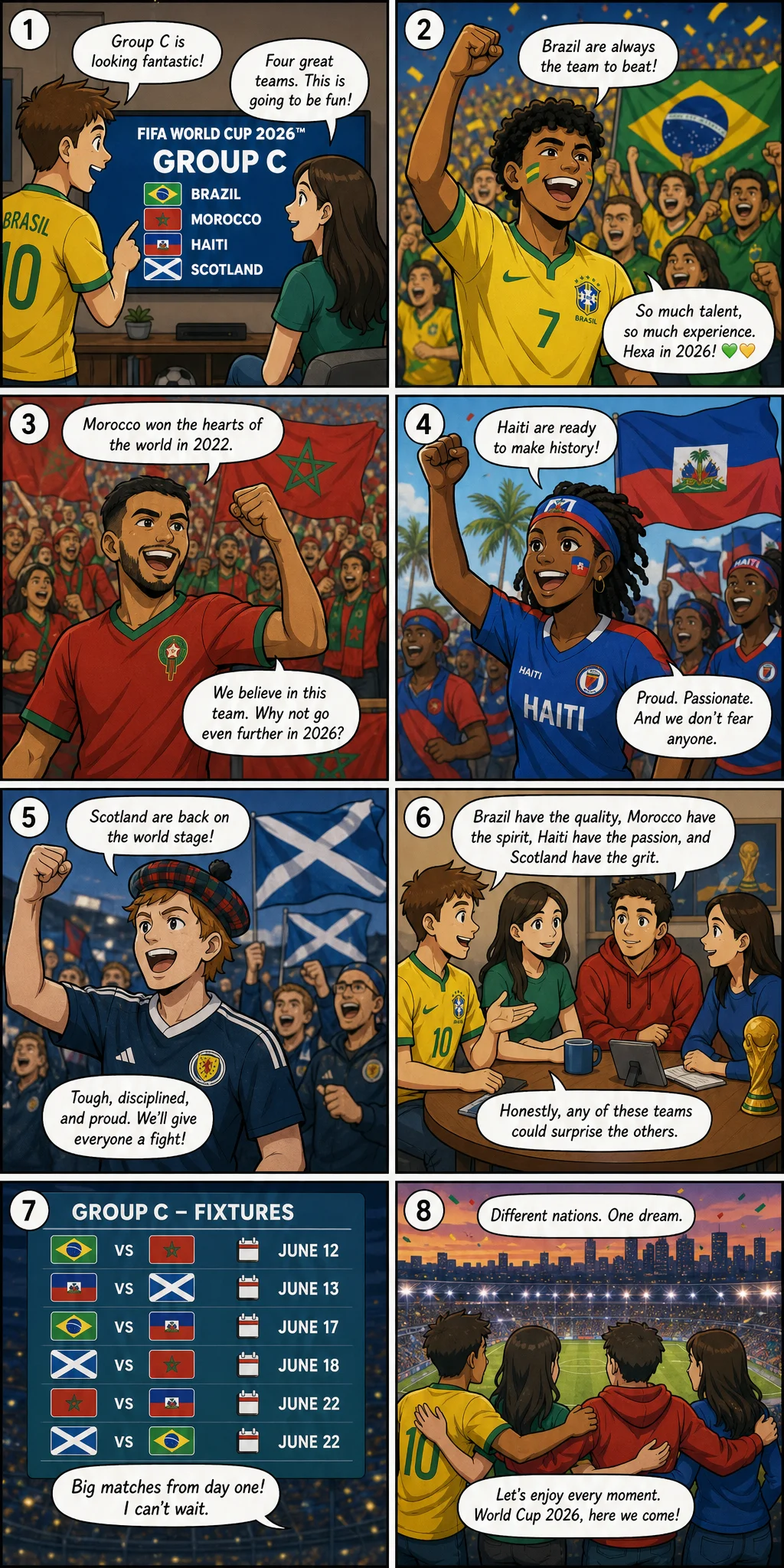
Group C Power Analysis: Brazil, Morocco, Haiti, Scotland
Group C: Brazil, Morocco, Haiti, Scotland. Brazil under Ancelotti seeks redemption; Morocco proves 2022 was no fluke; Scotland returns after 28 years; Haiti makes historic debut
Published: June 8, 2026
World Cup Group C appears on the surface to be a group of mismatched matchups: football powerhouse Brazil, 2022 semi-final miracle Morocco, Scotland returning to the finals after 28 years, and Haiti making their World Cup debut. However, delving into the tactical board and the structural evolution of the teams, the "group of death" aura here stems not from the dominance of traditional powers, but from the subtle tension of stylistic clashes and systemic battles.
Brazil: Ancelotti's "Systemic" Redemption
Since their 2002 title win, Brazil's knockout stage performances have never matched their talent. The "Samba football" of the past often devolved into individualistic heroics, lacking off-the-ball movement and collective pressing discipline. Ancelotti's arrival brings a decisive shift: from "talent-driven" to "structure-driven."
Ancelotti's 4-3-3 system will feature Vinícius Júnior and Rodrygo as the core wingers, but the key lies in midfield balance. He will deploy Paquetá as a "false left midfielder," cutting inside during attacks to form a second striker, creating depth for Vinícius; on the right, Raphinha will stretch the width. In the defensive midfield role, Bruno Guimarães and Douglas Luiz will provide stable horizontal distribution and interceptions—a "rhythm control" Brazil's midfield has lacked.
The tactical highlight is how Ancelotti solves the "two-striker" issue. He is likely to use Richarlison as a mobile center-forward, tasked with pressing opposition center-backs and dropping deep to link play, rather than a traditional target man. This system has proven at Real Madrid to maximize the threat of wingers.
However, Brazil's weakness lies in defensive transition discipline. Ancelotti's teams in the Champions League have often been caught out by quick counter-attacks against high defensive lines, and Group C's Morocco and Haiti possess strong vertical attacking capabilities. If Brazil fails to maintain focus after taking the lead, an "upset" in the group stage is not impossible.
Morocco: The "Geometric" Evolution of the Counter-Attacking System
At the 2022 World Cup, Morocco proved they were not a dark horse but a strong team with a mature tactical system. Walid Regragui's side showcased extreme "asymmetric pressing" in defense: ceding possession but using targeted high pressing and compact defending to funnel opponents into wide traps.
Morocco's core tactics are "full-back inversion" and "midfield triangle." Achraf Hakimi and Noussair Mazraoui do not blindly push forward in defense but form a five-man backline with the center-backs, forcing opponents into lateral passes. In midfield, Sofyan Amrabat handles sweeping, while Hakim Ziyech and Sofiane Boufal act as "free men" on the counter, exploiting gaps between opposition center-backs and full-backs.
In attack, Morocco's lethal weapon is "vertical passing." They avoid excessive buildup, instead directly targeting striker Youssef En-Nesyri, leveraging his physicality and aerial prowess. This tactic poses a significant threat against Brazil's high defensive line—if Brazil's full-backs push too high, Morocco's dual-wing counter-attacks could be devastating.
The weakness lies in their ability to break down compact defenses. When opponents opt for deep defending (as Scotland might), Morocco lacks consistent midfield creativity. Ziyech's form fluctuations and En-Nesyri's injury history are key variables in whether the team can advance past the group stage.
Scotland: The "Disciplined" Return After 28 Years
Scotland's qualification is no accident. Steve Clarke's system is built on extreme defensive discipline and set-piece tactics. This team lacks superstars but boasts one of Europe's most underrated "three-center-back" systems: Andrew Robertson and Aaron Hickey (or Nathan Patterson) as wing-backs covering the entire flanks; center-backs Kieran Tierney, Grant Hanley, and Scott McKenna emphasizing physicality and aerial ability.
The tactical core lies in "transition tempo." Scotland will not actively control possession but rely on Scott McTominay and John McGinn's aggressive pressing to win the ball in the opponent's half and launch quick counters. McTominay's late runs into the box and goal-scoring ability (well-proven at Manchester United) are key to breaking deadlocks. Additionally, set pieces are their ace—Robertson's crosses and Hanley's headers are the most reliable scoring methods against stronger opponents.
The biggest weakness is technical inferiority. Against high-intensity pressing from Brazil or Morocco, Scotland's ability to play out from the back will be severely tested. If they cannot consistently progress through midfield, they will be pinned back. Moreover, injury histories of key players (Robertson, Tierney) could compromise defensive stability.
Haiti: The "Tactical Dilemma" of a Historic Debut
Haiti's World Cup debut is historic, but tactically, they are the most vulnerable team in Group C. Head coach Jean-Jacques Pierre's side lacks a structured defensive system, relying excessively on individual ability. Midfield core Duckens Nazon (playing in Ligue 1) is the only organizing point, but he lacks consistent support around him.
Haiti's attacking approach is extremely simple: quickly transition through midfield to find forward Carl Frédéric (playing in MLS) for physical battles. Defensively, they tend toward man-marking, lacking zonal defensive discipline. This means their defense will collapse instantly against Brazil's wide rotations or Morocco's vertical passes.
The only potential variable is "fighting spirit." As underdogs, Haiti might adopt extreme low-block defending and tactical fouling, attempting to drag the game into chaos. However, given the tactical maturity of their group opponents, this strategy's feasibility is very low.
Group Prediction
The qualification picture in Group C is relatively clear: Brazil and Morocco are favorites, Scotland could cause upsets, and Haiti is likely to finish bottom.
Brazil holds absolute strength advantage in the group stage, and Ancelotti's system will ensure they top the group. Morocco's defensive counter-attacks will be most effective against Scotland but may become passive against Brazil due to tactical conservatism. Scotland's set pieces and discipline could earn them a draw (against Haiti or Morocco), but overall strength is insufficient for advancement.
Predicted Standings:
1. Brazil (7 points)
2. Morocco (5 points)
3. Scotland (2 points)
4. Haiti (0 points)
The real suspense in this group lies in whether Morocco can secure qualification through counter-attacking efficiency in their second match against Scotland. As for Brazil, they need to prove that their "system" can not only win matches but also win the title.