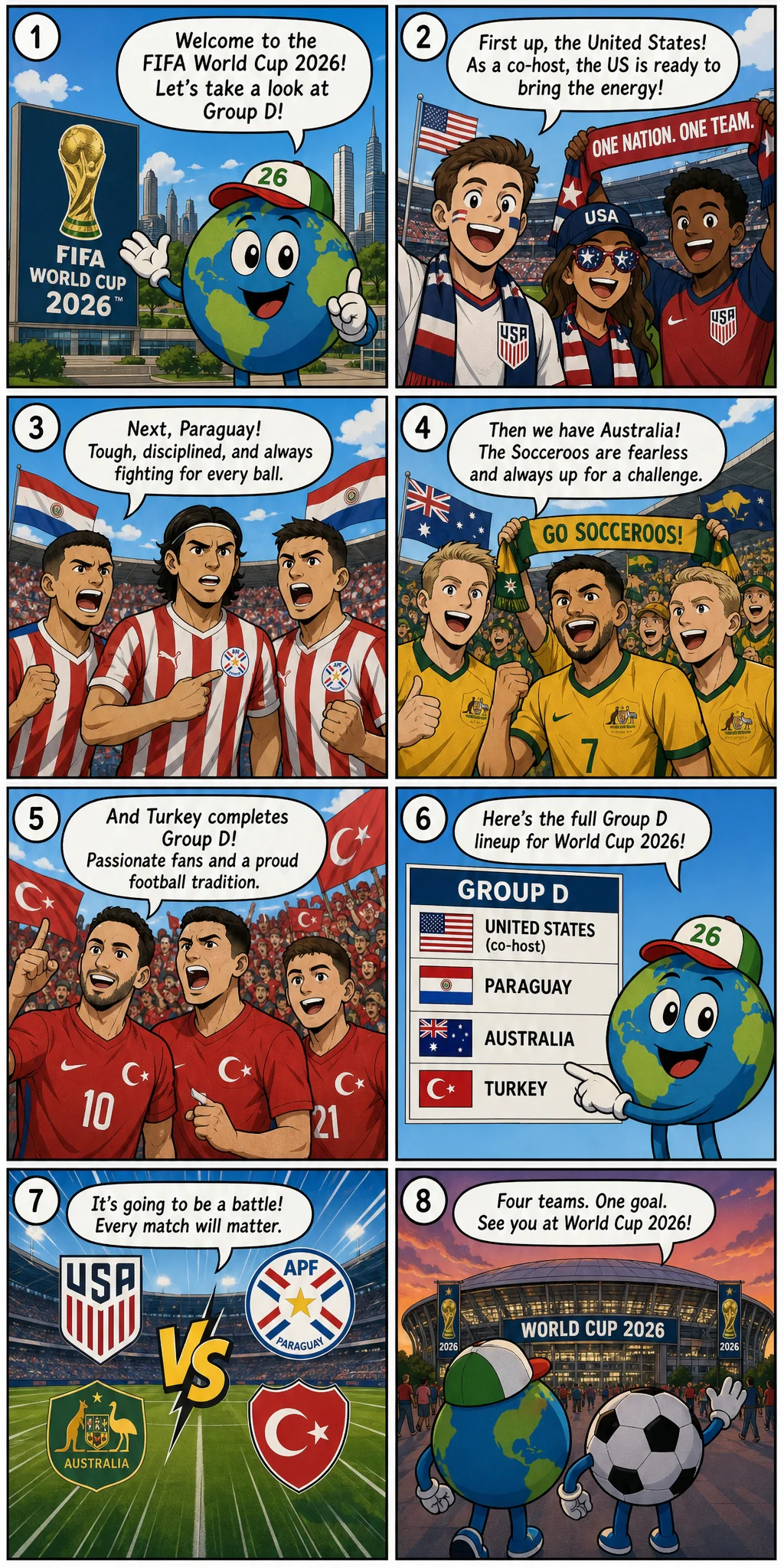
Group D Power Analysis: United States (co-host), Paraguay, Australia, Turkey
Group D: United States (co-host), Paraguay, Australia, Turkey. US hosts under pressure; Pulisic-McKennie-Balogun generation; Australia's golden era; Paraguay's defensive grit; Turkey's passionate return
Published: June 8, 2026
The draw for Group D of the 2026 World Cup has been revealed: the United States, Paraguay, Australia, and Turkey. At first glance, this is not a group of death, but rather a chessboard full of historical paradoxes and tactical tension. The United States, as the host nation, carries immense pressure; Paraguay brings South America's traditional steel defense and tactical discipline; Australia is experiencing the twilight of their golden generation, eager to prove themselves with one final glory; and Turkey returns to the stage with fervent fans and a passion marked by offensive imbalance. These four teams, each embodying distinct football philosophies, will stage a dialectic of rhythm, space, and willpower on the North American continent.
The United States' situation epitomizes the typical dilemma of a modern World Cup host: bearing expectations while confronting structural flaws. The core trio of Pulisic, McKennie, and Balogun represents the fruits of American football in Europe's top leagues. Pulisic's stints at Chelsea and AC Milan have made him the most mature attacker in U.S. history, with his dribbling and breakthroughs serving as the primary source of offense. McKennie is an energetic midfielder whose forward runs and pressing can disrupt opponents' defensive balance. Balogun's movement and finishing provide the U.S. with a true number nine.
However, the U.S. team's tactical issue lies in the stability of their midfield and defense. Their high pressing and quick transitions are strengths, but against teams that control the tempo, communication errors in the backline often prove costly. The coach must find a balance between pressing and control, rather than relentlessly chasing speed. The U.S. weakness is a lack of experience in high-stakes matches like the World Cup, where young players are prone to mistakes in crucial moments. They need to prove they are not just a running team but one capable of tactical maneuvering against opponents.
Paraguay's football philosophy is an almost obsessive defensive aesthetic within South American football. Their tactical core is discipline, physicality, and counter-attacking efficiency. Paraguay's backline is renowned for its resilience; they eschew possession, instead using compact defense and zonal pressing to disrupt opponents' rhythm. In midfield, they possess technically skilled players capable of passing in tight spaces, but their primary task is interception and transition. The forward line relies on individual ability to deliver decisive strikes.
Paraguay's strength lies in their tactical execution and team spirit. They maintain high concentration throughout matches, rarely collapsing under opponents' tempo shifts. However, their weaknesses are equally clear: against technically refined, rhythmically diverse teams, their defensive system can develop gaps. Paraguay's long-standing Achilles' heel is their lack of attacking firepower. If they cannot capitalize on counter-attacks, winning closely contested matches becomes difficult. This team's fate hinges on whether they can find effective offensive methods alongside their defense.
Australia's golden generation is experiencing its final flourish. Their core players have amassed extensive experience in European leagues, boasting excellent physicality and tactical discipline. Australia's style leans toward English football: high intensity, high physicality, with an emphasis on set pieces and second-ball battles. Their midfield controls the tempo through long balls and physical duels, while forwards finish in the box.
Australia's advantage is their team cohesion and match experience. They often display unexpected resilience in key games. However, their weaknesses are equally apparent: relatively rough technical skills, leaving them vulnerable against technically adept teams. Australia's attacking methods are one-dimensional, overly reliant on physicality and set pieces, lacking players who can create chances in tight spaces. If they cannot showcase more tactical variety, breaking out of Group D will be challenging. This team's future depends on whether they can achieve a true breakthrough at the twilight of their golden generation.
Turkish football is a blend of passion and chaos. Their fans are famously fervent, injecting boundless energy into the team. Turkey's tactical style is unpredictable; they can produce brilliant attacks or collapse in an instant. Their midfield boasts excellent technique and creativity, capable of breaking down defenses through individual skill. The forward line relies on speed and agility to create threats.
Turkey's strength lies in their attacking talent and the unpredictability of their games. They can generate numerous chances, especially when opponents' defensive systems show cracks. However, their weaknesses are equally clear: poor defensive discipline, prone to elementary errors at critical moments. Tactical stability is their biggest issue; they need to prove they can not only mount beautiful attacks but also maintain focus defensively. This team's fate depends on whether they can find a balance between passion and discipline.
In this group, the United States' host advantage and young core make them favorites to advance, but their defensive stability will be key. Paraguay's defensive discipline and tactical execution give them the ability to cause trouble in contests. Australia's experience and team spirit make them capable of playing spoiler. Turkey's passion and talent render them the most unpredictable factor.
Final prediction: The United States advances as group winners, while Turkey, leveraging their attacking talent and the pressure of home fans, secures second place. Paraguay and Australia will display tenacious fighting spirit in the group stage but ultimately exit due to insufficient offensive firepower. This group's matches will be a dialogue between tactical discipline and individual talent, a dialectic of defense and attack, and a profound chapter in football history written on North American soil.