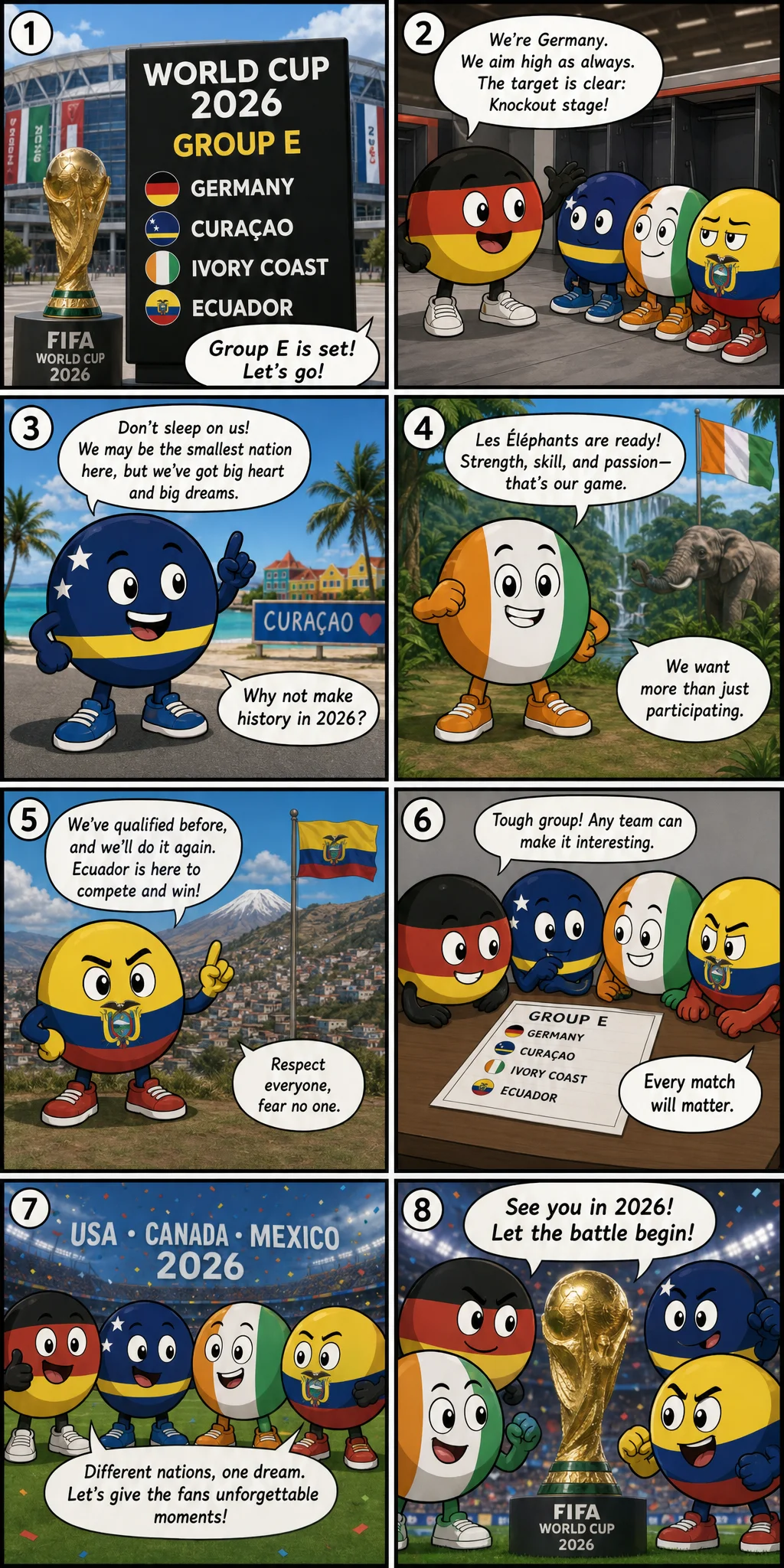
Group E Power Analysis: Germany, Curacao, Ivory Coast, Ecuador
Group E: Germany, Curacao, Ivory Coast, Ecuador. Germany rebuilds after 2022; Curacao's fairytale debut; Ivory Coast's physical power; Ecuador's altitude-adapted pressing under Bielsa
Published: June 8, 2026
2026 World Cup Group E: Germany, Curaçao, Ivory Coast, Ecuador – A Tapestry of Rebirth, Fairytale, and Power
When the draw was revealed, Group E's composition might have lacked the blood-and-thunder intensity of a Group of Death, yet it concealed a more stirring undercurrent. This is not a simple tale of disparity between strong and weak, but a dialogue on the soul of football. Germany, a once-glorious battleship that sank in Qatar, is striving to rebuild its flag amid the ruins; Curaçao, the jewel of the Caribbean, steps onto their historic first World Cup journey with a fairytale hue; Ivory Coast, the African elephants, armed with their iconic strength and talent, yearn to leave a deeper mark on the world stage; and Ecuador, warriors forged in the winds of the Andes, under the guidance of the mad scientist Bielsa, are poised to disrupt everyone's expectations with their unique rhythm.
Germany: Seeking a New Bavarian Spirit from the Shadows of Qatar
Walking through the streets of Berlin, you can sense a collective silence. The group-stage exit at the 2022 World Cup in Qatar was not just a competitive failure; it felt like a collapse of faith. The German team, once ruling the world with willpower, discipline, and efficiency, suddenly lost its way. But rebuilding has never been more urgent. New head coach Julian Nagelsmann, a young tactical mind, is conducting a bold experiment.
Germany's strength lies in their still-deep talent pool. From Bayern Munich's Jamal Musiala, a young man with magical dribbling, to Dortmund's Julian Brandt, they are trying to reclaim the creativity lost in German football. The key player is undoubtedly Musiala. He is like a flame dancing within the rigid German tactical system; every dribble he makes is a rebellion against the past's inflexible style. Tactically, Nagelsmann favors high pressing and flexible possession, but this requires time to gel. The weakness lies in the stability of the defense. The successor to Neuer is not fully resolved, and the center-backs' coordination, when facing pacey forwards, always raises concerns. Germany must overcome not only their opponents but also the mental hurdle within themselves—can the once-indomitable "German will" be reignited?
Curaçao: A Caribbean Blue Fairytale and a First Love with the World Cup
Imagine in Willemstad, Curaçao, beneath those colorful Dutch colonial buildings, children playing football, dreaming not of distant European leagues but of their national team standing on the World Cup pitch. The rise of this team is one of the most touching stories in international football in recent years. They were once a Dutch overseas territory; many hold Dutch passports, but they chose to represent this land of sunshine and waves.
Curaçao's strength is their innate technical talent and flexibility. Many players ply their trade in the Eredivisie, absorbing the technical foundation of Dutch football while retaining the improvisation and joy of Caribbean football. The key player is forward Justin Kluivert (son of Dutch legend Patrick Kluivert), whose speed and goal-scoring instinct are their counter-attacking weapons. Tactically, they will be very pragmatic, likely adopting a defensive counter-attack strategy, using width and pace to threaten opponents. Their weakness is glaring: inexperience. This is their World Cup debut; facing tactically astute teams like Germany and Ecuador, can they remain composed under pressure? Their defensive organization, when confronted with Ivory Coast's physicality, will be a brutal test. But isn't the beauty of football that fairytales can come true?
Ivory Coast: The Roar of the African Elephants, the Ultimate Display of Power and Talent
From the streets of Abidjan to Europe's top leagues, Ivorian football has always carried a raw charm. Their physicality is as formidable as elephants on the African savanna; their attack is as vibrant as a tropical rainforest. As the golden generation of Drogba and Yaya Touré fades, the new generation of "African Elephants" is trying to prove they are not just physically strong but also tactically mature.
Ivory Coast's strength is their unparalleled physical attributes and impact. Their frontline boasts a center-forward like Sébastien Haller, who has proven himself in Europe's top leagues; his hold-up play and finishing are a nightmare for any defense. Winger Jérémie Boga's speed and dribbling can tear apart defensive lines. Tactically, they favor direct, efficient play, using physical dominance to pressure defenses and unleashing explosive counter-attacks. Their weakness lies in tactical discipline and consistency. They sometimes rely too heavily on individual brilliance and can fall into one-on-one battles when facing well-organized defenses. Defensive concentration in the latter stages of matches may wane. For Curaçao, they are an insurmountable wall of power; for Germany, they are the ultimate litmus test for defensive resilience.
Ecuador: The "Madmen's Legion" of the Andes, Bielsa's Rhythmic Revolution
Ecuadorian football was once inextricably linked with the "high-altitude home" label. But when "El Loco" Marcelo Bielsa took the reins, everything changed. He brought not traditional counter-attacking football but a near-obsessive, suffocating press. In Quito's altitude, Ecuador is fearsome; on neutral World Cup grounds, Bielsa aims to prove his football philosophy can thrive at any elevation.
Ecuador's strength is their terrifying work rate and tactical execution. Under Bielsa's system, players run like perpetual motion machines, pressing frantically from the front to win the ball back in the opponent's half. The key player is defensive midfielder Moisés Caicedo, the heart and lungs of this system; he not only handles defensive interceptions but also orchestrates transitions from defense to attack. Forward Enner Valencia is their sharp edge up front. Tactically, Bielsa's 3-3-1-3 formation is highly aggressive but also extremely risky. Their weakness is defensive stability. When the high press is bypassed, the backline is exposed to huge gaps. Facing Ivory Coast's power and Germany's possession-based penetration, can this radical defensive approach succeed? It's a gamble, but Bielsa has never been afraid to gamble.
Prediction: The Fairytale Will End, Power and Rebirth Dominate the Stage
The script for this group might unfold like this: Curaçao's fairytale will produce dazzling moments in clashes with Germany and Ecuador, but the gap in experience and quality will see them taste the cruelty of the World Cup for most of the time. Ecuador, under Bielsa's command, will whirlwind through and disrupt Germany's rhythm, but their aggression may be punished by Ivory Coast's powerful counters. Germany's road to revival will not be smooth; they will show new vitality in the group stage but also endure growing pains. Ultimately, the decisive match will be Germany versus Ivory Coast.
I boldly predict: Germany will top the group. Their rebuilding may be imperfect, but their pedigree and experience will steady them in the group stage. Ecuador, Bielsa's "Madmen's Legion," will advance as group runners-up, thanks to their astonishing work rate and tactical discipline. Ivory Coast's powerful impact will earn them respect, but they will fall short in key battles against Germany and Ecuador due to tactical deficiencies, exiting with regret. As for Curaçao, they will leave with pride, having etched the Caribbean blue dream into World Cup history.