Group F Power Analysis: Netherlands, Japan, Sweden, Tunisia
Group F: Netherlands, Japan, Sweden, Tunisia. Koeman's Dutch possession machine; Japan's technical evolution; Sweden post-Zlatan; Tunisia's African resilience
Published: June 8, 2026
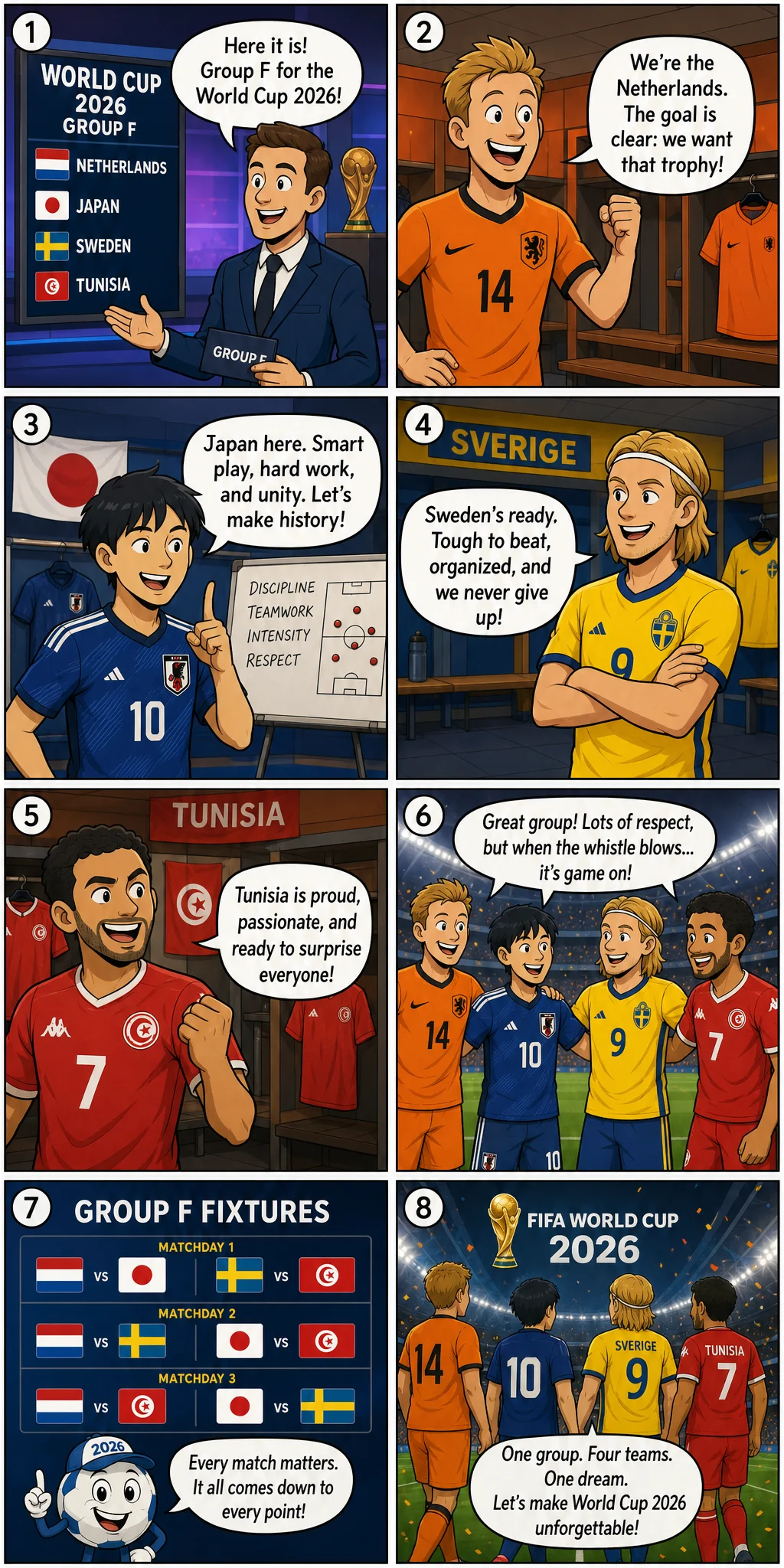
World Cup 2026, Group F draw is out. Netherlands, Japan, Sweden, Tunisia. A group full of tactical details, technical collisions, and physical confrontations. Not a definitive group of death, but every step could be fatal. Let's break down these four teams. HERE WE GO.
Netherlands: Koeman's Possession Machine, Back to Basics
Koeman is back, and the DNA of Dutch football is rebooted. No longer the pragmatic 3-5-2 of Van Gaal's era, but a purer 4-3-3, emphasizing ball possession and building from the back. This isn't fantasy football; it's a precise possession machine.
Core Strength: The output ability of the center-backs is the lifeline of the Netherlands. Van Dijk remains the leader, but De Ligt's steady growth at Bayern, along with Ake's tactical understanding at Manchester City, gives the Dutch defense top-tier ball-playing ability. In midfield, De Jong is the metronome, but his injury concerns are the biggest variable. Reijnders' rise at Milan provides deep runs and goal-scoring ability, precisely what the Netherlands has lacked most in recent years.
Key Player: Cody Gakpo. Continuously adapting between striker and winger roles at Liverpool, he has become the most consistent finisher and link-up player in the Dutch attack. Xavi Simons' breakout at Leipzig offers explosive dribbling and creativity on the flanks.
Tactical Approach: High pressing, short-passing buildup starting from the goalkeeper. Koeman demands full-backs push high to form a 2-3-5 attacking shape. Weakness? Transition defense. When losing possession, the space behind the Dutch midfield and full-backs is vast, and Van Dijk's turning speed will be magnified against fast counterattacks.
Weakness: Finishing efficiency up front. Depay's form has declined, and Weghorst is a tactical piece rather than a regular weapon. The Netherlands can create plenty of chances, but whether they can convert them determines their ceiling. The lack of a world-class striker is the final piece missing from this possession machine.
Japan: Technical Evolution, but Need to Break the Physical Ceiling
Moriyasu has proven that Japanese football is no longer just an Asian powerhouse but a World Cup disruptor. Beating Germany and Spain in Qatar was no accident; it was the inevitable result of years of technical accumulation in Japanese football. Now, they aim to transition from disruptor to group-stage qualifiers.
Core Strength: The depth and quality of the European-based contingent. Kubo is a core player at Real Sociedad, Mitoma's wing play is a nightmare for any defense, Kamada has found form at Lazio, and Endo has matured in his defensive midfield role at Liverpool. This is not a team reliant on a single star but a complete tactical system.
Key Player: Takefusa Kubo. He is no longer a teenage prodigy but an attacking core who can decide the game's direction. His dribbling, vision, and shot selection are key to breaking deadlocks for Japan. Mitoma's change of pace is Japan's trump card on the counter.
Tactical Approach: High-intensity pressing and rapid transitions. Moriayasu adjusts the formation based on the opponent, but the core is maintaining compactness and using numerical advantages in midfield for localized pressing. In attack, they rely on wingers' individual ability to create space and seek late runs from midfield.
Weakness: Physical duels and set-piece defense. Against Sweden's tall lineup and Tunisia's physical toughness, Japan will face immense pressure defending set pieces. Additionally, maintaining high-intensity pressing for 90 minutes against the Netherlands' elite possession game is a huge physical test. The lack of a top-class target man makes them vulnerable in settled attacks.
Sweden: Post-Ibrahimovic Era, Tactically Disciplined Nordic Iron Force
The Ibrahimovic era is officially over. Swedish football has entered a more collective, disciplined, and pragmatic phase. They are no longer reliant on a single superstar but function as an efficient tactical machine.
Core Strength: Physicality and tactical execution. Sweden possesses top-tier physical attributes in Europe, especially aerial dominance. The center-back pairing of Lindelof and rising star Hien combines experience with aggression. In midfield, Forsberg remains the creative source, but a successor to Karlström has yet to emerge, relying more on collective running and interceptions.
Key Player: Alexander Isak. The Newcastle striker is the only top-tier talent in Sweden's attack. His pace, dribbling, and finishing are the deadliest weapons on the counter. He needs to take on more responsibility for dropping deep to receive and link play.
Tactical Approach: Solid defense, quick counterattacks. Sweden won't chase possession; they will drop deep, using physicality to disrupt opponents' rhythm. In attack, they look for long balls to Isak or utilize wide crosses to exploit aerial advantages. Set pieces are their most important scoring method.
Weakness: Lack of creativity. When Isak is tightly marked, Sweden's midfield lacks a passer capable of unlocking defenses. Against compact defenses like Japan's, Sweden's settled attack may appear one-dimensional. Additionally, the backline's lack of pace makes them vulnerable to technical forwards running in behind.
Tunisia: African Resilience, Textbook Defensive Counterattacks
The Carthage Eagles are always the toughest nut to crack in Africa. They have no superstars but possess the core qualities of African football: resilience, discipline, and tactical execution.
Core Strength: Defensive organization and midfield disruption. Tunisia's defensive system is highly mature, with strong awareness of cover and rotation among players. In midfield, the pairing of Skhiri and Laïdouni combines toughness and running ability, key to disrupting opponents' rhythm.
Key Player: Wahbi Khazri. Despite his age, Khazri remains the most threatening player in Tunisia's attack. His experience, movement, and finishing in crucial moments are the end point of their counters. Additionally, winger Achouri's growth in the Bundesliga provides a dribbling option on the flank.
Tactical Approach: Deep defense, quick transitions. Tunisia will cede possession and set up a compact defensive line around the box. They excel at using physical contact and fouls to break the game's flow. In attack, they rely on individual ability up front for quick counters or exploit set pieces for chaos.
Weakness: Lack of attacking talent. Compared to the Netherlands and Japan, Tunisia's overall technical level and creativity are clearly inferior. They struggle to create clear-cut chances in settled attacks. Additionally, against Sweden's aerial bombardment, their physicality may not be an advantage.
Prediction:
The key to this group lies in matchups. The Netherlands' possession game against Japan's high press is a duel of technique and will. Sweden's tall lineup against Tunisia's compact defense is a clash of physique and discipline.
The Netherlands are the strongest team and should secure top spot without issue. The key is whether they can overcome their finishing efficiency against strong defenses.
The battle for second place will be between Sweden and Japan. Japan has a more mature technical system and richer attacking options, but Sweden's tactical discipline and physical advantages cannot be ignored. This will be a clash of contrasting styles.
Tunisia has a chance to be a spoiler, but their lack of attacking firepower makes it difficult to advance from the group.
Final Prediction:
1. Netherlands
2. Japan
3. Sweden
4. Tunisia
Japan will edge out Sweden, relying on a more stable tactical system and the individual quality of key players, to advance from the group stage for the second consecutive World Cup. The Netherlands will secure top spot with a perfect record. HERE WE GO.