Egypt: Journey to 2026
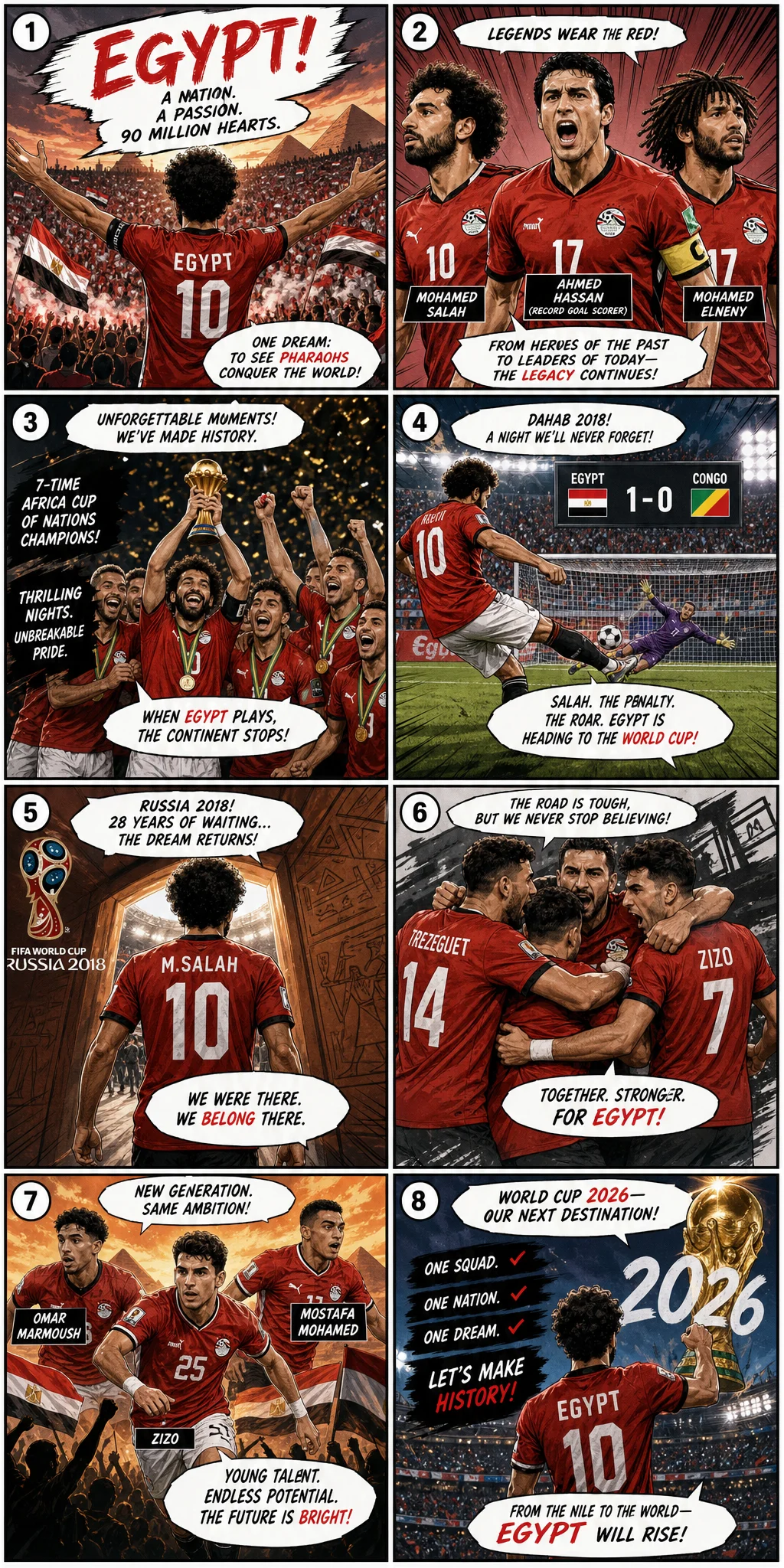
8-panel comic about Egypt national football team and their journey to the 2026 FIFA World Cup.
Published: June 5, 2026
Egypt National Football Team: The Pharaohs' Quest for Global Glory
The Egypt national football team, known as "Al-Fara'ena" — The Pharaohs — represents the Arab world's most populous nation and one of African football's most historic and successful programs. Egypt's record seven Africa Cup of Nations titles, its passionate football culture centered on the Cairo giants Al Ahly and Zamalek, and the transcendent presence of Mohamed Salah have made the Pharaohs one of the most recognizable brands in African and Arab football. Egypt's qualification for the 2026 FIFA World Cup — after missing the 2022 tournament in heartbreaking fashion — represents a crucial opportunity for a football nation that has waited far too long for World Cup relevance.
HISTORICAL FOUNDATIONS
Egypt possesses perhaps the deepest football history in Africa and the Arab world. The Egyptian Football Association was founded in 1921, and the national team was competing in the Olympic Games as early as 1920. The Cairo derby between Al Ahly (founded 1907) and Zamalek (founded 1911) is one of the world's oldest continuous football rivalries, predating most European and South American derbies in its intensity and cultural significance.
Egypt made history in 1934 as the first African and first Arab nation to participate in the World Cup, traveling to Italy and losing 4-2 to Hungary in the first round. This pioneering appearance, achieved during the period of British colonial influence, established Egypt as African football's trailblazer. The decades that followed brought continental dominance — Egypt won the first two editions of the Africa Cup of Nations in 1957 and 1959, establishing a tradition of continental excellence that has yielded a record seven titles.
The gap between continental success and World Cup participation defined Egyptian football for generations. The Pharaohs dominated Africa Cup of Nations tournaments — winning in 1986, 1998, 2006, 2008, and 2010 — while consistently failing to navigate World Cup qualification. The 1990 World Cup in Italy, Egypt's second appearance, saw the team draw with the Netherlands and Ireland before a narrow 1-0 defeat to England eliminated them. The 28-year gap between 1990 and the next World Cup appearance in 2018 became a source of national sporting anguish, a stain on the record of Africa's most decorated football nation.
LEGENDS OF THE PHARAOHS
Mohamed Salah is Egypt's greatest ever footballer and one of the most important athletes in African and Arab history. His career at Liverpool — where he has broken scoring records, won the Premier League and Champions League, and established himself as one of the world's best players for an extended period — has elevated Egyptian football to unprecedented global visibility. Salah's 2021-22 season, in which he was arguably the world's best player, and his consistent excellence across multiple Premier League and Champions League campaigns make him the benchmark of modern African football achievement. For Egypt, Salah is more than a footballer — he is a national symbol, a source of pride for a country of over 100 million people, a figure whose image adorns walls from Alexandria to Aswan.
Salah's penalty in the 94th minute against Congo in 2017 — the goal that sent Egypt to its first World Cup in 28 years — produced scenes of national celebration that will be recounted for generations. The image of Egyptian streets erupting in joy, of people weeping in the stands, of a nation collectively releasing three decades of World Cup frustration, captured the emotional power of international football at its most profound.
Aboutrika — Mohamed Aboutrika — is beloved in Egypt and across the Arab world for his elegance, his creativity, and his moral character. The Al Ahly legend who led the club to multiple CAF Champions League titles and the national team to consecutive Africa Cup of Nations triumphs was the cerebral center of Egyptian football in the 2000s — a player whose intelligence and vision made everyone around him better. His retirement from football and subsequent political engagement reflected the intersection of sport and public life that characterizes Egyptian football.
Hossam Hassan, Egypt's all-time leading goalscorer with 68 international goals, was the ultimate competitor — a striker whose fire, passion, and scoring instinct made him the face of Egyptian football in the 1990s. His twin brother Ibrahim formed a sibling partnership unique in international football history. Essam El-Hadary, the goalkeeper who became the oldest player in World Cup history at age 45 in 2018 (saving a penalty from Saudi Arabia's Fahad Al-Muwallad), represented the longevity and dedication characteristic of Egyptian football professionals.
THE MODERN ERA
Egypt enters the 2026 World Cup seeking to translate its continental dominance into World Cup relevance. The 2018 tournament in Russia ended without a victory — defeats to Uruguay and Russia, followed by a 2-1 loss to Saudi Arabia in a match where Egypt had taken the lead through Salah — but the experience of competing at the highest level, and particularly the drama of Salah's fitness battle after Sergio Ramos's challenge in the Champions League final, provided the modern generation with World Cup education.
The heartbreaking 2022 World Cup qualification playoff against Senegal — a penalty shootout defeat in which Salah and his Liverpool teammate Sadio Mané faced each other as captains, Egypt losing after laser pointers and hostile atmospheres at both legs — added another layer of World Cup anguish to the Egyptian football narrative.
The current squad revolves around Salah but is increasingly defined by emerging talents. Omar Marmoush, the Eintracht Frankfurt and Manchester City forward whose intelligent movement, technical quality, and goal-scoring ability have made him one of Europe's most coveted attackers, provides the supporting cast that Salah has long needed. The domestic Egyptian Premier League, anchored by Al Ahly and Zamalek, continues to produce talented players, though the financial disparities between Egyptian football and Europe's top leagues create a constant talent drain.
The coaching staff faces the perennial challenge of maximizing Salah's unique talents while building a collective system that does not depend entirely on his individual brilliance. The 2018 World Cup demonstrated the limitations of a Salah-dependent approach; the 2026 version must demonstrate greater tactical variety and distributed goal-scoring threat.
FOOTBALL AND EGYPTIAN CULTURE
Football in Egypt is a cultural phenomenon that permeates every level of society. The cafes of Cairo, Alexandria, and every provincial city fill with spectators for matches, the smoke of water pipes mixing with the roar of commentary. The Al Ahly-Zamalek rivalry divides the nation — families, workplaces, marriages — with an intensity that foreign observers sometimes underestimate. Al Ahly's continental dominance, particularly its record CAF Champions League titles, is a source of national pride.
The Ultras movements — organized supporter groups that emerged from the political ferment of the 2011 revolution and became key actors in subsequent political struggles — have added a complex political dimension to Egyptian football. The relationship between football supporters, club administrations, and the state has been contentious, with Ultras groups banned and their members periodically targeted by security forces.
Football and national identity are deeply intertwined in Egypt. The national team's successes provide moments of collective joy in a country where daily life can be challenging. Salah's global stardom has been embraced as a symbol of Egyptian excellence, a counter-narrative to Western media portrayals of Egypt and the Arab world. The Liverpool forward carries the hopes and expectations of over 100 million people every time he steps onto a pitch — a burden that he seems to bear with remarkable grace.
THE PATH FORWARD
Egypt enters the 2026 World Cup determined to achieve what no previous Egyptian team has accomplished: progression beyond the group stage of a World Cup. The expanded tournament format provides a more favorable structure for nations from Africa and Asia, and Egypt's combination of world-class individual talent (Salah, supported by Marmoush and emerging attackers) and growing collective experience makes this the most promising Egyptian World Cup campaign in history.
The tactical approach will balance defensive organization — historically a strength, with the Egyptian tradition of producing intelligent, technically proficient defenders — with the counter-attacking threat posed by Salah's pace and finishing. The midfield will need to provide better service to the forward line than in previous World Cup appearances, and set pieces — a traditional strength, with Egypt's aerial threats and Salah's delivery — will be critical in tight matches.
For Egypt, the 2026 World Cup is about more than football. It is about representation — the most populous Arab nation proving its competitive worth on the world's biggest stage. The Pharaohs carry a history of African football pioneering and Arab football pride. Mohamed Salah, the king of Egyptian football, leads his nation into battle. The quest for global glory continues.